
A burst of digitization jobs is not a faster archive
A museum can enqueue thumbnail generation, format conversion, and accessibility image checks for hundreds of scanned photographs. If every queued request reaches the same small worker service at once, concurrent memory use and I/O can spike. Some tasks time out or receive overload responses; retries then add more work. Cloud Tasks maxConcurrentDispatches is a queue-level ceiling on tasks dispatched concurrently, intended to help bound the pressure placed on the target.
The setting does not promise a particular processing speed or prove each image was preserved. A small concurrency limit can protect a fragile worker while making the backlog longer. Define the workload and acceptable delay before adjusting anything. Separate heavy image processing from visitor-facing requests when they compete for the same resources, and maintain a record of each asset’s final processing outcome.
Understand the two main queue limits
Google documents rateLimits.maxConcurrentDispatches as the maximum concurrent dispatched tasks. When the threshold is reached, the queue stops dispatching until in-flight requests decline. A different field, maxDispatchesPerSecond, controls dispatch rate through a token-bucket mechanism. These two controls answer different questions: how many requests may be active, and how quickly new attempts may begin.
The API also reports maxBurstSize, which Cloud Tasks calculates for API-managed queues and exposes as output only. Do not design a configuration script that tries to write that field. The queue rate limits apply to first attempts and retries, but a manually forced RunTask debugging operation is a documented exception. Any capacity plan should exclude manual debugging traffic from assumptions about an ordinary dispatch ceiling.

Estimate a conservative starting concurrency
Take a recent, representative workload sample from your own authorized worker logs: image dimensions, memory per conversion, average and long-tail duration, and external-service rate limits. A job that reads a multi-page scan may consume much more memory than a small icon. Choose a conservative number of simultaneous requests that the worker can sustain without resource exhaustion. Do not borrow limits from another museum, cloud account, or unverified benchmark.
For a hypothetical service with uncertain memory pressure, start with the smallest practical active batch, collect error and latency signals, and increase only through an approved change. Record the previous value and expected test window. Avoid hardcoding throughput promises into public guidance, because autoscaling configuration, file sizes, network limits, and backoff behavior change the result.
Use one configuration management path
Google documents updating Cloud Tasks queue limits with gcloud tasks queues update, including –max-concurrent-dispatches, or with the Cloud Tasks API. Read the existing queue before a patch and target the intended project and location. Some environments use queue.yaml; Google recommends avoiding a mixture of queue.yaml and API-based queue management for the same queues, because settings can interact unexpectedly.
Treat the change as infrastructure configuration requiring review. Compare the resulting queue description to the approved number rather than assuming command success establishes effective behavior. Use least-privilege queue permissions; do not paste credentials or actual private project identifiers into incident screenshots or tutorials.
Distinguish overload from a slow ramp-up
Cloud Tasks can ramp dispatch gradually after inactivity or a sudden burst. Its documented backoff behavior may reduce the effective rate when handlers return certain overload or server error responses. An apparently idle worker and a growing queue therefore do not automatically mean maxConcurrentDispatches is too low. Check task age, dispatch attempt outcomes, handler duration, worker instance counts, and upstream error rates together.
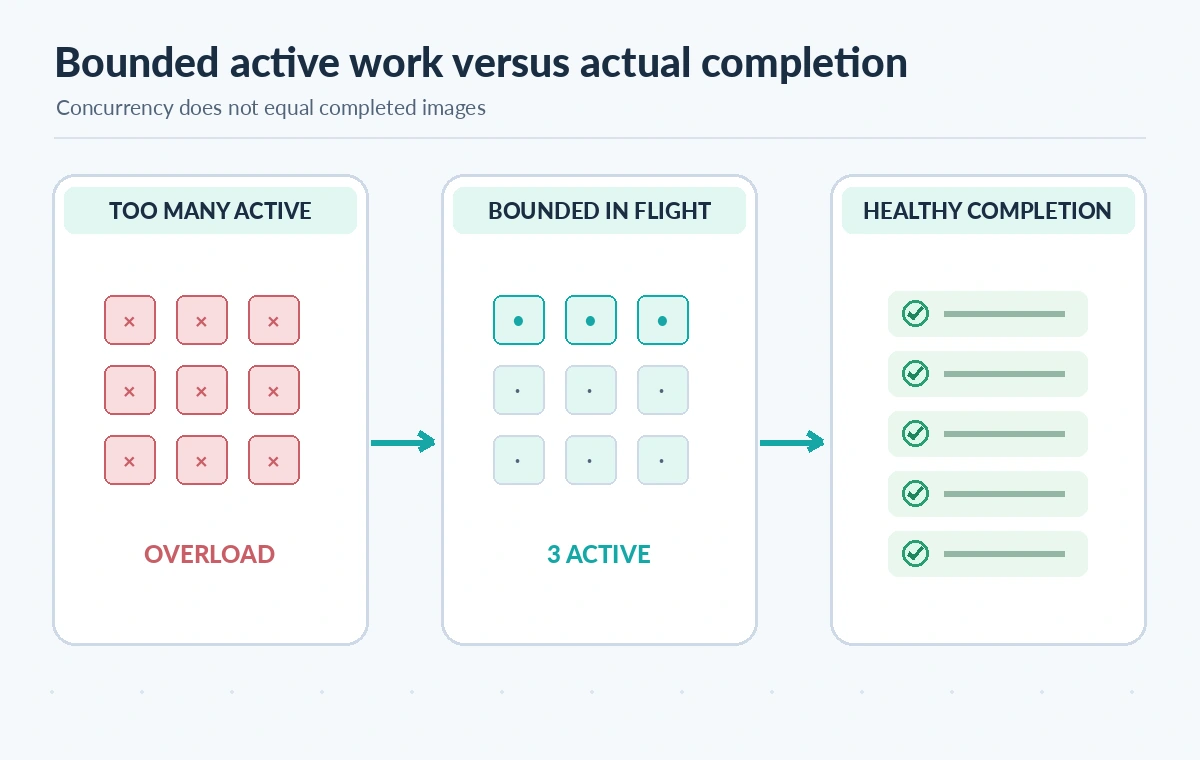
In the illustration, the left panel shows more in-flight requests than a small worker should handle; the middle panel shows a bounded active set with pending work; the right panel shows acknowledged completions. These are conceptual states, not measurements. Increasing concurrency can worsen latency if the underlying CPU, memory, database, or storage service is already saturated.
Protect against duplicate work
Cloud Tasks delivery is designed around retries and a handler can receive a request more than once. A response may be lost after work completed or an attempt may fail midway. Give each asset job a stable idempotency key derived from an authorized work item, and store processing state in a durable ledger. Retry should not create a second public image, overwrite the original, or emit duplicate curator notifications.
Use atomic state transitions so one worker can mark an asset completed without racing another. Keep a safe temporary output path and verify checksums before publishing derivatives. If a task is retried, compare the requested source revision and intended output signature with the stored receipt. Concurrency controls help reduce overload; they are not an exactly-once processing guarantee.
Observe active, queued, failed, and finished
Track queue age separately from current active dispatches, worker utilization, HTTP responses, and actual asset completion. Cloud Monitoring and structured application logs are more useful when all parties agree on definitions. A successful HTTP acknowledgment should be tied to a durable processing result, not merely to accepting a job into another unmonitored local queue.
Do not hide failed images in a generic success counter. Mark stalled work for inspection, preserve a non-destructive repair path, and monitor unusual spikes in 429, 503, or timeouts. Worker owners should be able to identify which source images still lack a verified derivative even when the dispatch queue looks quiet.
Stage a safe load-change exercise
Use synthetic image jobs or authorized test copies, not irreplaceable originals, to exercise a proposed limit. Compare bounded active requests, worst-case processing time, memory use, retry behavior, and backlog drain under a controlled burst. Run a failure case where the worker crashes after uploading an output but before acknowledging the task. Confirm that replay avoids double publication.
Require a rollback rule for elevated errors, a contact for the worker service, and a record of every configuration adjustment. After a test, reconcile expected jobs against completed asset identifiers. A faster-looking queue that skipped or corrupted some images is not a successful improvement.
Release checklist and documented boundaries
Before changing production limits, confirm queue location and type, existing dispatch settings, external service quotas, image processing capacity, retry configuration, and idempotent receipt storage. Reconcile produced derivatives to source files and verify image rights. These controls matter more than maximizing a dispatch number.
No queue was updated, no worker was benchmarked, and no production traffic was observed for this article. The limits and diagrams are conceptual and sourced from current Google Cloud documentation. Cloud Tasks features, quotas, billing, and system throttling may change; verify them in the service and your real environment.

How We Research
Official primary documentation reviewed November 11, 2026: Google Cloud configure queue limits and retries; Cloud Tasks REST Queue RateLimits reference; Cloud Tasks issues and limitations. We compared the named technical feature against its provider reference and designed a hypothetical archive workflow covering configuration, risks, error handling, and human authorization. We did not run an API call, inspect a customer account, benchmark software, or verify outcomes in a production environment. Images are editorial diagrams rather than product screenshots or observed results. Confirm current documentation, support, privacy requirements, quotas, costs, and actual deployed settings before making changes.
Frequently Asked Questions
It sets the maximum number of tasks the queue dispatches concurrently before it pauses additional dispatches until requests finish.
No. The first controls in-flight concurrency; the second controls the rate of dispatch attempts.
No. Google describes maxBurstSize as output-only for API-managed queues.
No. Workers still need idempotent handling because retries and ambiguous acknowledgments can occur.
No. Overloaded workers and downstream services can become slower or fail more often; measure the real bottleneck first.