
A green check does not identify the precise caption test
A museum website checks caption files in several locales. The same validation action runs more than once in a job, and a release reviewer receives a report labeled only with a step name. The label looks official but may be an automatically generated identifier that changes after someone inserts a new step.
GitHub Actions exposes GITHUB_ACTION, the name of the action currently running or the ID of a step. The field is useful as diagnostic context, not as a globally unique evidence key. Build traceability from the repository, workflow run, attempt, source commit, and explicit step purpose.
Know how GitHub constructs action names
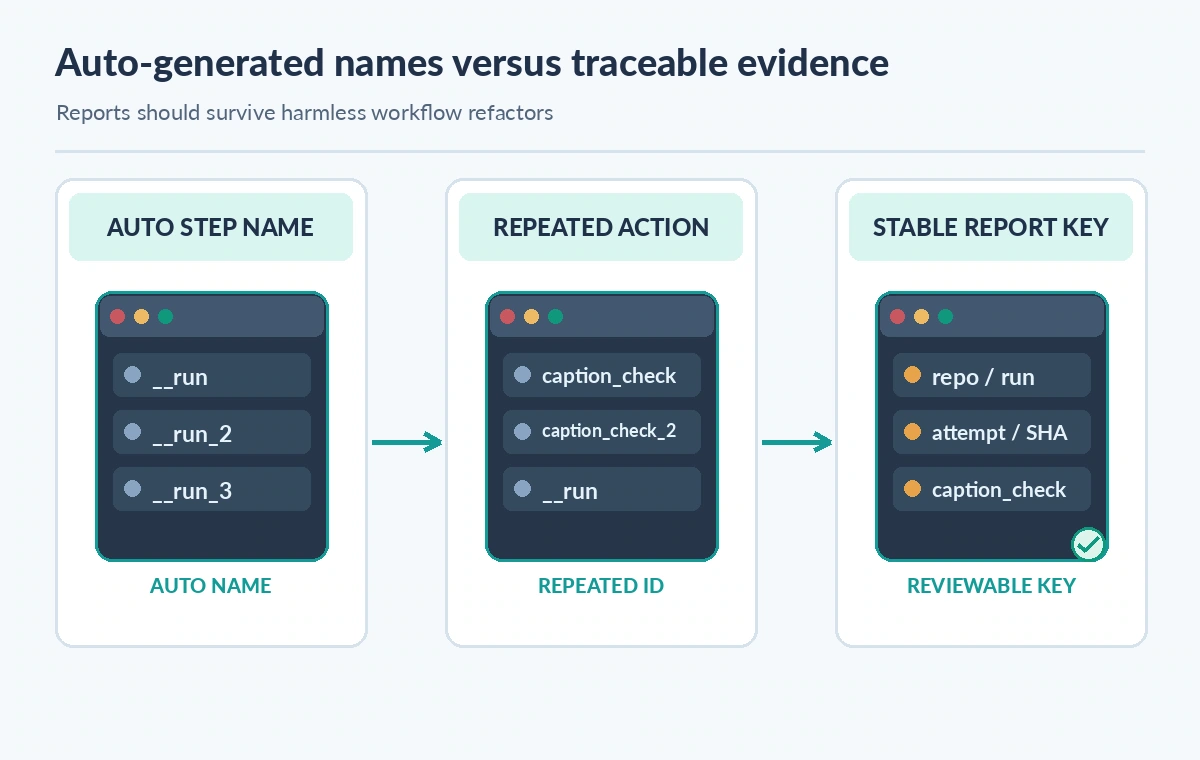
GitHub documents that GITHUB_ACTION can use the step id or an action-derived name. It removes special characters from generated names. For a script step without an explicit id, the value may be __run; repeated script steps can become __run_2 and later suffixed variants. Repeated invocations of the same action can also receive sequence suffixes.
Do not hardcode a generated identifier as a permanent compliance key. Adding a setup command earlier in the workflow can change the naming or numbering of later steps without changing their substantive job. Prefer a human-readable, explicit step id in workflow source where feasible, and record it with the immutable run context.
Separate an action identifier from a workflow ID
An action name describes the currently executing step or action context. A workflow run has its own identity, and a re-run has an attempt number. A source commit is yet another dimension. None of these should be replaced by a string such as __run_2.
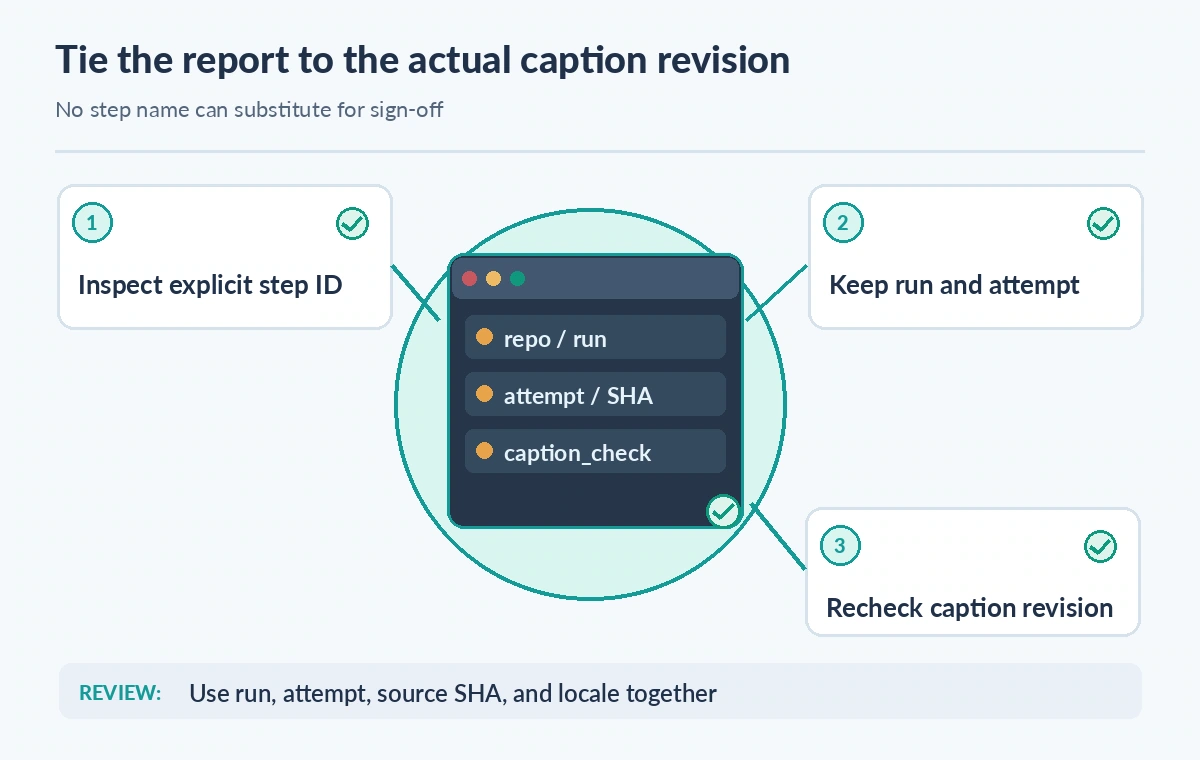
For example, a report may need repository ID, workflow file revision, GITHUB_RUN_ID, GITHUB_RUN_ATTEMPT, GITHUB_SHA, and a controlled step label. That information helps determine whether two reports concern the same input and the same execution. A file named captions-pass.txt without this context can be mistaken for a newer approval.

Give caption validation steps explicit responsibilities
Divide an accessible-caption workflow into parsing, synchronization checks, terminology review, and final human approval. Each automated phase needs a stable description, expected inputs, and a defined failure policy. The step ID can help developers link a log to the relevant phase, but cannot convert a machine check into editorial authorization.
Use only trusted inputs when constructing paths or artifact names. A caption file path from a pull request might contain punctuation or unexpected characters. Validate the repository-relative path and pass untrusted values as data, not directly as shell code. Preserve original file identifiers without using them as executable commands.
Show the difference between repeated step states
The article’s comparison graphic shows an automatic __run-style label, a repeated action with a sequence suffix, and a stable evidence key composed from approved run metadata. These labels are conceptual, not captured from a real GitHub job. They demonstrate why display context and source identity must remain separate.
A stable report key should include the repository and run attempt plus a safe purpose label, and it should point to the exact caption file revision. The report content still needs to disclose which checks ran, which failed, and whether a human reviewed timing and meaning. Naming improves investigation but does not prove correctness.
Handle composites and reused workflows carefully
Composite actions and reusable workflows can introduce additional layers between the initiating workflow and the step that produces evidence. The github.action context can be useful when debugging that layer, but the executable code version, calling workflow, and source data still matter.
If the same validator runs for three languages, ensure each output includes its locale and independent pass/fail state. A concatenated artifact without file IDs can hide the fact that one locale was skipped. Use separate structured result records when merging outputs rather than trusting a green conclusion in a single comment.
Keep untrusted event text out of shell commands
Pull request titles, branch names, user-entered locale labels, and file contents can contain characters that matter to the shell. Do not inject those strings unescaped into run blocks. Use safe environment-variable passing, restricted permissions, and a controlled allowlist for output destinations.
Avoid printing subtitle text or unpublished audio transcripts to public CI logs. Log a safe file identifier, line position, error code, and checker version when that is enough. If a report needs sample text for editorial review, store it in an access-controlled artifact with an appropriate retention policy and audit trail.
Build a test for workflow refactors
In a branch, create two script steps without ids and the same action twice; inspect how labels are represented. Then add an explicit ID for the critical caption validation step and compare the resulting documentation. This exercise is about identity and traceability, not about increasing a test score.
Record expected values from the current GitHub reference and the actual output from the authorized test repository if run. Do not claim to have observed live behavior from this article: no workflow was executed here. If a generated name changes after a refactor, the report should remain findable by run ID and source revision.
Review failure paths instead of only passing samples
A thorough fixture set includes overlapping subtitle timestamps, missing text, an unsupported language tag, and a caption that changes the meaning of a safety instruction. A parsing pass alone does not validate accessibility. Ask a reviewer to compare the source audio, caption track, and approved visitor-facing message.
Preserve evidence that a skipped step was skipped. A successful overall job can occur while an optional validator was not invoked or a matrix entry never ran. Compare expected locales and checks with actual completed results, and require a manual hold whenever a critical segment lacks a signed-off outcome.
Make release approval explicit
A release can proceed only when the exact caption revision has the required automated outcomes, a human accessibility review when mandated, and a signed publication approval. Keep GITHUB_ACTION as a useful clue for finding the step that ran, not a surrogate for any of those gates.
This is documentation-based guidance with hypothetical captions and workflow names. We did not inspect a repository, run GitHub Actions, or certify accessibility. Recheck current variable behavior, token permissions, and storage retention settings before deploying a real release process.
How We Research
We consulted these primary vendor documents on November 11, 2026: GitHub Actions variables reference; GitHub Actions contexts reference; GitHub Actions workflow syntax. We checked the named request fields, response definitions, and known limitations, and compared them with a hypothetical collection-management failure mode. The images are original conceptual diagrams rather than product screenshots or measured before-and-after results. No live API calls, customer content audits, source-image recognition tests, performance benchmarks, permission tests, or price measurements were performed. The example museum, identifiers, and outcomes are fictional. Production decisions require fresh version-specific documentation, authorized access, rights review, and human acceptance testing.
Frequently Asked Questions
It names the currently running action or identifies a step; GitHub also generates names when a step has no explicit id.
Repeated script steps without explicit IDs can receive suffixed automatically generated names.
No. Use repository, run ID, attempt, source revision, and a purpose label for reliable traceability.
GitHub documents default GITHUB_ variables as system-provided and not overwritable in the normal workflow environment.
No. It supports provenance. Caption meaning, timing, source fidelity, and human release approval require separate checks.