
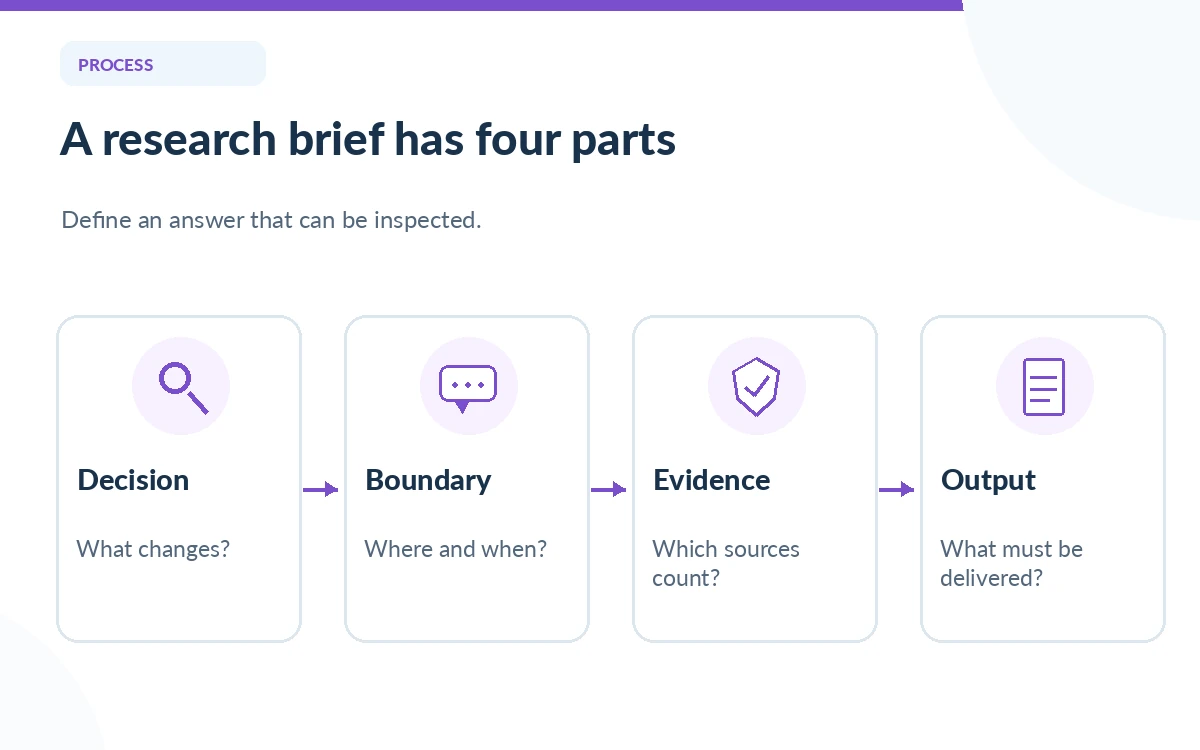
The most useful deep-research prompt is not the longest one. It is the prompt that states a decision, limits the evidence universe and defines what the final document must let another person check. Without those constraints, a research agent can work hard on the wrong question, gather polished but irrelevant background and produce a confident conclusion that nobody can audit.
These four templates are adaptable structures, not magic words or performance guarantees. They work as planning briefs for products that offer research modes, including ChatGPT, Gemini and Claude, although buttons and source settings vary. Use placeholders only after replacing them with real dates, geography, documents and the business or academic decision at hand.
Before any template: define the decision and cutoff
Write a one-sentence decision the reader must make, not merely a topic. “Should a 20-person US support team move its knowledge base?” has useful constraints; “research knowledge bases” does not. Add jurisdiction, relevant dates, comparison set and the people affected. Specify excluded materials, such as vendor blogs when an independent regulator or primary filing exists. Ask the agent to return a plan and source list before drafting a conclusion.
Also identify the person who will inspect the evidence. If no reviewer has access to source PDFs, paywalled articles or internal drives, a complicated citation format may become useless. Set the expected format—one-page memo, annotated table or evidence register—and instruct the system to flag unsupported values as unknown rather than inventing estimates. This moves quality control into the task definition.
Template 1: a market landscape with named competitors
Prompt structure: “Our decision is [choice]. Investigate [market] for [US region and date window]. Compare only [named firms or objective inclusion rule]. For each, use an official product page and at least one independent source where available. Return a table of positioning, pricing model without invented dollar amounts, verification date, evidence link and missing facts. List excluded candidates and why.”
This template prevents the common mistake of treating marketing adjectives as market share. If the output names “leading” providers without a selection rule, request a revision. Compare business models and buyer restrictions instead of pretending to estimate adoption from search snippets. For a genuine market sizing study, add a separately sourced methodology and do not let the model manufacture a total addressable market.
Template 2: a policy or regulatory change brief
Prompt structure: “For [jurisdiction and process], identify changes effective between [two dates]. Prioritize the primary law, agency guidance and dated official FAQs. Table fields: requirement, who is affected, effective date, exact source, current uncertainty and proposed owner. Keep proposed actions separate from legal obligations. Exclude commentary published before the latest official revision unless useful as context.”
Never ask a research agent to deliver unreviewed legal advice. Agencies may publish proposals, final rules, court decisions and implementation guidance with different legal status. The template should make the distinction visible. Put a counsel-review field beside high-impact statements and require an “unable to confirm” label for any deadline that lacks a directly linked authoritative source.
Template 3: a scientific evidence map with contradictions
Prompt structure: “Investigate [specific population, intervention, comparator and outcome]. Define eligible study designs and [publication years]. Separate randomized studies, observational work and reviews. For each pivotal paper report sample, endpoint, direction of effect, limitations and DOI or direct original source. Identify contrary findings and studies outside scope. Do not calculate a pooled effect without original data and appropriate methods.”
This is a narrative evidence map, not a systematic review performed by a professional search team. Database coverage may be incomplete, abstracts can omit crucial qualifications and a reported association may not imply causation. Ask for screening criteria and a clearly labeled list of studies requiring full-text reading. Where the topic concerns health, the interpretation should receive qualified expert review.

Template 4: a vendor decision with measurable trade-offs
Prompt structure: “Compare [vendors] for [specific workflow and user count]. Requirements: [five must-have constraints]. Use official integration, security and support documents; do not infer compliance from a logo. Return a matrix with evidence URL, documented capability, unknowns, implementation dependencies and a question to ask each vendor. End with two plausible options and a pilot plan, not a single asserted winner.”
Many purchasing documents fail because they treat advertised integrations as operational proof. Insist on a small acceptance test: who owns data export, how permissions are enforced, what breaks if an integration is unavailable and who handles migration. Clearly separate cost assumptions from official billing terms. Security, legal and accessibility checks remain the buyer’s responsibility.
Ask for an evidence ledger, not decorative footnotes
Every template should require a claim ledger with columns for claim, original source, date checked, directly supporting passage and remaining dispute. A real link is not enough: a vendor landing page can be relevant without substantiating a numerical claim. Prefer a reference to the exact document section or quoted table label, while observing copyright and quotation limits.
After receiving the report, sample the highest-risk claims first: dates, dollar figures, permissions and recommended actions. Open the cited document in a separate browser tab, check its context and look for contradictory primary evidence. If the evidence fails, mark the statement as unverified and revise the conclusion. This is a human review protocol, not a claim that the model checked itself independently.

Revise the plan before spending research effort
Both OpenAI and Google document research workflows in which a plan can be reviewed before execution. Make use of that opportunity. Ask the tool to show subquestions, included source types and what it will not attempt. Remove irrelevant tasks and overbroad searches while the scope is still inexpensive to change. For tools without a pre-run plan screen, have the assistant produce an outline as a separate interaction.
Avoid supplying confidential contracts, personal data or restricted documents by default. Check the workspace permission model and the provider’s data-handling controls first. If several people use the same template, record a version number in the team’s own brief, not as a label imposed on published images or reader-facing diagrams.
A clean handoff from research to a final decision
The final report should contain an executive decision question, a short answer with qualifications, primary evidence, competing explanations, outstanding risks and a date for refresh. Assign an owner to each unresolved issue. In a fast-changing AI market, subscription terms and product names can change quickly; the report needs a clear as-of date and an explicit next check rather than claims of permanent accuracy.
Save the original prompt, source inventory and corrected evidence table with the report. If the project is repeated, compare newly gathered facts against the prior ledger instead of asking an agent to rewrite from memory. The value of prompt engineering here is a consistent review artifact that can be audited across analysts and months.
How We Research
We derived these editorial templates from the documented planning and sourcing features in OpenAI Deep Research, Google Gemini Deep Research and Anthropic Research, reviewed October 26, 2026. The sample prompts are original editorial examples, not vendor-endorsed commands. We have not measured improved output accuracy, and users must apply domain-specific professional review to consequential research.
Frequently Asked Questions
The best prompt defines a specific decision, scope, permitted source types, deliverable format and evidence checks. A generic “research everything” instruction is rarely useful.
Yes as text, but multi-step research, plan review and source restrictions depend on the tool and plan available to your account.
No. Citations can be incomplete or misapplied. The evidence ledger and independent human verification are essential.
There is no universal count. Favor independent, directly relevant primary sources and document important omissions rather than optimizing for a long bibliography.
Only when a transparent method and reliable input data exist. Otherwise record the market-size estimate as unavailable and list what data would be required.