
Deep research is not simply an AI answer with more paragraphs. A useful research system finds material across multiple steps, organizes a long report and makes it possible to trace important claims back to the evidence. That last requirement matters more than a glossy executive summary. A report can contain dozens of links yet still miss critical dissenting sources or interpret a figure incorrectly.
This comparison focuses on the specific work each tool is designed to support: a documented research brief, a connected-document analysis, a continuing source search or a paper-grounded collection. It is not a laboratory benchmark, and we did not run identical paid accounts or measure citation-error rates. Treat the recommendations as a fit matrix to narrow your own trial.
What actually separates deep research products?
The decisive features are source boundaries, the ability to revise the research plan, access to original documents, exportable evidence and visibility into what remains uncertain. Check whether you can limit sources to named domains or files, whether the tool shows a plan before executing, and whether citations point to exact underlying material rather than a generic homepage. Different questions require different standards: market estimates need dates and methodology, whereas academic claims need actual study methods.
Build a four-column comparison for each candidate: permitted source types, controls over the search, shape of the deliverable and required human verification. A tool that searches widely may excel at discovery but be weak when a regulated team must restrict evidence. Conversely, a document-only assistant may be excellent for interpreting an approved packet but unsuitable for uncovering new competitors.
ChatGPT Deep Research: planned reports with source restrictions
OpenAI documents a process that starts with a goal, creates a reviewable research plan, searches the public web or selected sites and returns a structured report with links. Uploaded files and eligible connected apps may be available according to account permissions. This makes ChatGPT Deep Research a natural candidate for a decision memo where you need to agree on scope before the agent runs and then audit the claims against sources.
Its limits are organizational rather than merely technical. The sources selected by the user can be incomplete, account-level availability varies, and a linked source is not proof that the summary interprets it correctly. Ask for a list of material exclusions, an evidence table for pivotal numbers and a separate section that names contradictory findings. Do not assume the report has independently verified every citation.
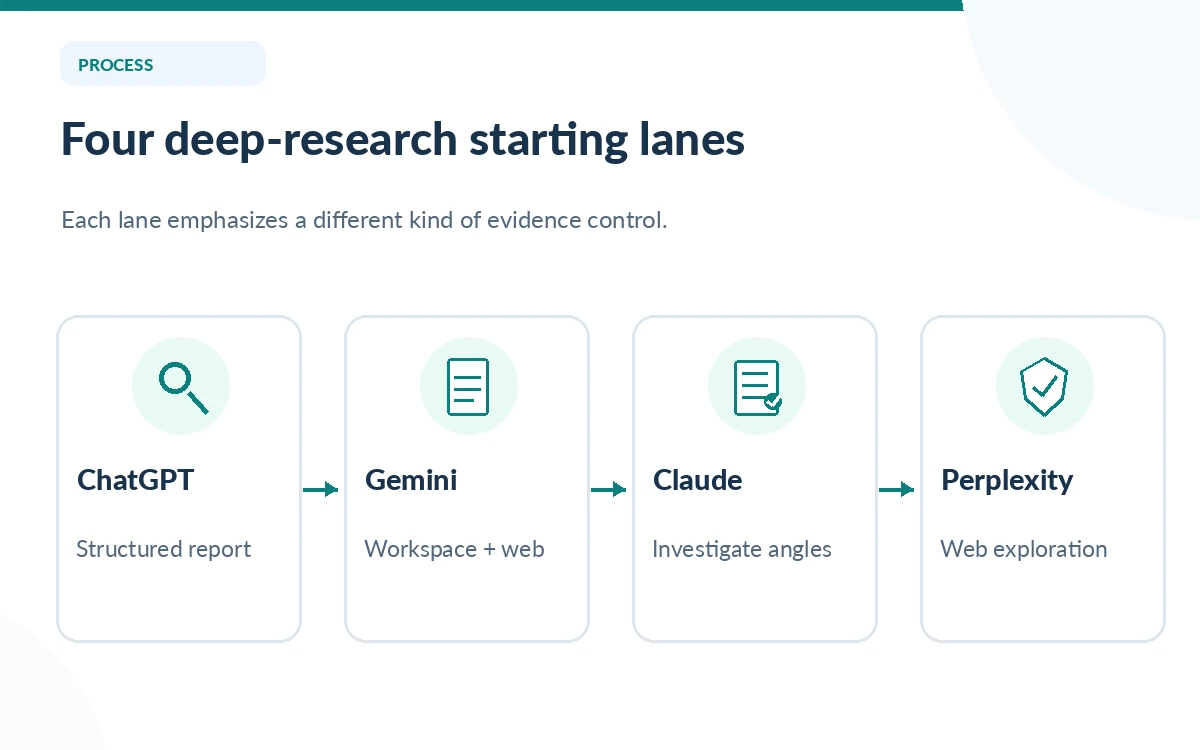
Gemini Deep Research: web and selected workspace sources
Google describes Gemini Deep Research as using Google Search by default, with options to add supported sources such as Gmail, Drive, uploaded files or notebooks when enabled. Users can review and edit a proposed plan before a report begins. This is useful when research legitimately combines current web material with your own permitted background documents. A company may find this more practical than copying approved context between apps.
The quality of the final synthesis still depends on the scope and permissions you provide. A private document could reflect internal opinion rather than outside evidence, so identify the origin of each finding in the report. Confirm the selected sources in the current interface before uploading confidential material; features and daily limits vary by account and geography. Source inclusion is not a general permission to reuse protected data.
Claude Research: iterative investigation and clear narrative
Anthropic says Research conducts multiple searches across different angles and presents cited answers; web search must be enabled, and access is tied to eligible paid Claude plans. It can draw on connected internal sources where permissions allow. This makes it worth considering when the deliverable is a nuanced narrative that must reconcile several positions rather than assemble a quick product list.
Claude Research is not an independently certified fact-checker. Investigative breadth can increase consumption of account usage allowances, and access to internal sources is conditional. For a high-stakes report, separate quotations from interpretations and ask for the strongest primary source supporting each disputed sentence. If a document was inaccessible, note that explicitly instead of letting a fluent synthesis imply complete coverage.
Perplexity Research: efficient discovery and follow-up
Perplexity describes Research Mode as a separate choice for complex questions that builds a comprehensive report; its standard search modes serve shorter tasks. This can be attractive for scouting an unfamiliar product category or finding several lines of inquiry quickly. Its conversational environment also makes it easy to ask for counterexamples, change regional assumptions and collect candidate sources for later verification.
Use it as an opening research lane rather than an automatic authority. A report can incorporate syndicated copies of the same claim or sources that share a single press release. Examine source independence, dates and missing perspectives. Do not compare vendors by the length of the source list or imply that publicly displayed research features guarantee identical access on every subscription.
Gemini Notebook: study a controlled source collection
Gemini Notebook, previously called NotebookLM, is a different research lane: it is most valuable when the answer must remain anchored in a selected collection of documents and imported research. Google documents source discovery and a Deep Research import workflow where the user can review and choose sources. The strength is a relatively inspectable packet of materials rather than unlimited open-web exploration.
The weakness is equally important: a controlled packet cannot alert you to every important paper or external change when that evidence is missing. Inventory the source collection, record publication dates and add a separate discovery step. Do not treat a notebook response as an independent systematic literature review or as a replacement for opening the original documents.

A comparison exercise that avoids fake rankings
Try the same meaningful prompt on each accessible product: identify regulatory changes affecting one concrete process, with a cutoff date and requested output table. Require each answer to include claim, source, document date, conflicting evidence and confidence qualifier. Score each candidate on a simple 0–2 user-defined rubric for primary-source traceability, scope control, source diversity and exportable follow-up. Keep raw links for independent checking.
This is a practical buyer exercise, not a published accuracy benchmark. A single prompt cannot establish a general winner, and a tool with better citations on one topic can underperform elsewhere. Your final selection should minimize the unresolved research work for your actual assignments, within your privacy and budget constraints.
The safest shortlist by deliverable
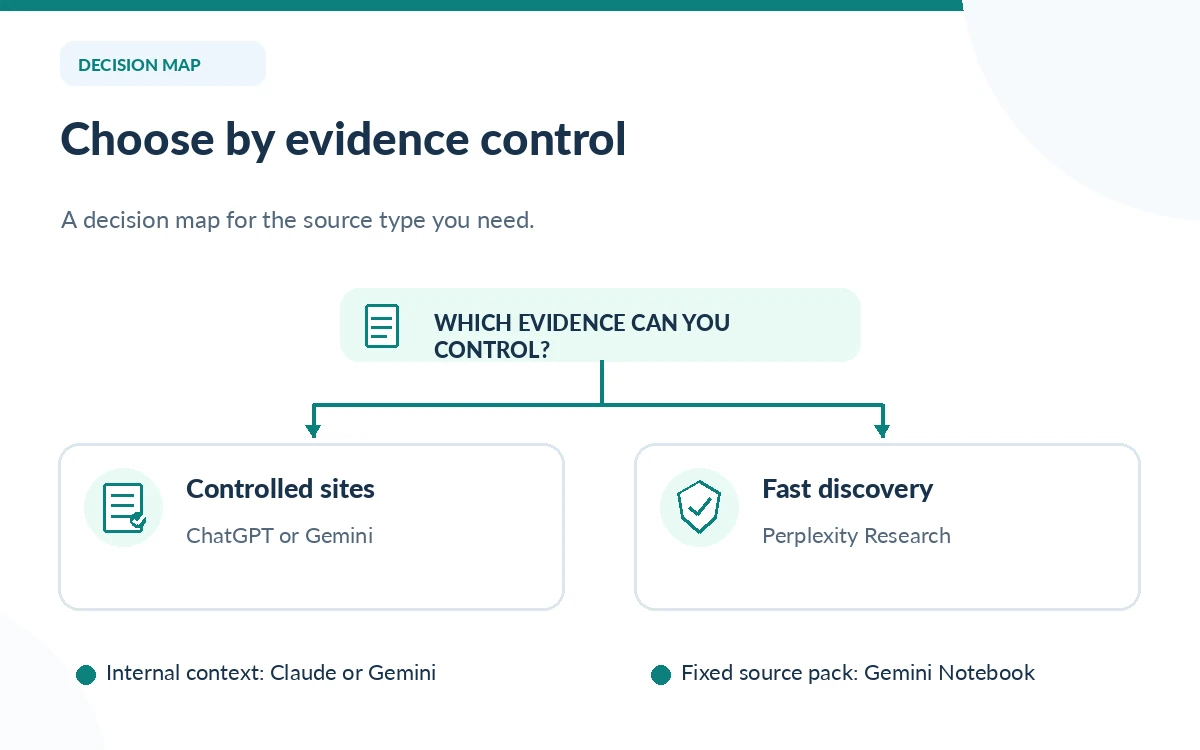
For a governed decision brief, evaluate ChatGPT Deep Research and Gemini Deep Research first because they document plan and source controls. For iterative synthesis across connected context, examine Claude Research. For rapid exploration of web evidence, try Perplexity Research. For intensive analysis of a defined collection, consider Gemini Notebook. These are use-case recommendations, not measured product rankings.
Before purchasing, verify present account access and remaining research quotas inside each product. Make a one-page approval checklist: permitted source categories, export format, restricted materials, reviewer and future refresh date. A defensible research report is a maintained evidence artifact, not a one-time chatbot answer.
How We Research
We reviewed the official OpenAI deep-research guide, Google Gemini Deep Research instructions, Anthropic Research guidance, Perplexity Research Mode description and Gemini Notebook source documentation as of October 26, 2026. Recommendations are workflow fit judgments from vendor documentation; we have not conducted controlled tool testing, verified live plan eligibility for individual accounts or assigned accuracy scores.
Frequently Asked Questions
There is no defensible universal winner without specifying the task. Compare source control, original-document access and reviewer effort with the same task across products.
It often does more steps and supplies a longer report, but that does not ensure accurate citations or complete coverage. Verify important claims directly.
Some tools support uploaded files and enabled connectors. Confirm organizational permissions, data-handling policy and relevant account features first.
No. Notebook workflows center on selected source collections; Gemini Deep Research can plan broader research across chosen sources and web search.
Eligibility and usage limits vary by product, account and region. Review official plan and in-product limits immediately before deciding.