
An AI research assistant becomes useful when its findings survive handoff to another person. A polished answer without sources, scope or an uncertainty log might speed up the first meeting but create expensive rework later. A dependable research process treats the assistant as a way to discover leads and organize evidence, while keeping factual authority in the documents that can be inspected.
This guide is about workflow design rather than choosing the “best” assistant. It suits a product manager preparing a vendor decision, an analyst writing a policy brief or a student documenting a non-systematic research project. It is not a substitute for professional advice or rigorous systematic-review standards where those are required.
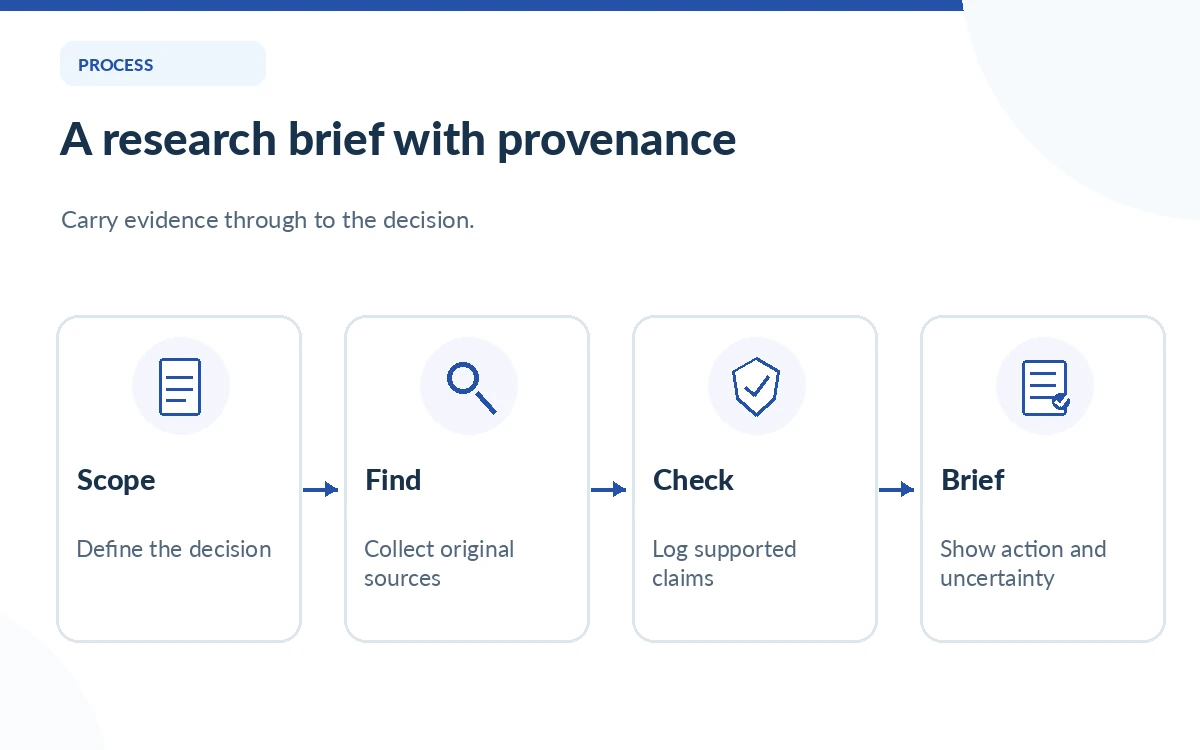
Define the decision and the limits of the search
Start by writing the decision in one sentence: “Should our team evaluate option A for a defined workflow in the United States this quarter?” Add intended users, time horizon and what you will not investigate. Specify the minimum evidence needed to proceed and which uncertainties would stop the decision. Without a decision boundary, an assistant may produce pages of interesting but irrelevant background.
Distinguish an exploratory brief from a review meant to be comprehensive. An exploratory brief can seek a bounded set of representative credible sources; a formal review needs systematic inclusion criteria and traceable searches. Record the date of the research and assign an owner to update fast-changing information such as product limits, pricing and terms.
Write a source policy before prompting
List acceptable primary sources for each claim type: vendor documentation for feature availability, regulator publications for rules, original studies for research findings and financial filings for reported company metrics. Independent journalism can provide useful context, but it may repeat an earlier announcement. Ask the assistant to distinguish a primary source from commentary and leave unsupported fields blank.
For a vendor comparison, require fields for product, claim, URL, source owner, date and caveat. Do not treat more citations as inherently better. A single current authoritative document can outweigh several older opinion pieces. Define how to handle paywalled, inaccessible and contradictory sources before they appear in the first draft.
Use AI search for leads, then collect originals
Ask a research-oriented assistant for a small group of sources covering the central question and obvious alternatives. Perplexity documents multi-step sourced search; ChatGPT Search supports web answers with citations. Neither claim implies that every link is fully checked. Open the retrieved pages and verify that each one exists, is current enough and actually discusses the asserted fact.
Prefer collecting durable original URLs rather than relying only on chat citation markers. For a technical specification, capture the version or release notes. For news, capture when the underlying event occurred as well as the article’s publish date. Store sensitive source documents only in approved systems. Redact confidential customer details before sending prompts to services outside your controlled environment.
Construct a claim ledger that survives the chat session
Create a table with seven columns: claim, source URL, document date, evidence excerpt or locator, confidence rationale, unresolved question and verification owner. Use “verified,” “qualified” and “unresolved” as workflow statuses, not statistical probabilities. Add a separate inference column for judgments that combine several facts. That structure prevents a reasonable recommendation from being misquoted later as a directly sourced observation.
One claim may need two entries when information conflicts across regions or versions. Keep both until the difference is explained. Avoid copying substantial copyrighted text into public artifacts; a small locator and your own paraphrase are normally enough. Preserve a decision log for anything an editor or stakeholder might challenge, including why a source was rejected.

Challenge the draft with disconfirming questions
Once the assistant proposes a conclusion, ask what evidence would make it wrong. Request the strongest documented alternative and any excluded population, business scenario or technical constraint. Search directly for the counterclaim. AI assistants may mirror the assumptions built into an initial prompt; a deliberate contradiction pass is more useful than asking them to “be unbiased” in generic language.
For example, if the brief says a new search workflow saves time, ask whose time, at what volume, and whether checking sources erases the savings. If a paper supports the intervention only under supervision, record that condition. Mark unresolved issues explicitly rather than burying them in a footnote. A good research artifact communicates uncertainty in a way a decision maker can act upon.
Turn the ledger into a short, decision-ready brief
Use a predictable structure: question, recommended next action, confirmed findings, important caveats, alternatives, cost or operational implications and open items. Give each major factual assertion a source link. Keep the model’s proposed interpretation distinct from the underlying evidence. The goal is not to fill a page count; it is to help a reader reconstruct why the recommendation follows.
If several stakeholders have different needs, show the trade-offs in a small matrix rather than a blanket winner. For decisions with financial, medical or legal consequences, seek appropriately qualified review. Do not claim that the AI “tested” products when it summarized documentation, and do not attach a confidence percentage that was never calibrated against observed outcomes.
Set review triggers and reusable templates
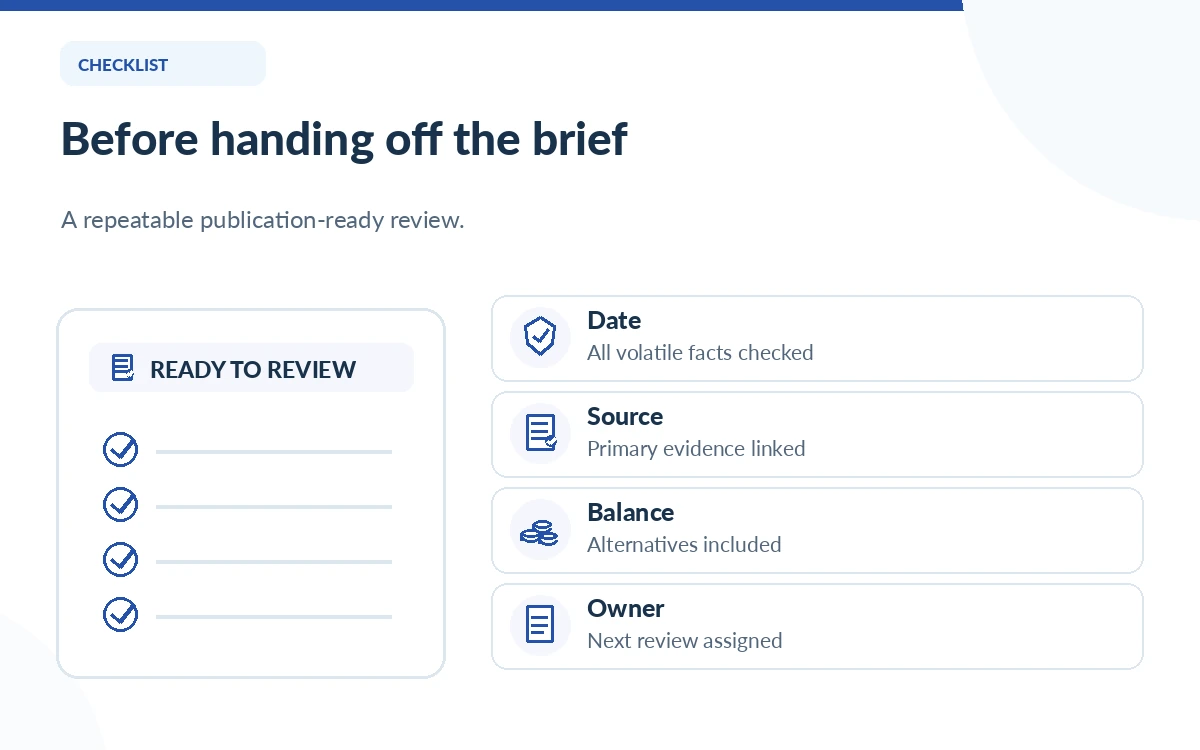
Save a sanitized prompt template, the source rules, the ledger format and a schedule for revisiting fragile facts. A price change, new model release, updated product policy or superseding study should trigger targeted checks. Archive what changed and who verified it so the brief has a trustworthy version history. A recurring project benefits more from clean inputs and review responsibilities than from increasingly elaborate prompts.
At completion, run one final audit: are all dates concrete, all important numbers sourced, all alternative conclusions represented fairly and all links still relevant? Name the remaining unknowns and the owner of the next action. The assistant has done its job when the team can maintain the research without depending on the original conversational session.
How We Research
We compared OpenAI’s search-source guidance with Perplexity’s sourced-search documentation and Scite’s evidence-checking feature descriptions, checked October 26, 2026. This article provides an original editorial process template. We have not performed a time-saving experiment, built a deployed enterprise assistant or measured error rates; the suggested ledger and review triggers are best-practice recommendations.
Frequently Asked Questions
Write a bounded decision question with audience, geography, time frame and an acceptable-evidence policy. Otherwise a well-written answer may have little decision value.
Not necessarily. A source-enabled assistant and a well-maintained source ledger may cover many small projects. Add specialist tools only when your task demands their particular evidence types or controls.
Require direct original-source URLs, open every high-impact citation and mark inaccessible or unsupported links as unresolved. A model instruction alone cannot guarantee valid citations.
Deliver a concise decision brief together with a claim-level source ledger, explicit uncertainties, correction history and an owner for facts that may change.
It can help organize preliminary information, but high-stakes decisions need qualified professional review and appropriate formal research methods. Do not treat an AI-generated synthesis as professional advice.