
Disclosure: LabFin is reader-supported. If you sign up for a tool through links on this page, we may earn a commission at no extra cost to you. Commissions vary between providers and our ratings do not — here’s our full disclosure.
Claude vs Cursor looks like a choice between two coding tools, but the two overlap more than most pairs. Claude Pro includes Claude Code, Anthropic’s coding agent, which runs in the terminal and in editors, Cursor among them. Cursor, in turn, sells Claude models alongside models from OpenAI, Google and others.
So the real question is where you want to work and how you want to pay. Both start at $20 a month, and our reviews also score both 3.6. The sections below compare plans, models, agent scores, data rules and security.
Claude vs Cursor: The Short Answer
Choose Claude if you want a terminal-first agent plus a general assistant for writing and research, on one plan. Choose Cursor instead if you want AI built into the editor, with Tab completions and a choice of models from several labs.
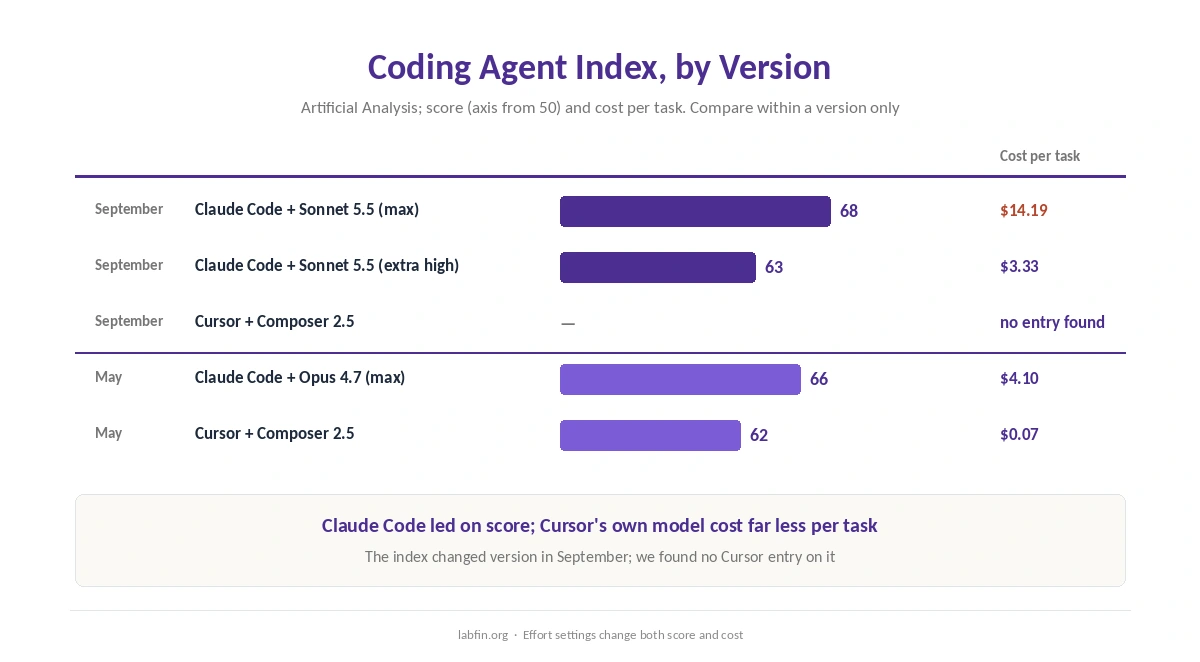
On Artificial Analysis’s September index, Claude Code with Sonnet 5.5 scored 68 at maximum effort, the top entry we recorded, but at $14.19 a task. Cursor has no entry on that version. On the May version, however, Cursor’s Composer 2.5 scored 62 at $0.07 a task, against 66 for Claude Code with Opus 4.7.
Head to Head
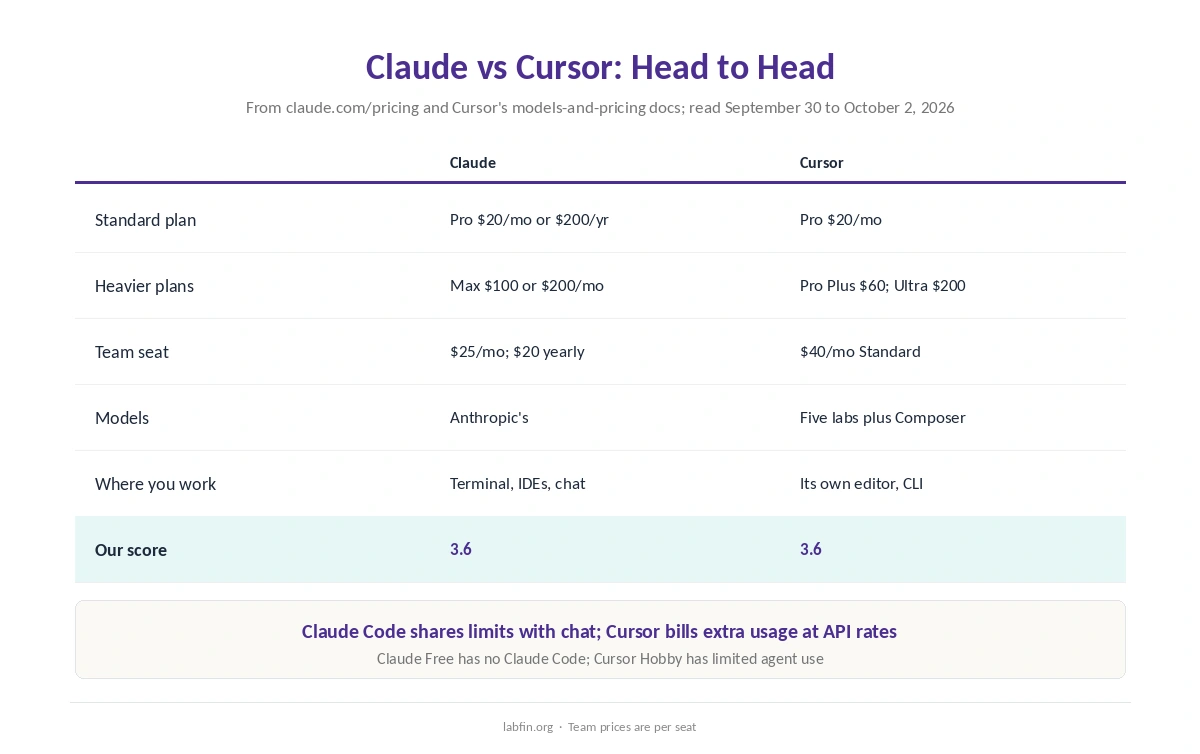
| Criterion | Claude | Cursor |
|---|---|---|
| Free plan | Chat only; no Claude Code | Hobby, with limited agent and Tab use |
| Standard plan | Pro $20/mo or $200/yr | Pro $20/mo |
| Heavier plans | Max $100 or $200/mo | Pro Plus $60; Ultra $200/mo |
| Team seat | $25/mo, or $20 billed yearly | $40/mo Standard |
| Models | Anthropic’s | Anthropic, OpenAI, Google, SpaceXAI, Meta, Composer |
| Where you work | Terminal, IDEs, chat app | Its own editor, CLI, cloud agents |
| Training on your code | Personal plans: yes, unless you opt out | Only with Privacy Mode off |
| Our score | 3.6 | 3.6 |
Prices and Usage
Claude Pro costs $20 a month, or $200 a year billed up front, about $17 a month. Claude Code comes with Pro and Max, and its usage counts against the same five-hour and weekly limits as chat. Above that, Max costs $100 for five times Pro usage or $200 for twenty times.
Cursor Pro also costs $20, while Pro Plus costs $60 and Ultra $200. Each paid plan splits usage into two pools: a larger one for Cursor’s own models, Composer 2.5 and Grok, and one for third-party models at API prices. However, Cursor’s docs estimate that daily agent users spend $60 to $100 a month in total. For API prices outside both tools, see our list of the best AI tools for developers.
For teams, Claude Team Standard costs $25 a seat monthly or $20 billed yearly. Cursor Teams costs $40 a seat, or $120 for Premium. In addition, Cursor charges $0.25 per million tokens on third-party models for Teams and Enterprise.
Models: One Lab or Many
First, Claude Code runs Anthropic’s own models, such as Sonnet 5.5 and Opus 5.5. Cursor, by contrast, lists models from Anthropic, OpenAI, Google, SpaceXAI and Meta, plus its own Composer 2.5.
Notably, Cursor bills Claude Opus 5.5 at $4 per million input tokens and $20 per million output tokens, the same as Anthropic’s own API price. So in Cursor you can run Claude’s models inside a different agent, which changes results and cost. Our Claude review covers the models themselves.
Where You Work
Claude Code is terminal-first, and it also runs in VS Code, JetBrains IDEs and Cursor, according to Anthropic’s help center. Claude Pro also includes chat, Research and projects, so one plan covers code and writing alike. Our guide to Claude for coding covers setup and limits.
Cursor is the editor itself. For example, paid plans include unlimited Tab completions, the agent, Cloud Agents and Bugbot code reviews, and Cursor also offers a CLI. It does not, however, replace a general assistant for research or writing. Our Cursor review covers the editor in depth.
What the Agent Scores Show
Artificial Analysis scores each agent together with its model, and it changed the index version in September. Therefore, we compare only figures from the same version.
On the September version, Claude Code with Sonnet 5.5 scored 68 at maximum effort, at $14.19 and about 1.5 hours per task. At extra-high effort, though, it scored 63 for $3.33, and at high effort 55 for $1.24. We found no Cursor entry on that version.
Earlier, on the May version, Claude Code with Opus 4.7 at maximum effort scored 66, at $4.10 a task. Cursor with Composer 2.5 scored 62 at $0.07. So Claude Code led on score, while Cursor’s own model cost far less per task. Our list of the best AI for coding tracks newer entries.
Data and Privacy
Claude’s personal plans train on chats, including Claude Code sessions, unless you turn off Help improve Claude. With training on, Anthropic keeps that data for five years, and with it off, for 30 days. Team and Enterprise plans, however, keep data out of training by default.
Cursor’s rule, by comparison, hinges on Privacy Mode. With it on, Cursor does not train on your code and keeps zero data retention agreements with its model providers. With it off, Cursor may store and use code, prompts and editor actions to train its models. For teams, Privacy Mode is on by default.
Security Record
Claude Code’s Manual mode starts read-only, writes stay inside the working folder, and network commands are not approved automatically, according to Anthropic’s security docs. Still, in April 2026 researchers showed that prompt injection in pull request titles could steer Claude Code Security Review, a GitHub Action, into leaking secrets.
Cursor, meanwhile, also fixed two flaws rated 9.8 out of 10, dubbed DuneSlide, in version 3.0, released on April 2. Cato AI Labs disclosed them in July. In both cases, the lesson is the same: text an agent reads can steer it, so keep the guardrails on.
Who Owns Each
Anthropic is a public benefit corporation, with Amazon and Google among its large shareholders. In May 2026 it raised $65 billion at a $965 billion valuation, Fortune reported. Cursor’s maker, Anysphere, became part of SpaceXAI when SpaceX’s purchase closed on August 14, 2026, Bloomberg reported. Our Grok review covers SpaceXAI’s assistant.
Where Each One Is Weakest
Claude is weakest on cost at the top setting and on model choice. Its best agent score costs $14.19 a task, usage limits are shared with chat, and Claude Code runs only Anthropic’s models. In addition, Free users get no Claude Code at all.
Cursor is weakest on cost predictability and security history. Heavy agent months can run well past the plan price, DuneSlide followed earlier prompt-injection flaws, and its current agent score is missing from the September index.
Winners by Category
Top current agent score: Claude, with 68 on the September index. Cost per agent task: Cursor, at $0.07 against $4.10 on the May index. Model choice: Cursor, with models from five labs plus its own. Editor experience: Cursor, with Tab completions built in.
One plan for code, writing and research: Claude. Team price: Claude, at $25 a seat monthly against $40. Security: no clear winner, since both have had prompt-injection findings. Overall, in Claude vs Cursor our scores tie at 3.6.
When to Choose Each, or Both
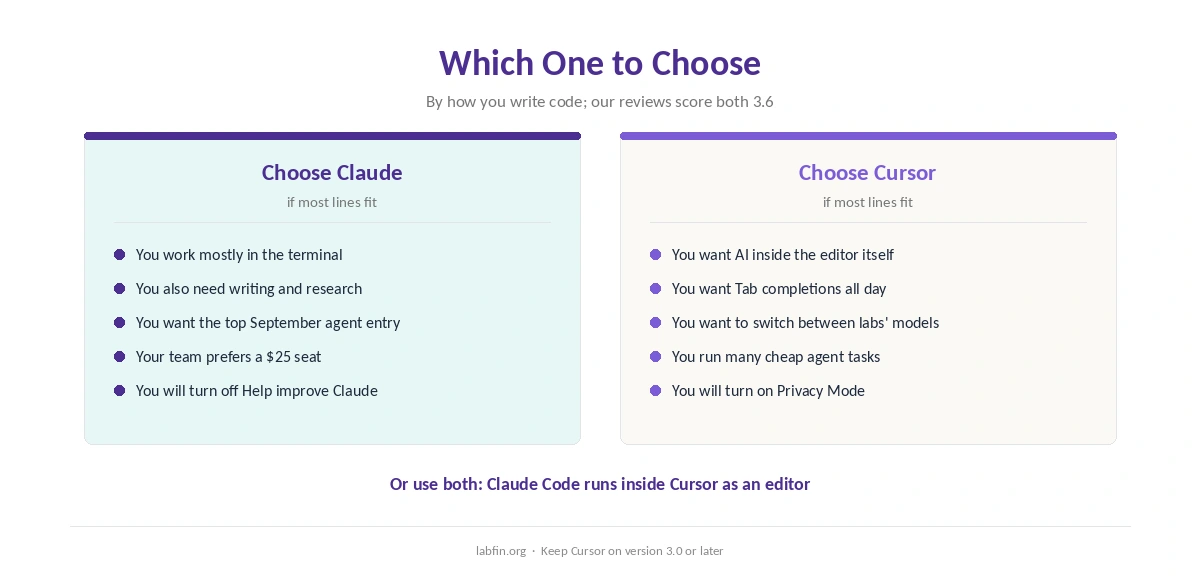
Take Claude when you work in the terminal, want the strongest current agent entry, or also need an assistant for writing and research. Then turn off Help improve Claude if your code is private. If you would rather stay with OpenAI, our guide to ChatGPT for coding covers Codex.
Take Cursor when you want completions and an agent inside one editor, or the freedom to switch models. Turn on Privacy Mode first. Alternatively, use both, since Claude Code runs inside Cursor. For other editors, see our list of Cursor alternatives, and for learners, the best AI for coding beginners.
How We Research
This Claude vs Cursor comparison takes Claude’s plans from claude.com/pricing and Anthropic’s help center, and Cursor’s from its models and pricing docs and data-use page. We read them between September 30 and October 2, 2026.
Agent scores come from Artificial Analysis, ownership from Fortune and Bloomberg, and security findings from the Cloud Security Alliance and The Hacker News. Our score for each tool comes from its review, and our about page explains the criteria. For the chat side, our comparison of ChatGPT vs Claude may help.
Claude vs Cursor FAQ
Both score 3.6 in our reviews. Claude Code holds the top September agent entry, 68, at a high cost per task; Cursor offers an AI editor, several labs’ models and a far cheaper own model.
Yes, in two ways. Cursor lists Claude Opus 5.5 and Sonnet 5.5 among its models at API prices, and Claude Code itself runs inside Cursor as an editor, according to Anthropic’s help center.
Both standard plans cost $20 a month; Claude Pro is also $200 a year. Claude Max costs $100 or $200, and Cursor Pro Plus $60 and Ultra $200. Team seats cost $25 on Claude and $40 on Cursor.
Yes. Claude Code comes with Pro and Max, and its usage counts against the same limits as chat. The Free plan does not include it.
Claude’s personal plans train unless you turn off Help improve Claude. Cursor may train unless Privacy Mode is on, which teams get by default.
The Verdict
Claude vs Cursor ties on our scores, and the tools fit together more than they compete. Claude gives you the top current agent entry and an assistant for everything else, while Cursor gives you an editor with completions and a choice of models.
Pick by where you work: the terminal and one plan for everything, or an AI editor. Either way, set the training controls before you open a real repository.