
ChatGPT Business and Claude Team both package AI models for organizations with managed seats, shared context, and administrative features. This is not a generic ChatGPT-versus-Claude model contest: a company needs to know how staff access approved knowledge, who manages the tenant, what permissions and usage controls are available, and how extra consumption is billed. The article provides a matched six-task pilot and a decision record instead of unearned claims that either vendor won a benchmark.
Compare team problems rather than chatbot personalities
List the jobs you actually need: summarize approved internal documents, prepare client-ready drafts, research public sources, explain spreadsheet findings, assist developers, and reuse shared working instructions. A business purchasing primarily for coding needs a different task set from a creative agency. For each job record inputs, allowed systems, expected output, reviewer, maximum permissible data sensitivity, and whether the tool must perform actions or only propose them.
Do not compare “helpfulness” in the abstract. One assistant may produce attractive prose while missing a file restriction; another may produce a cautious but less fluent answer. Score the outcome against a defined, verifiable acceptance test. A shared workspace is valuable only when its access rules and onboarding experience fit real staff behavior.
Normalize Standard and Premium seat prices
As checked October 27, 2026, OpenAI Business lists Standard seats at $20 per month on annual billing or $25 per month billed monthly, with Premium at $100 or $125 on the same respective bases. Claude Team posts comparable US figures for its Standard and Premium seats. Both describe options to mix usage tiers. These parallel prices do not prove feature equivalence, identical capacity accounting, or identical renewal terms.
Verify geography, applicable taxes, current minimum membership, contract terms, and which department pays. For a four-person team using three Standard and one Premium seats, the illustrative public monthly-billing seat subtotal is $200 (three times $25 plus $125), before taxes or separately charged services. This is arithmetic from listed pricing, not an invoice. The same numerical total cannot settle the vendor choice without workflow tests.
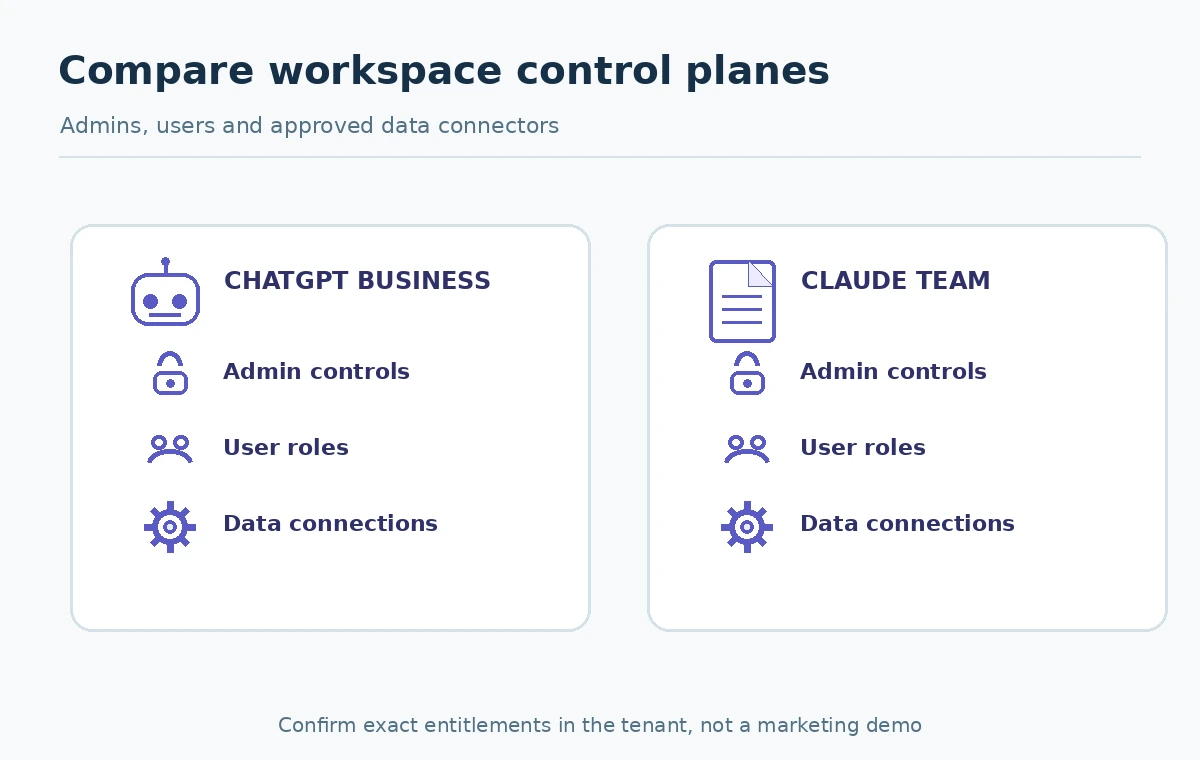
Check governance and privacy at the workspace boundary
OpenAI’s Business overview describes centralized billing, user administration, identity and usage controls, with no training on business workspace data by default. Anthropic’s Claude Team page describes managed team controls, connectors, and no training on team content by default. Those are published commitments; the responsible administrator must still configure the account and confirm the exact retention, sharing, connector, and contractual settings required by company policy.
Use a simple approval test: sign in as a standard member, create or access shared working context, and attempt to reach material that role should not see. Do not use real sensitive information for this initial test. Record which settings prevent unwanted data movement and where administrators can audit user access. An assistant saying it respects privacy is not proof that a tenant has correctly enforced it.
Understand connectors, code and API differences
Both products describe connections to workplace tools, but catalog and permission models change. Check support for the exact apps your team uses, whether a specific connector is read-only, how access is granted, and whether downstream actions require review. A connector should preserve existing source permissions rather than silently expanding them. Verify which features are currently included in each tier rather than assuming every item shown in a product demo applies to your account.
OpenAI states that ChatGPT Business subscriptions do not include OpenAI API usage: the API has separate billing. Anthropic now has a specific Claude Team API-credit program with eligibility, pooled monthly amounts and a stated cap. This is not the same thing as claiming Claude API calls are unlimited or interchangeable with seat quotas. Check the date, claiming conditions, balance, and additional usage pricing before including that benefit in a cost model.
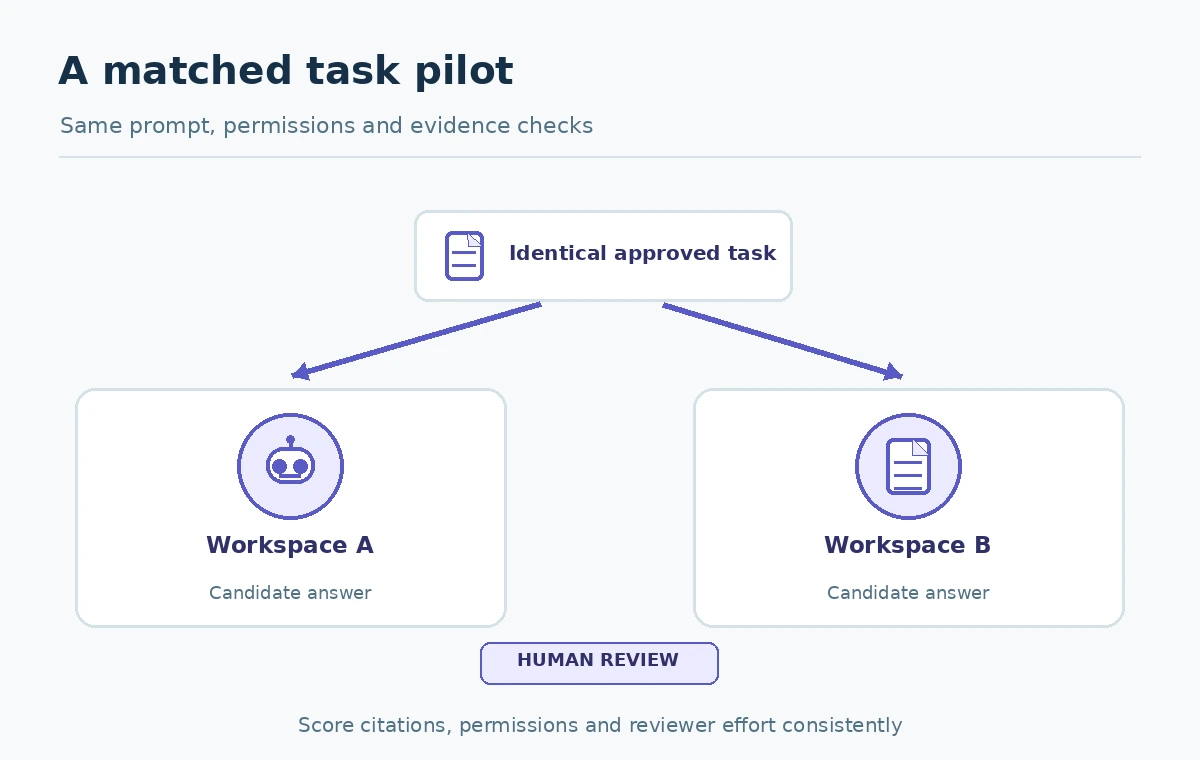
Run a six-task matched pilot with expected answers
Choose six lawful, non-sensitive tasks: summarize a two-page policy with citations; rewrite a difficult customer reply; extract action items from a meeting note; audit a small spreadsheet total; produce a draft software-function explanation; and decline a request to reveal restricted data. Publish the task definitions, expected output elements, data sources, time limit, and who adjudicates the answers. Use the same task and a consistent instruction standard for each product.
Record factual accuracy, evidence traceability, formatting, missing information disclosures, access behavior, reviewer correction effort, and whether the feature was actually available on the chosen seat. Separate “unsupported,” “permission denied,” “wrong,” and “correct.” Refusing a disallowed action can be the best result. These six examples form a suggested evaluation plan, not results of a LabFin hands-on test.
Consider the real adoption cost
Workspace rollout includes onboarding, naming conventions, sharing guidance, source-owner permissions, and someone to answer questions. Train staff not to paste customer records into unapproved sessions, to check output citations, and to distinguish rough drafts from authorized external messages. Keep a change log for connector additions, newly enabled agents, and model default changes. These operational details can matter more than a model’s score on an unrelated public benchmark.
Estimate support burden: How many staff can complete the core task without a specialist? Where do they hit a capacity limit? Can admins see usage signals and manage seat changes? Is there a stable way to share an approved template or output while protecting unrelated chats? Pilot notes should capture both good outputs and confusing interfaces. Avoid turning a single enthusiast’s success into a universal team claim.

Apply weighted criteria only when they are measurable
An editorial scorecard might allocate 30 percent to required-task completion, 25 percent to security and governance, 20 percent to integrations, 15 percent to reviewer effort, and 10 percent to observed cost. Those numbers are an example of an internal decision framework, not independently validated weights. Each organization should decide which failures are non-negotiable and which factors can trade off. A permission failure must not be offset by more elegant prose.
If both platforms pass, compare them against your existing software environment and contract terms. A mixed-tool policy may create duplicated billing and training burden, but consolidating can also remove a genuinely needed capability. Maintain one canonical list of approved use cases so employees do not purchase personal subscriptions that bypass company settings.
Publish a defensible workspace decision
Write a final record identifying eligible users, approved tasks, excluded data, connectors to enable, settings to check, pilot reviewer, seat mix, budget owner, and re-evaluation date. The record should make clear what the two products were actually asked to do and which outcomes were observed. Attach links to the latest official seat and feature descriptions; do not freeze 2026 promotional prices into an evergreen decision.
Choose the team workspace that passes your critical tasks under acceptable access boundaries with predictable cost. For a regulated or contract-sensitive deployment, involve security and legal reviewers for terms and data movement. If the pilot cannot establish adequate controls, defer purchasing either option instead of choosing a winner from brand recognition.
How We Research
Source verification date: October 27, 2026. We reviewed these first-party documents: OpenAI Business plan prices and workspace features, ChatGPT Business security and billing details, Claude Team product and pricing details, Claude Team included API credit program. This article supplies source-anchored product details and a proposed editorial worksheet or pilot, not claims of LabFin purchasing the products, testing customer accounts, measuring vendor performance, or providing legal opinions. Illustrative arithmetic and sample tasks are labeled and should not be treated as actual charges or measured results. Verify plan terms, eligible regions, rollout dates, entitlements, and privacy controls in your own account before adopting any tool.
Frequently Asked Questions
Their listed US Standard and Premium headline prices are similar for the billing intervals cited, but conditions, capabilities and consumption rules differ.
No. Anthropic documents a limited eligibility-based pooled API credit benefit, with limits and separate usage rules.
No. OpenAI explicitly separates workspace subscriptions and API billing.
Neither can be universally certified by this article. Compare documented commitments against your tenant settings, source permissions and contract.
Successful approved tasks, permissions, evidence quality, staff correction effort and total cost under a recorded workload.