
A visitor planning a trip to the fictional Harbor Point ferry terminal finds a PDF labeled “Summer sailing times.” A web result also shows a brief notice about a replacement vessel. The two documents appear compatible until the visitor checks their dates: the timetable was published last season, and the notice describes a temporary service change. A fluent answer that merges them could send somebody to the dock at the wrong time.
ChatGPT Search can find web information and return linked sources, according to OpenAI’s search documentation. That is helpful for discovering likely operator pages, but it does not make a scraped schedule a live dispatch feed. This tutorial uses invented ferry times, notices, and operators. The purpose is to teach a date-aware research workflow; it is not travel advice for a real route.
Write a question with a place, direction, and service date
Ask about one direction, departure terminal, and exact calendar date rather than simply requesting the “next ferry.” A useful fictional question is: “Find the official Harbor Point to West Quay departures for Saturday, November 14, 2026, including any posted replacement-service notices.” The place names and date make this a demonstration, not a claim of real sailings.
Include the time zone, requested departure window, and whether the answer is for foot passengers or vehicles when those distinctions matter. An answer about a return crossing should not be blended into an outbound schedule. Create a small fact sheet with columns for operator, route, date, direction, source URL, source publication or revision date, and verification status.
Use Search to discover sources, not to certify them
OpenAI documents manual selection of Search from the tools menu as well as automatic searching when current information is useful. The interface and available limits depend on account and platform. Ask Search to identify the operator’s official timetable and a separate service-alert page, and request direct citations for each proposed departure.
Click the cited sources yourself. OpenAI warns that citations and results can be incomplete, outdated, or mistaken. A result snippet that repeats a time is not proof that the original operator still uses it. If the assistant provides a third-party travel aggregator, mark it as a lead rather than the authoritative record.
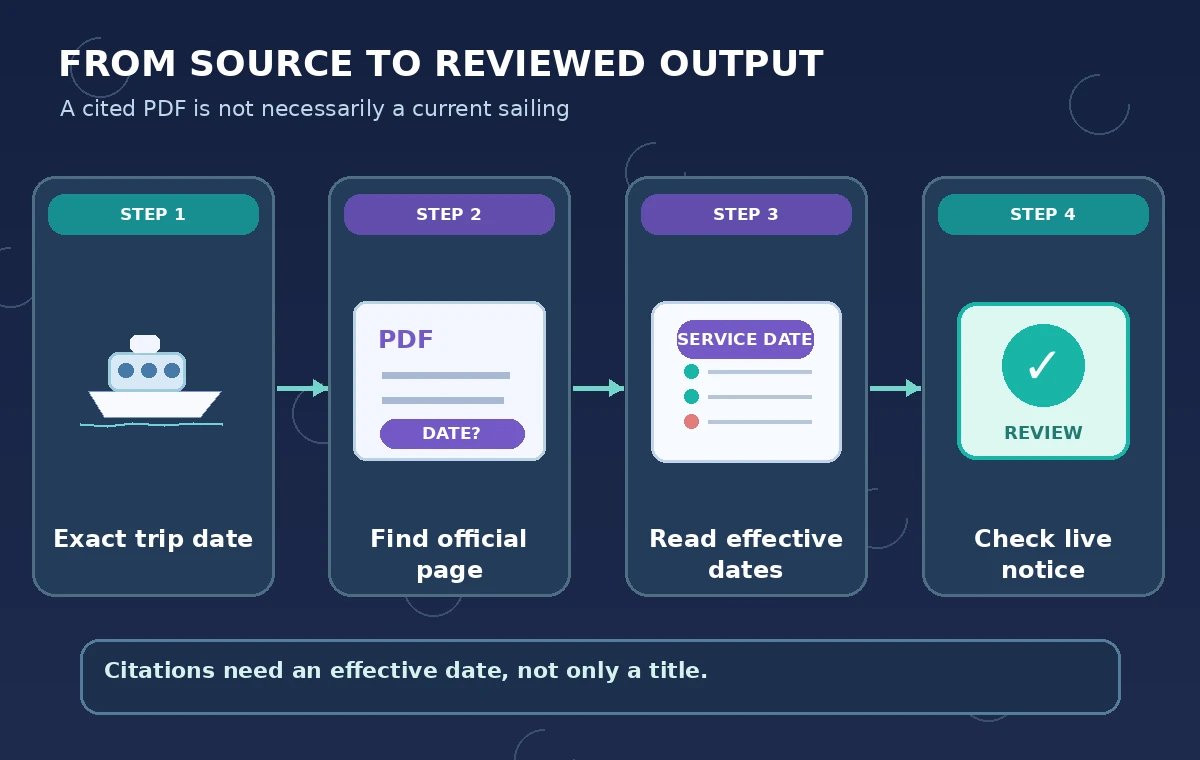
Check the date attached to the timetable itself
A PDF filename can be misleading. Read the timetable’s header, effective date, revision number, direction legend, footnotes, and any seasonal labels. An archived summer schedule may still rank well in search results because its title contains the exact route. Record the document’s actual coverage period rather than the date it was indexed.
Compare dates in the context of the requested trip. If a notice says “effective until November 13,” it should not silently determine a November 14 departure. If a notice says only “from next week,” trace that phrase to the notice’s publication date. When dates remain ambiguous, do not fill the gap with a confident invented timetable.
Separate permanent sailings from short-lived alerts
Operators often publish normal sailings and exceptional disruptions on different pages. Keep these as separate rows in the review sheet: scheduled departure, temporary service message, date affected, and whether an override is confirmed. A replacement vessel announcement is not automatically a new daily timetable, and a weather cancellation should not be assumed to apply all week.
In a hypothetical comparison, an old PDF states 09:10 while a current official alert directs travelers to check same-day departures. The correct editorial output is “09:10 from an outdated PDF; current departure unconfirmed,” not “ferry at 09:10.” The corresponding illustration is a conceptual comparison, not an actual search result.
Resolve discrepancies with the operator’s official channel
Look for a published live board, dated service advisory, or contact number on the official operator domain. When the website does not resolve the difference, the safest answer is to explain that the sailing time cannot be verified from available material and direct the reader to the operator. Do not invent a phone call, personal confirmation, or accessible alternative.
Check return directions separately and be precise about source scope: a homepage banner may describe all terminals, while a dock-specific notice applies to one boarding point. Avoid quoting a timetable extracted from an image if the alignment between days and times is unclear. Use the original PDF layout as the reference.

Present the answer with citation, date, and uncertainty
Create an output table with “Claim,” “Official source,” “Effective date,” and “Checked status.” Only list an exact departure as verified when a dated authoritative source supports it for the requested crossing. If the schedule is uncertain, do not convert a previously listed time into a recommendation. Link the alert page next to the related line.
Write a short paragraph beneath the table identifying what changed and what remains unknown. Avoid claims like “confirmed today” unless you actually performed that check at the claimed time. Live service status can change after any article is drafted; give readers a way to recheck rather than freezing the result as a permanent promise.
Audit accessibility and practical traveler details
A ferry departure is only one part of a traveler’s decision. The operator may separately specify pedestrian boarding cutoff, vehicle check-in, accessibility accommodations, and weather restrictions. Do not infer any of these from the route duration or from a third-party review. Preserve the distinction between official policy and a general suggestion.
For a useful public-facing guide, verify the precise terminal, check-in guidance, and whether the source even covers the passenger category in question. If accessibility data is absent, label it unknown and direct readers to the official accessibility contact. A polished AI answer that omits a necessary condition is not necessarily a usable trip plan.

Keep the workflow reproducible without claiming a live test
Save the query, a short source inventory, each page’s visible date, and your editorial decision. For sensitive or time-dependent guidance, a second reviewer should compare the output against the source pages. The audit record explains why a route time was excluded as well as why another was retained.
We did not search a live ferry route, observe real departures, or measure ChatGPT retrieval accuracy for this example. The imaginary 09:10 line illustrates the danger of old schedules, not an actual service alert. Use a real operator’s site and an exact local date whenever you apply this method to an actual journey.
How We Research
On November 5, 2026, we consulted OpenAI Help: Searching the web with ChatGPT and OpenAI Help: Accuracy and limitations. We matched named functionality, settings, and restrictions to this narrow hypothetical scenario, compared factual claims with vendor text, and reviewed each diagram for misleading certainty. We did not access a paid vendor account, test accuracy, collect real interviews or records, or independently measure outcomes. Interface, pricing and availability can change; verify the current documentation before following these steps.
Frequently Asked Questions
No. Search can cite stale or incomplete sources. Open the official operator page and check when the timetable applies.
No. Read the effective period and any revisions inside the original PDF, not just the indexed snippet.
Not from a normal timetable. A departure or live-running claim requires a separate authoritative operational source.
Show the conflict, do not invent a resolution, and ask the traveler to verify with the operator.
No. The operator, crossing, date comparison, and 09:10 example are fictional teaching material.