
Disclosure: LabFin is reader-supported. If you sign up for a tool through links on this page, we may earn a commission at no extra cost to you. Commissions vary between providers and our ratings do not — here’s our full disclosure.
Zapier vs Make compares two automation platforms. Zapier connects thousands of apps through Zaps, with Copilot to draft them and agents for multi-step jobs. By contrast, Make chains modules on a visual canvas and builds scenarios with its Maia assistant.
Our reviews, for example, score Zapier 3.4 and Make 3.5. So the choice depends on the job and how much you care about data terms.
Zapier vs Make: The Short Answer
Choose Make, first, on our scores: it scores 3.5 against 3.4 and fits visual control at a low cost per run.
Choose Zapier, however, if you want the quickest setup for non-technical teams; its entry paid plan is Professional $19.99 a month yearly.
Head to Head
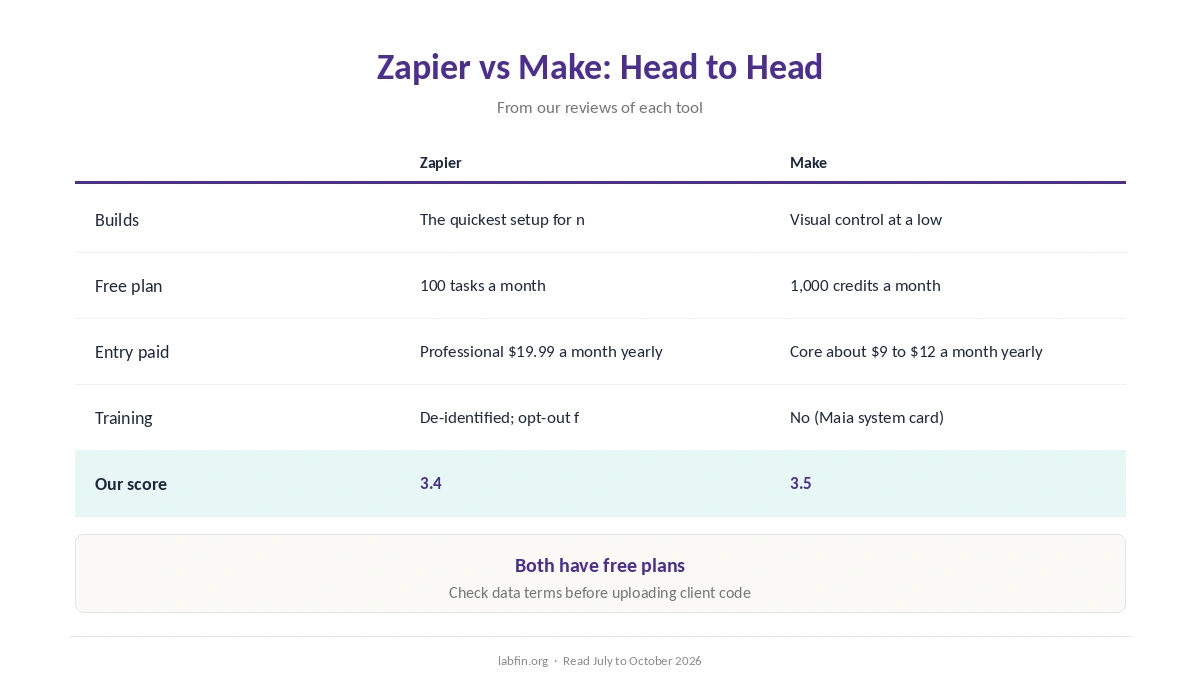
| Criterion | Zapier | Make |
|---|---|---|
| Best for | The quickest setup for non-technical teams | Visual control at a low cost per run |
| Works in | Cloud only | Cloud only |
| Free plan | 100 tasks a month | 1,000 credits a month |
| Entry paid plan | Professional $19.99 a month yearly | Core about $9 to $12 a month yearly |
| Billing | Tasks per action step | Credits per module action |
| Training on your data | De-identified; opt-out form | No (Maia system card) |
| Our score | 3.4 | 3.5 |
What Each Does
To begin with, Zapier connects thousands of apps through Zaps, with Copilot to draft them and agents for multi-step jobs. As a result, it suits you if you want the quickest setup for non-technical teams.
In contrast, Make chains modules on a visual canvas and builds scenarios with its Maia assistant. It suits you if you want visual control at a low cost per run.
Prices and Billing
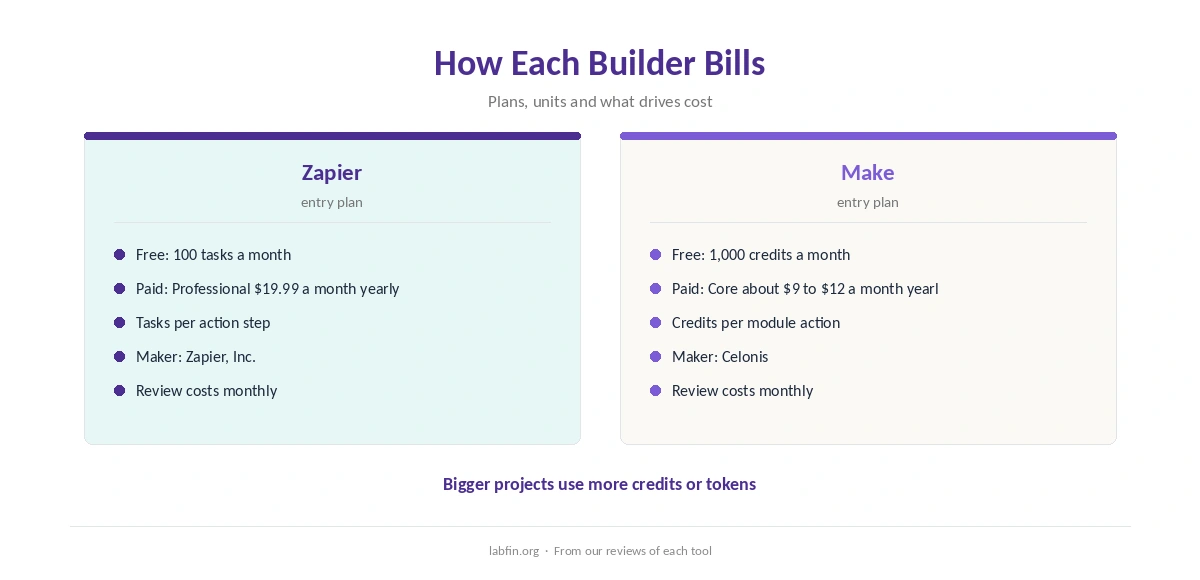
Zapier starts with 100 tasks a month on two-step Zaps, and its entry paid plan is Professional $19.99 a month yearly. Make, meanwhile, starts with 1,000 credits a month and two active scenarios, with Core about $9 to $12 a month yearly as its entry paid plan.
Billing also works differently. Zapier uses tasks, one per action step.
Make, however, uses credits, one per module action. Our list of the best AI for productivity compares more options.
Data and Training
On training, for Zapier, its terms allow training on de-identified data unless you opt out by form. For Make, by contrast, its Maia system card says Make does not train the models on customer data.
Therefore, keep regulated data out of AI steps until terms are clear. Our guide to which AI tools train on your data compares more tools.
Reliability and Safety
Zapier holds credentials for every connected app, so a misconfigured agent can reach many accounts, one security assessment notes. Make’s loops use a credit per item per module, so costs can jump on large data sets.
Automations act on real accounts, so test with sample data, add approval steps for sensitive actions, and give connections the least access they need.
Our guide to reducing AI hallucinations also covers the checklist, and our list of the best AI for business ranks more tools.
Winners by Category
In short, Zapier wins for the quickest setup for non-technical teams. The other tool, by contrast, wins for visual control at a low cost per run.
Overall, in Zapier vs Make our scores favor Make, 3.5 against 3.4.
Which One to Choose
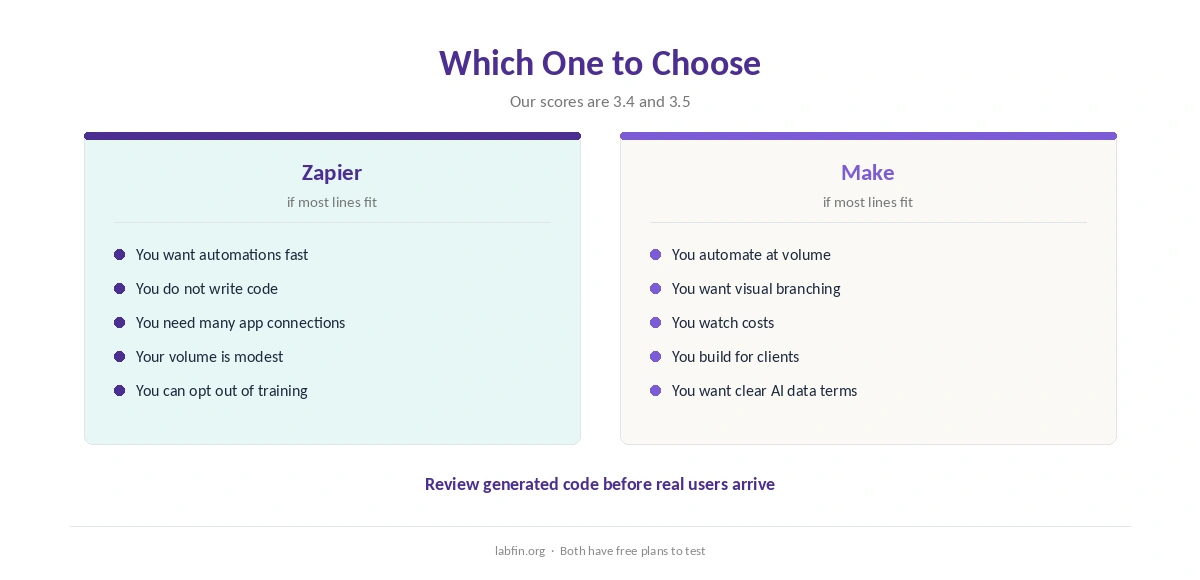
Therefore, take Zapier if you want the quickest setup for non-technical teams. Otherwise, the other tool may fit better.
Our pages on the cheapest useful AI tools and reducing AI subscription costs, in addition, cover other options.
Whichever you pick, our guides to building a personal AI workflow and combining AI tools also help.
Other pairings are covered in our Make vs n8n and Zapier vs n8n comparisons.
How We Research
This Zapier vs Make comparison reuses the sources behind our reviews of each tool, read between July and October 4, 2026, including Make’s Maia system card.
However, we run no tests of our own. Our about page explains the criteria, and our list of the best AI tools for developers covers more tools.
Zapier vs Make FAQ
Our scores favor Make, 3.5 against 3.4.
Entry paid plans are Professional $19.99 a month yearly and Core about $9 to $12 a month yearly, in that order.
For Zapier, its terms allow training on de-identified data unless you opt out by form. For Make, its Maia system card says Make does not train the models on customer data.
No; both run as cloud services.
Yes; some teams run simple jobs in one and heavy workflows in the other.
The Verdict
Overall, Zapier vs Make favors Make on our scores. The other, however, still wins for its own kind of job.
So pick by the job, check the output, and also keep sensitive material out of lower plans.