
A retention plan cannot rely on a rule name
A museum stores preservation scans, accessible derivatives, and temporary working copies across Amazon S3. A migration plan claims that an Intelligent-Tiering policy automatically protects all the masters from costly retrievals. The storage administrator has seen a configuration ID but has not confirmed its scope or whether the affected objects even use the intended storage class.
GetBucketIntelligentTieringConfiguration retrieves a named configuration for a bucket. It returns a policy definition, not a live inventory of every object’s current access tier or proof of archival compliance. Keep configuration review, per-object metadata, retention controls, and restoration planning in separate evidence columns.
Retrieve the configuration by its exact ID
The S3 API requires a bucket name and a configuration id to retrieve one Intelligent-Tiering configuration. The response includes the Id, optional filter, Status, and Tiering entries. An expected bucket-owner safeguard is available in the request; use authorized ownership information to avoid auditing the wrong account.
Do not fabricate a configuration ID based on a friendly storage label. If the ID is unknown, use the documented list operation and inspect each returned configuration within the organization’s scope. Permissions must be confirmed, and an access denial is not evidence that the bucket has no matching rules.
Read filter, status, and optional tiering settings separately
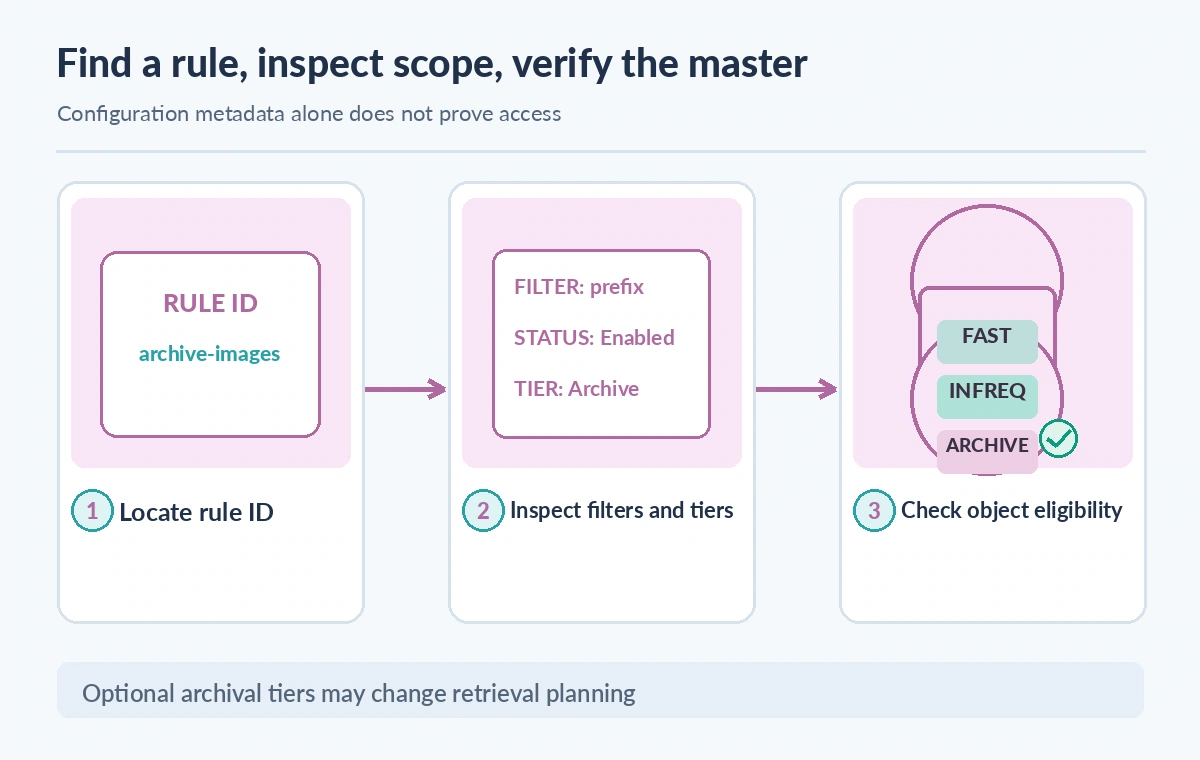
A filter can scope a configuration by prefix, tag, or an AND-style combination. Status tells whether the configuration is enabled or disabled. Tiering entries describe optional archive tiers and their day settings. These fields together show intended policy selection, but they do not indicate that each museum master has already entered a particular tier.
Check whether prefixes match exact object key conventions and whether object tags are populated consistently. A tag named approved-for-display should never be treated as a storage-level proof that a file may be published. If a configuration is disabled, record that state explicitly instead of interpreting a past policy as active.
Do not confuse storage class with access tier
S3 Intelligent-Tiering is a storage class with automatic access tiers and optional archive capabilities. AWS documents automatic movement among low-latency tiers and an option to enable Archive Access or Deep Archive Access, which involve different access expectations. The same storage class name does not by itself reveal the current tier for an individual object.
For a curator who needs a high-resolution master tomorrow, the presence of optional archive rules can materially change retrieval planning. Verify current published retrieval procedures, eligibility, timing, and charges before scheduling a public exhibition deadline. Avoid giving a universal number of hours or a fixed cost without an applicable rule and current pricing.
Build an object-level scope inventory
Create an authorized manifest of preservation objects with stable key, version ID where relevant, source accession, object size, storage class, relevant tags, and integrity checksum. Compare each object’s prefix and tags with the configuration filter. This is a candidate-eligibility check, not proof that the object is currently in a tier.
Small items and other storage-class constraints can affect monitoring or automatic tiering. Review current S3 documentation for exact eligibility and billing boundaries. Keep tiny text manifests and large image masters in their appropriate workflows rather than using an object count as a reliable estimate of tiering savings.
Make comparison states evidence-aware
The diagram contrasts an assumed rule, a retrieved configuration with identified fields, and an independently checked object. The middle state represents policy metadata, not the outcome of a live S3 API call. The final state needs object-level evidence before the team can make a claim about retrieval readiness.
Do not label a drawing “all objects archived” simply because a rule contains an archive tier. Optional archiving may not apply to the selected prefix or tag set. A config can be correctly returned while a particular object remains outside the rule or belongs to a different storage class.

Distinguish cost planning from preservation policy
Storage tiering can affect access cost and operational timing, but it does not replace immutability, Object Lock, replication, backups, rights management, or fixity checks. A museum preservation policy needs separate evidence that master objects remain available and unmodified and that legitimate retrieval paths are documented.
Do not infer a guaranteed cost reduction from seeing an Enabled status. Cost depends on object mix, access patterns, request behavior, monitoring charges, and optional archive choices. Any financial recommendation should be based on an approved inventory and current AWS price tables, not on invented savings percentages.
Test recovery before promising access
Use an approved non-sensitive object in a sandbox or sanctioned bucket to test the retrieval process that matches your configuration. Record relevant metadata, request state, elapsed time if measured, and whether the source file passed integrity checks after retrieval. Do not experiment on irreplaceable masters to validate a blog example.
When a retrieval requires an asynchronous restore process, keep its status separate from completion and warn downstream teams not to publish an unavailable derivative. A technical request submission is not evidence that a preservation copy is ready. Build a manual exception route for urgent access or donor conditions.
Track changes without rewriting history
Store the bucket identity, rule ID, filter, Status, tier settings, review date, and responsible operator in the inventory. If the configuration changes, keep the old revision and identify which object populations could be affected. Do not overwrite the previous audit row with the new state and call it a continuous policy.
Changes to storage or archiving behavior can have consequences beyond a single service request. Require a change review that includes retrieval stakeholders, security administrators, collection managers, and finance. Flag any rule whose prefix overlaps a restricted collection or whose archive option might delay routine research.
Approve archival workflow using separate evidence
Release an updated preservation plan only when the selected rule is verified, object inventory reconciled, retrieval requirements validated, retention and rights approved, and actual integrity controls reviewed. Treat configuration inspection as one step in an audit rather than a certificate of data safety.
The article relies on AWS documentation and an illustrative museum use case. We did not access S3 accounts, read bucket configurations, test object retrieval, or calculate measured savings. Validate current AWS API behavior, bucket-type support, regional requirements, and costs with authorized operators before taking production action.

How We Research
We consulted these primary vendor documents on November 11, 2026: S3 GetBucketIntelligentTieringConfiguration API; S3 ListBucketIntelligentTieringConfigurations API; How S3 Intelligent-Tiering works. We checked the named request fields, response definitions, and known limitations, and compared them with a hypothetical collection-management failure mode. The images are original conceptual diagrams rather than product screenshots or measured before-and-after results. No live API calls, customer content audits, source-image recognition tests, performance benchmarks, permission tests, or price measurements were performed. The example museum, identifiers, and outcomes are fictional. Production decisions require fresh version-specific documentation, authorized access, rights review, and human acceptance testing.
Frequently Asked Questions
You supply a bucket and the specific configuration ID; the response describes that named Intelligent-Tiering rule.
No. It returns configuration metadata, not a live object-by-object tier inventory.
Review Id, Filter, Status, and Tiering entries, then compare eligibility against the approved object manifest.
No. AWS documents that this bucket operation is not supported for directory buckets.
No. Preservation also needs retention controls, integrity checks, recovery procedures, and separately approved access and rights policies.