
Why an assembled file needs its own approval gate
A hypothetical collections team exports a large, approved catalog file to support a temporary analysis job. Sending the file in chunks may be operationally convenient, but an Upload with accepted parts is not yet a usable File. Treat assembly as an explicit stage whose output must be checked before an assistant or reviewer relies on its contents. The system of record remains the museum catalog, not a third-party upload container.
The institution should first decide whether the source is permitted to leave its environment. Remove restricted accession notes, donor information, unpublished locations and unlicensed media from the derivative. A successful API call does not confer intellectual-property permission, prove document accuracy, or replace the source-revision number needed when findings are later reviewed.
Understand the four objects and operations
The Uploads API creates an intermediate Upload with a declared filename, purpose, byte count and MIME type. Parts are added to that Upload and each accepted Part has its own part ID. The complete operation then takes an ordered list of those IDs and returns a completed Upload whose nested file field identifies a usable File object. These identifiers have different jobs and should never be used interchangeably.
OpenAI documents an 8 GB maximum per Upload and a one-hour lifetime for the intermediate Upload. Those limits are a planning constraint, not a promise that every model accepts every file type or size. Check the destination feature and its supported purpose and MIME combination before choosing an Uploads workflow for a catalog export.
Prepare an immutable export before dividing it
Create a deterministic export with stable row order and record its source revision, encoding, total byte length and a locally computed digest. A catalog containing accession numbers with leading zeros should be exported as text fields rather than relying on downstream numeric inference. Store a review-only copy under institutional control so a file can be compared with its origin without retrieving sensitive content from request logs.
Chunk the byte stream, not individual characters after a lossy text conversion. Maintain a local manifest with ordinal position, byte offset, exact length and a hash of each chunk. A chunk that arrives successfully can still be the wrong chunk; validating its position against a frozen source export makes reordering mistakes easier to detect before calling complete.

Create the Upload with accurate metadata
The documented create endpoint takes the intended total bytes, filename, purpose and MIME type. The declared bytes must represent the full file, not the length of one chunk or the size of a compressed transport wrapper. Select the purpose for the actual downstream endpoint; copying fine-tune from an example would be incorrect for a different use case without checking its supported input types.
Retain the intermediate upload ID and creation time in a protected job record. If a worker starts close to the Upload expiration deadline, do not assume it can finish by simply extending a browser session. End the attempt cleanly, review the source and create a new intermediate Upload if necessary rather than silently joining parts from separate attempts.
Save Part IDs separately from local chunk numbers
As each part is added, map its returned Part ID to the correct ordinal and length in the local manifest. Part IDs identify uploaded objects; they are not necessarily sequential numbers. A retry should not automatically append a second apparent copy to the final list. Resolve the status of an uncertain request, and store exactly which accepted part corresponds to which segment of the original export.
Never place API credentials, full exhibit transcripts or private object storage URLs into artifact labels. Operators need enough metadata to reconstruct ordering and diagnose errors, but not a copy of the underlying collection. A useful private log contains upload ID, worker attempt, ordinal, part ID, byte range and a short source revision reference.
Complete in source order, not response order
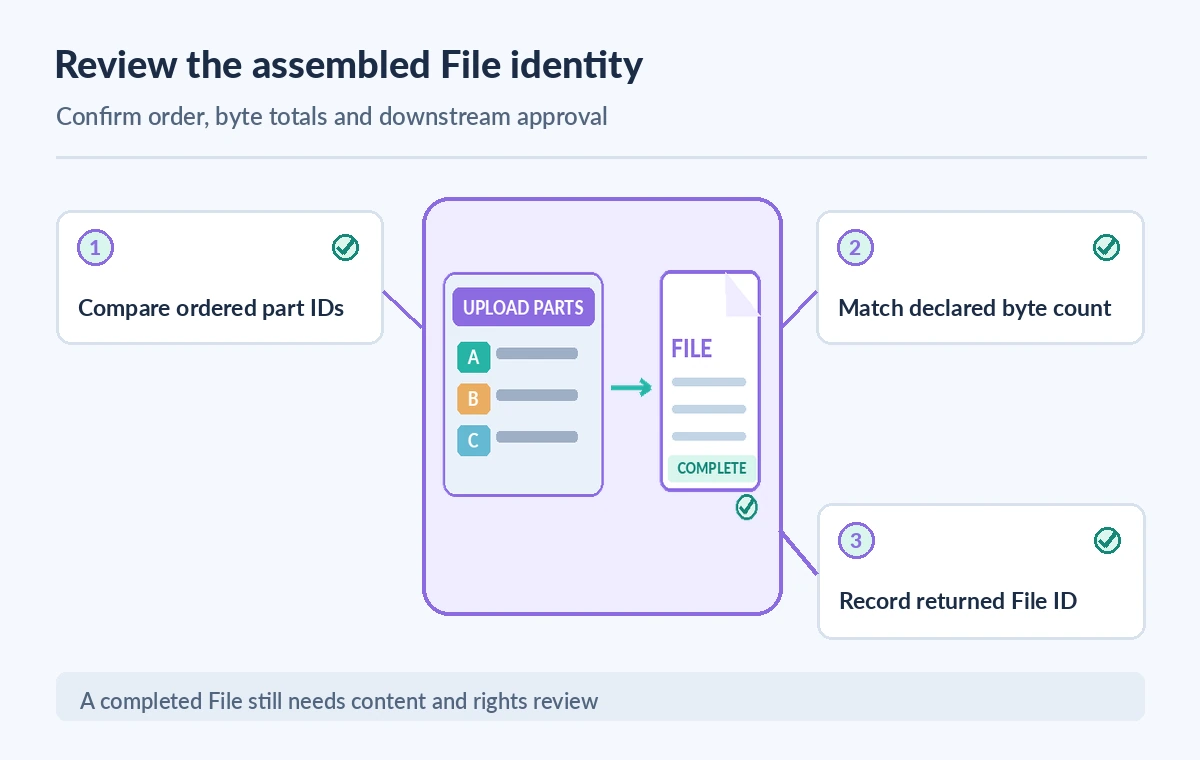
OpenAI says completion accepts an ordered part_ids array and requires the uploaded byte total to equal the number declared during creation. The correct order comes from the original byte-range manifest, not whichever parallel worker happened to respond first. Before completion, compare number of parts, all ordinals, accumulated bytes and any locally recorded hashes. Reject duplicates and missing segments rather than hoping the assembled file can repair itself.
The API also documents an optional md5 value on completion to check expected file contents. That option supplements the local source digest and the final integrity review; do not claim that a checksum establishes rights clearance or that a model has read every page. If completion is ambiguous because the client disconnected, first inspect the recorded response state instead of issuing blind duplicate requests.

Inspect the returned File object before analysis
A completed Upload has status completed and a nested File object ready to use elsewhere on the platform. Store the File ID separately from the Upload ID and confirm the purpose, filename and available size fields. The API response is evidence of assembly, not a semantic validation of accession dates, correct OCR or completeness of an exhibit narrative.
Use the source digest and export manifest to support independent integrity checks where permitted. If the downstream feature rejects the File for its purpose or format, that is a separate validation outcome. Display upload assembled, file accepted for processing and editorially approved as different statuses so a green transport state cannot accidentally release visitor-facing copy.
Compare three failure and success states
In the first schematic state, the same parts are listed out of order, creating a content-integrity hazard even if every network transfer succeeded. In the second, the parts exist but the intermediate Upload has not been completed; there is no File ID to hand to a downstream system. In the third, ordered IDs and declared bytes match and the completed response provides a File reference.
These are conceptual API states, not screenshots or results from a live account. The third state should be marked ready for downstream validation, not published or fact checked. The corresponding illustration makes the gap visible between correct file assembly and approving the claims contained in that file.
Handle cancellation, timeouts and provenance
The API provides a cancel operation for an incomplete Upload. A cancellation or expiration should be distinguished from deleting a previously completed File. If the source itself is withdrawn, review any File objects, downstream resources and other copies separately under your organization’s policy rather than assuming cancellation is a global erasure switch.
For ambiguous network failures, record the last confirmed operation and avoid restarting from an unverified state. A new upload may be required, but it should have a new internal attempt ID tied to the same approved export. This prevents an apparently successful restart from mixing different catalog revisions or leaving untracked temporary copies.
Use a source-first release checklist
Before a downstream AI-assisted catalog task begins, have a reviewer confirm the derivative is authorized, the source revision is frozen, the MIME and purpose are supported, ordered part IDs are complete, bytes reconcile and the response contains the expected File ID. After analysis, compare any public claim with the authoritative catalog and verify that references to protected collection material are handled appropriately.
This guide describes the published API contract and a fictional museum workflow. We did not upload real files, validate an account, measure throughput or test any deletion SLA. Product limits and allowed file purposes may change. Recheck official API references and internal processing approvals before using an Upload in production.
How We Research
For this November 11, 2026 desk review we compared authoritative documentation: OpenAI Create Upload API; OpenAI Add Upload Part API; OpenAI Complete Upload API; OpenAI Cancel Upload API. We reviewed the named field definitions, failure paths, and operational limits against a fictional museum workflow, and drew original conceptual illustrations. We did not run API requests, inspect customer accounts, measure service performance, approve any copyright license, or verify live collection data. Documentation, plan availability, security settings and preview status can change; confirm the current service reference and your organization’s legal and editorial policies before production use.
Frequently Asked Questions
No. A Part belongs to an intermediate Upload; the documented complete operation assembles Parts and returns a nested File object.
Yes. Complete uses an ordered list of Part IDs. Build that list from the original byte stream, not parallel worker response times.
The API states that bytes uploaded on completion must match the number specified when the Upload was created; reconcile locally before completing.
No. OpenAI documents a one-hour lifetime for the intermediate Upload. A finished File has its own separate lifecycle rules.
No. Transport assembly does not verify OCR, accession references, permission to process material or editorial correctness.