
Disclosure: LabFin is reader-supported. If you sign up for a tool through links on this page, we may earn a commission at no extra cost to you. Commissions vary between providers and our ratings do not — here’s our full disclosure.
ChatGPT for writing looks different in 2026. OpenAI retired canvas on May 28 and moved drafting into editable writing blocks inside the chat. The bigger difference is less visible: the model behind those blocks depends on your plan. For more, our page on prompt frameworks that actually help covers what the Wharton tests found about personas and step-by-step prompts.
Free and Go users write with GPT-5.6 Luna, a model family that placed 86th of 407 on Arena’s creative-writing board in September. Plus users get GPT-5.6 Sol, and the newest models reach Plus only in separate Work and Codex modes. This guide covers what ChatGPT does for writers, where it runs short, and what happens to your drafts. Our page on ChatGPT vs Jasper covers a general assistant against a marketing platform, data terms included.
ChatGPT for Writing: The Short Answer
For everyday writing on a paid plan, ChatGPT does the job. Plus at $20 a month gives you GPT-5.6 Sol at up to High effort and a full-screen editor for essays, reports and blog posts. The Free plan works for short emails and posts, but its model sits far down the independent creative-writing board.
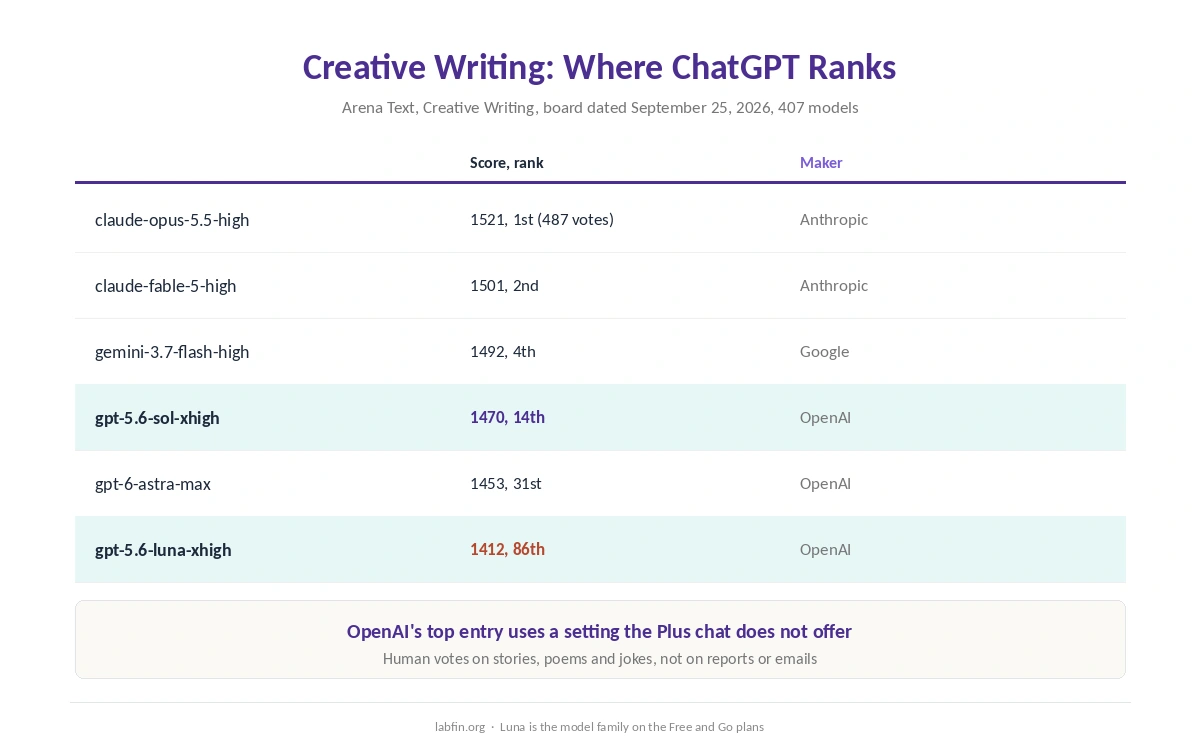
For fiction and voice-heavy work, check the boards first. On Arena’s creative-writing ranking of September 25, 2026, models from Anthropic took the top two places. OpenAI’s best entry came 14th, at a setting Plus users cannot select. Whatever you write, your drafts train OpenAI’s models on personal plans until you turn that off.
What ChatGPT Offers Writers Now
Canvas is gone. OpenAI’s release notes of May 28, 2026 say canvas is no longer available in GPT-5.5 Instant or GPT-5.5 Thinking. Writing now happens in chat through writing blocks. Many guides still describe canvas shortcuts that no longer exist.
Writing blocks are editable areas for drafts such as emails, posts and documents, according to OpenAI’s Help Center. They support common formatting, and your edits save with the conversation. Since June 8, 2026, longer pieces such as essays, reports and blog posts can open in a full-screen editor. Our ChatGPT vs Gemini for writing comparison also weighs price and data terms.
Beyond the editor, the tools that matter to writers are the general ones, such as file uploads for source material. Uploads are capped on Free, and the limits for other features by plan appear in our ChatGPT review.
Which Model You Write With, by Plan
The plan decides the model, and the model shapes the prose. OpenAI’s Help Center, updated September 29, 2026, puts Free and Go on GPT-5.6 Luna. Plus gets GPT-5.6 Sol at Instant, Medium and High effort, with no Extra High option in chat. Pro gets GPT-6 Pro in chat, with weekly limits.
Newer models sit outside the main chat on Plus. GPT-6 Astra is available there only in ChatGPT Work and Codex. OpenAI released GPT-6.1 Sol on September 29, 2026, again for Work and Codex, and says it is not yet available in chat. Our Grammarly vs ChatGPT for editing comparison covers which fits which job.
Context matters for long drafts. Free holds 27K tokens in a conversation, Go and Plus hold 54K in Instant mode and 256K with reasoning, and Pro holds 128K and 400K. A long manuscript can exceed the smaller windows, so paste it in parts or summarize earlier chapters as you go.
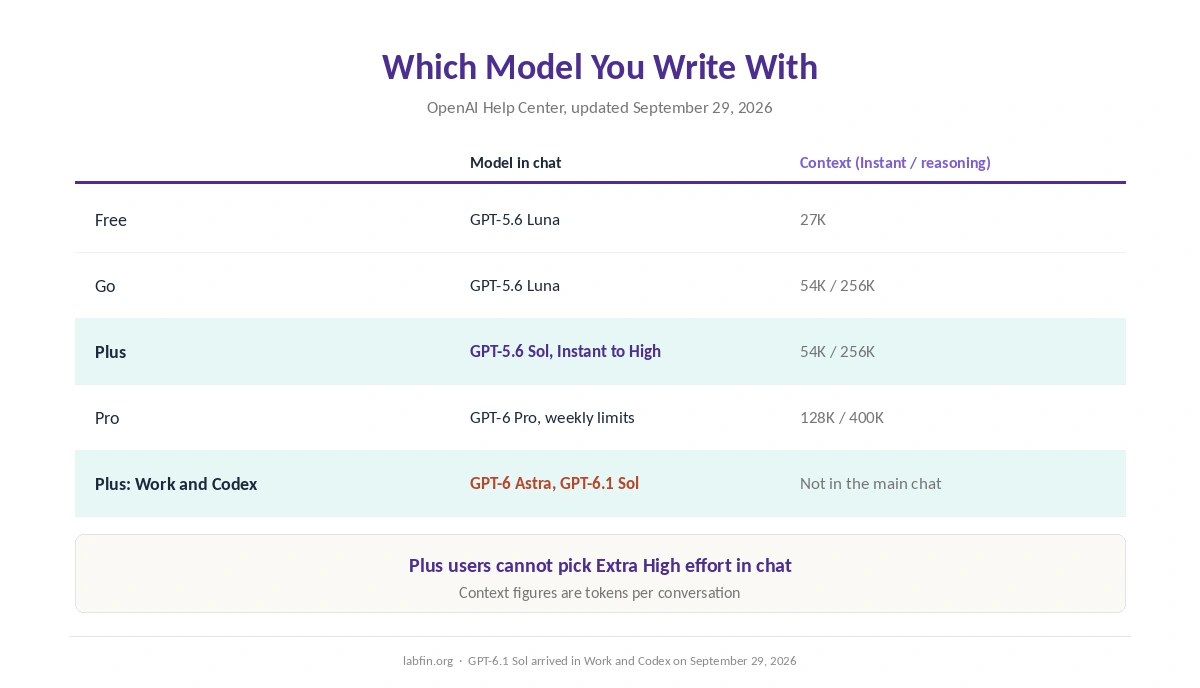
| Plan | Price (US) | Writing model and context |
|---|---|---|
| Free | $0 | GPT-5.6 Luna; 27K context; ads may appear |
| Go | $8/mo | GPT-5.6 Luna; 54K context; may include ads |
| Plus | $20/mo | GPT-5.6 Sol, Instant to High; 54K / 256K context |
| Pro | From $100/mo | GPT-6 Pro in chat, weekly limits; 128K / 400K context |
| Business Standard | $25/user/mo | No training on your data by default |
How ChatGPT’s Writing Ranks on Independent Boards
ChatGPT trails Anthropic and Google on Arena’s creative-writing board. The board, dated September 25, 2026, ranks 407 models by blind human votes on creative prompts such as stories, poems and jokes. Anthropic’s claude-opus-5.5-high sits first at 1521, though on only 487 votes, and claude-fable-5-high second at 1501.
OpenAI’s best entry, gpt-5.6-sol-xhigh, placed 14th at 1470. That Extra High setting is not in the Plus chat, which stops at High. GPT-6 Astra at maximum effort placed 31st, and gpt-5.6-luna-xhigh, from the model family on Free and Go, placed 86th at 1412.
⚠️ These ranks measure creative prompts, not reports or emails. No independent board we found ranks business writing by ChatGPT plan. Treat the gap as a signal for fiction and voice, not as a verdict on everyday drafting.
Your Drafts: Training, Ownership and Disclosure
On personal plans, your drafts train OpenAI’s models by default. That covers Free, Go, Plus and Pro until you opt out in Data controls. Rating a response can still send the whole chat for training after you opt out. Temporary Chat stays out of training, though OpenAI keeps a copy for up to 30 days.
OpenAI’s Terms of Use, effective January 1, 2026, say you own the output and assign you OpenAI’s rights in it, if any. The same terms warn that output may not be unique, since other users can receive similar text. They also bar you from representing output as human-generated when it was not.
Ownership under the terms is not the same as copyright. In January 2025, the US Copyright Office concluded that prompts alone do not make you the author of AI output. Your own writing, and your creative selection, arrangement or editing of AI text, can still be protected. This is not legal advice, so ask a lawyer about publishing contracts.
Where ChatGPT Runs Short for Writers
OpenAI does not publish a number for Plus thinking limits, so you cannot plan heavy drafting days around a known cap. Free and Go may show ads in OpenAI’s test regions, and Go costs $8 a month in the US. Pro starts at $100 a month and still has weekly limits on GPT-6 Pro.
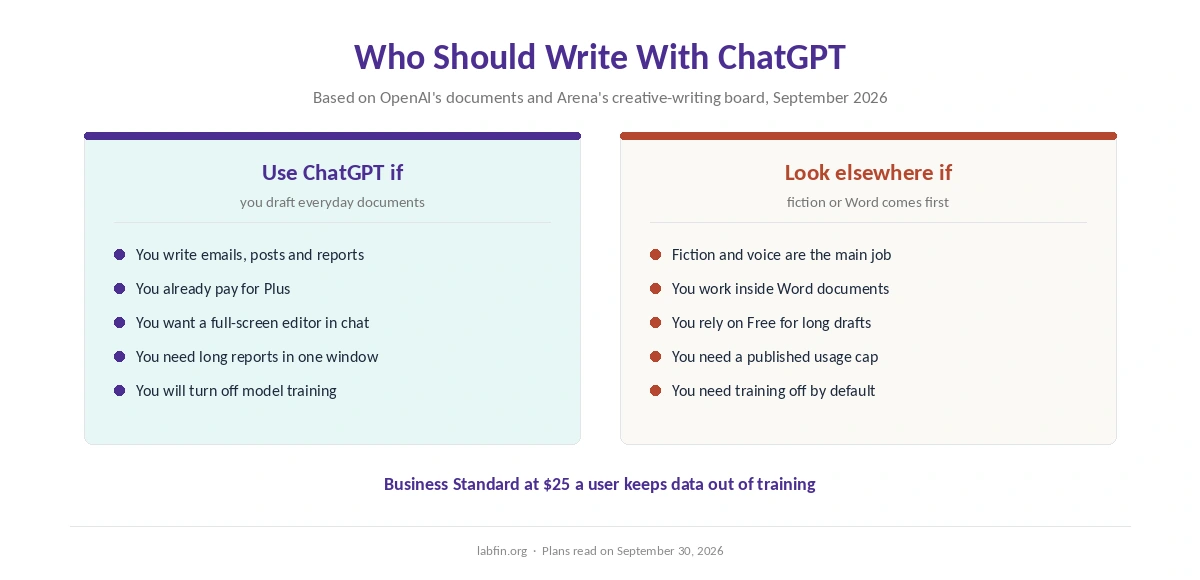
For teams, Business Standard at $25 a user a month keeps data out of training by default. That matters when drafts include client material or unpublished work.
Who Should Use ChatGPT for Writing, and What to Use Instead
ChatGPT suits writers who draft many short and mid-length pieces, such as emails, posts, reports and outlines. It suits those who already pay for Plus most, since the full-screen editor handles long documents and the 256K reasoning window holds a long report.
It suits fiction writers less. Anthropic’s models lead the creative-writing board, as our Claude review details. If you write in Word, Copilot works inside the document, as our Microsoft Copilot review explains. Claude’s consumer plans also train on chats unless you switch that off, so the opt-out matters wherever you write.
How We Research
This guide draws on OpenAI’s own documents, read on September 30, 2026. They include its release notes, the writing blocks article and its Terms of Use. Rankings come from Arena’s creative-writing board of September 25, 2026.
The copyright position comes from the US Copyright Office report of January 2025. We do not run our own writing tests or show sample outputs, since those would age with every model update. Our criteria live on our about page.
ChatGPT for Writing FAQ
For everyday drafting on a paid plan, yes. On Arena’s creative-writing board of September 2026, though, OpenAI’s top entry placed 14th, behind models from Anthropic and Google.
OpenAI removed canvas from its main models on May 28, 2026. Drafting now happens in writing blocks, which can open in a full-screen editor for longer pieces.
Plus at $20 a month gives you GPT-5.6 Sol and a 256K reasoning window. Free and Go use GPT-5.6 Luna with smaller context windows, and both may show ads.
OpenAI’s terms say you own the output and assign you its rights, if any. The US Copyright Office says prompts alone do not make you the author, so copyright covers your own edits and arrangement.
On Free, Go, Plus and Pro, yes, by default. Turn it off in Data controls, or use Temporary Chat, which stays out of training.
The Verdict
ChatGPT for writing makes sense on Plus, for everyday drafting more than fiction. Writing blocks and the full-screen editor cover most document work, and Plus unlocks GPT-5.6 Sol. On the independent creative-writing board, though, OpenAI’s models trail Anthropic’s and Google’s.
Before you paste a manuscript, turn off model training, and keep your own edits visible in the final text. If fiction is the main job, compare Claude’s plans first. Our page on ChatGPT for marketing covers ChatGPT’s ad platform and the FTC and EU rules on AI content.