
An oral-history archive has permission to preserve recorded interviews, but not to publish every address, personal diagnosis or telephone number spoken in them. Deepgram can redact recognized sensitive entities from a transcript, yet the underlying recording, permissions and contextual clues remain separate concerns. This guide follows an invented interview fragment through transcription, review and editorial approval; it does not claim an actual recording was processed or that automatic redaction guarantees anonymity.
Read the release agreement before choosing redaction
Preservation consent, transcription consent and public distribution rights may differ. Check the interview agreement and any donor restrictions before sending audio to a hosted processor or sharing a derivative transcript. Determine whether the participant authorized publication of their name, whether third parties are discussed, and whether sensitive passages need to be withheld entirely instead of mechanically masked.
Write a release specification that identifies the approved audience, the transcript version and the permitted excerpt boundaries. A redacted text file should not be generated simply because a researcher asks for one. Keep the master recording under its existing access controls, and avoid feeding restricted material to external tools without an authorized data-processing assessment.
Understand exactly what redact changes
Deepgram describes a `redact` parameter for transcription that replaces recognized sensitive entities in returned transcript text. Number redaction and entity redaction have different behavior. Entity groups include PII, PCI and PHI; entity-based options are documented for English, and language support must be checked for the chosen recording and model. Do not assume the same categories work on every language or streaming mode.
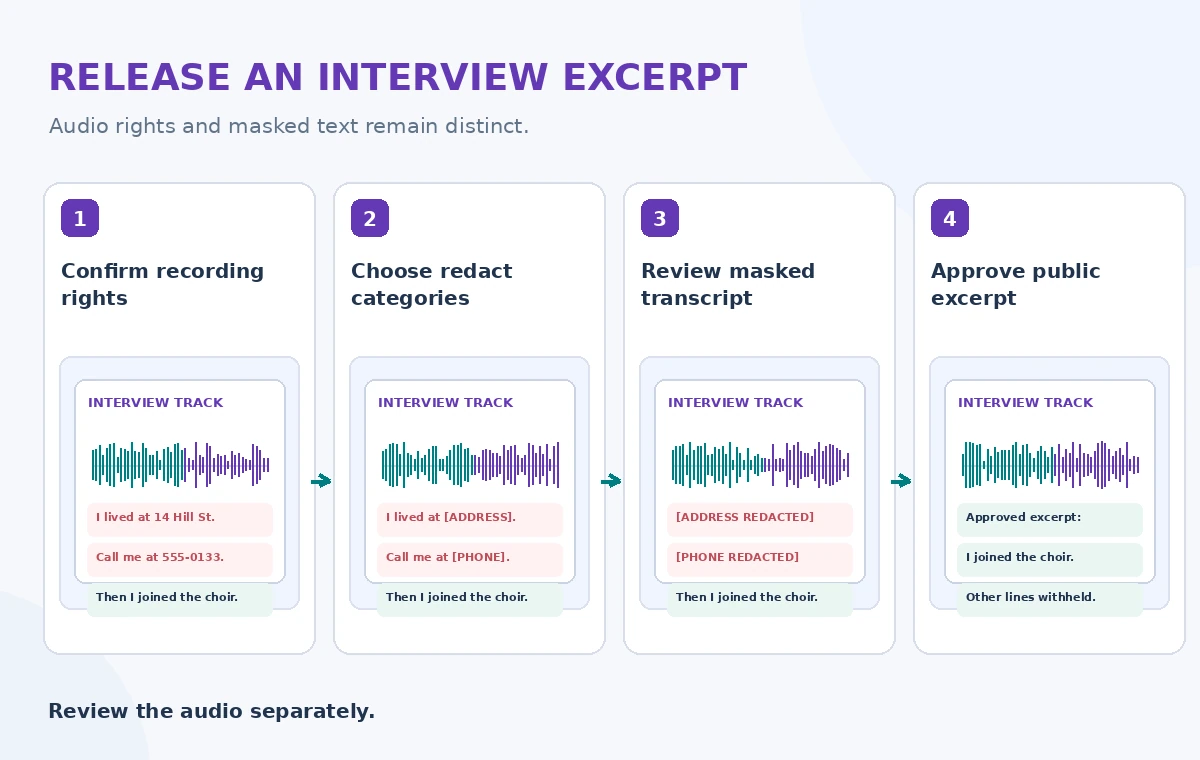
For a hypothetical account number, a broad numbers rule may remove useful dates or catalog numbers as well as private identifiers. For a personal name, entity redaction can hide context that historians need to interpret carefully. Choose a documented group according to the release purpose, then inspect output for both harmful omissions and dangerous misses. The correct choice is not automatically the most aggressive setting.
Call the supported transcription endpoint carefully
On the documented `/listen` endpoint, redaction options can be passed through the `redact` query parameter, including repeated values for multiple groups. Verify model, language, channel handling, format and regional data requirements in the current API reference. Keep API credentials outside application logs and do not put interviewee names in arbitrary request tags.
Use a protected test file with fictional or appropriately authorized content to verify how the response is structured. Store the request identifier and processing configuration in a restricted job record, not in the public excerpt. A network error or a missing redaction result must not cause the pipeline to fall back to publishing an unmasked transcript. Explicitly separate “processed successfully” from “approved for release.”
Preserve distinctions between text, audio and metadata
A masked transcript does not erase a spoken address from the original waveform. If your publication includes an audio clip, that clip needs its own review and potentially an edit or omission. Redaction also does not automatically remove personal details from filenames, captions, collection descriptions or exported metadata. Protect these layers independently.
Deepgram also documents `redact_usage=true`, which masks certain text values supplied as request parameters in usage records. It is separate from transcript redaction and separate from settings governing model improvement. Review each control individually. Avoid placing sensitive strings in tags or callback URLs, since the documented usage-record protection does not simply conceal every parameter.
Compare transcript states without promising anonymity
The comparison illustration follows one fabricated sentence: a raw sensitive fragment, an entity-masked transcript, and a narrower excerpt approved for public distribution. The last state removes unrelated biographical context rather than pretending that bracketed masks alone make the speaker unidentifiable. These are illustrative representations, not actual Deepgram outputs or accuracy measurements.
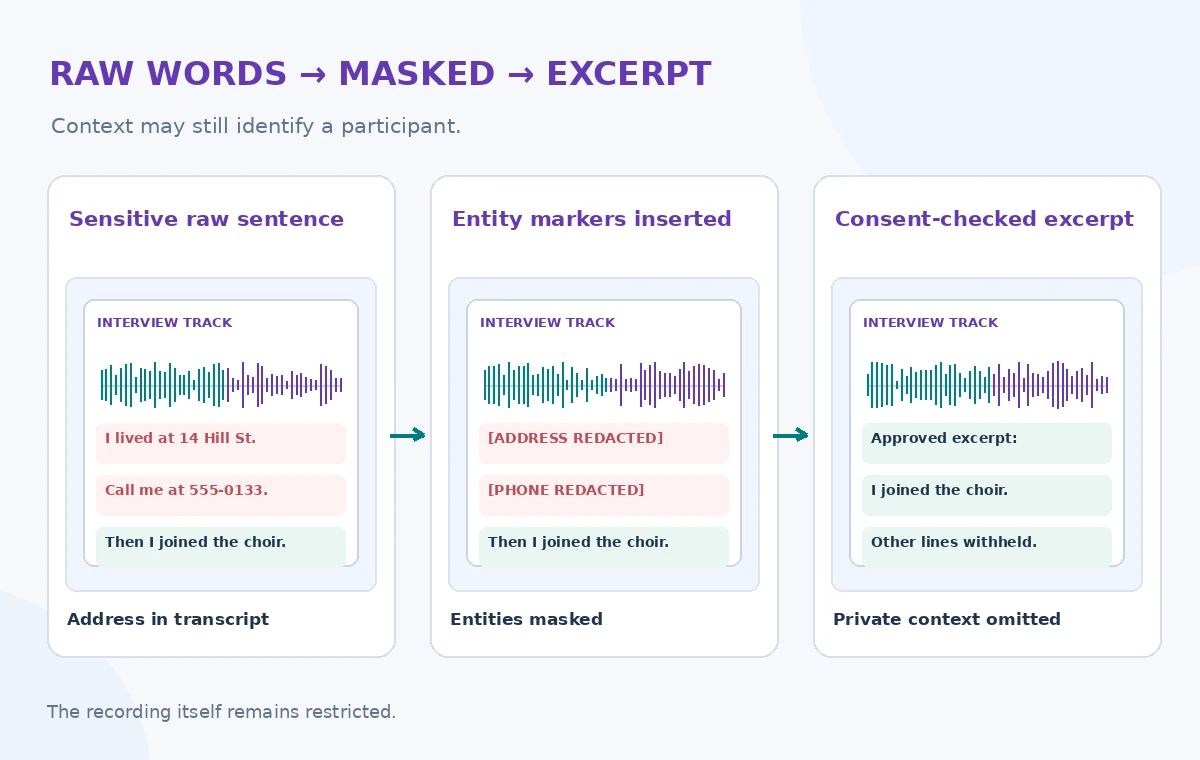
Consider indirect identifiers. An interview may mention a unique event, workplace or relative that reveals the person even after explicit names are removed. A trained reviewer should examine the paragraph around each mask and evaluate whether context should be paraphrased, restricted or withheld. Keep a versioned explanation of editorial omissions where the release agreement permits it.
Review missed sensitive information by listening
Use an authorized reviewer to listen to the relevant audio segment while checking the transcript. Proper names, multilingual speech, unusual phone-number phrasing and long account strings can defeat automatic classification. Inspect both false negatives and false positives: masking a museum accession number as a personal identifier can damage historical meaning, while leaving an actual address can compromise privacy.
If you maintain bilingual material, do not assume English-only entity functionality covers the non-English portion. Have competent language reviewers work from the recording, not a machine-translated transcript alone. Test whether multiple audio channels alter the context available to entity recognition, and document any review limitations instead of assigning a made-up completeness score.
Complete a four-part publication audit
Before release, check the audio for missed PII, verify treatment of dates and numbers, confirm access to the original recording is restricted, and inspect job logs and usage metadata. The verification image places these four checks beside an interview timeline. A final transcript cannot be cleared merely because a dashboard reports that redaction ran.
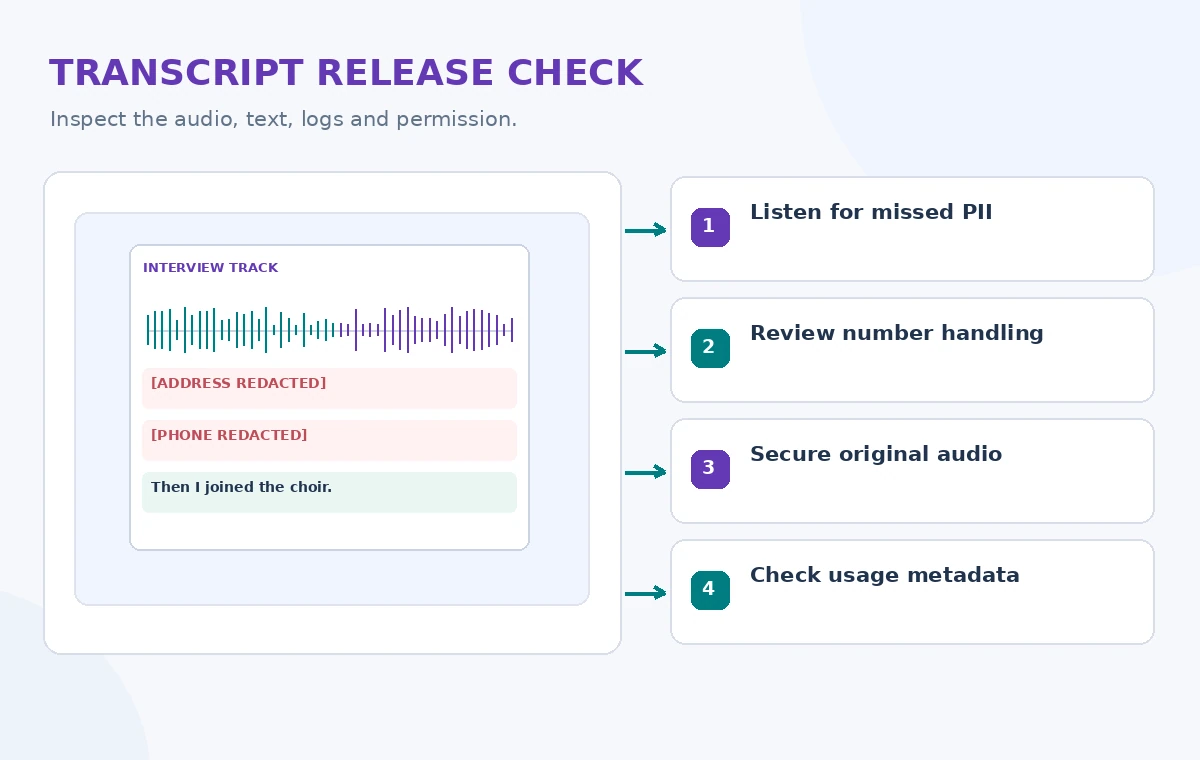
Review every derivative that will become public: subtitles, quote cards, PDFs, show notes and web snippets. A concealed name in the full transcript may still appear in a search preview or speaker label. Require approval from the person or office responsible for oral-history rights, and document whether the excerpt has restrictions on quotation or redistribution.
Maintain a revision and withdrawal pathway
Assign a source recording ID, transcript revision, redaction configuration and approver to the release record. If a participant withdraws consent within the governing agreement, identify each derivative to review or remove. Store copies according to retention policy and maintain a clear distinction between preservation masters and public derivatives.
Automatic redaction can reduce routine manual work, but it does not deliver legal clearance, perfect entity recognition or full de-identification. The durable workflow is based on rights review, minimal sharing, checked outputs, protected recordings and a reversible publication decision. Treat every later excerpt as a new release context, not as automatically approved because an earlier file was masked.
How We Research
For this November 2026 editorial review, we consulted official vendor references: Deepgram redaction guide; Deepgram redact usage guide; Deepgram pre-recorded transcription API. We mapped feature scope, input/output rules, failure conditions and developer guidance to a hypothetical community-service scenario. We did not execute paid API requests, upload private personal data, publish a real catalog record, run a security attack or measure service performance. The diagrams show original educational examples, not screenshots or recorded service results. Documentation, permissions, regional availability and service configuration can change; verify them in the current official reference and an authorized test before deployment.
Frequently Asked Questions
No. It changes recognized entities in transcript output, not the original audio waveform.
No. It masks selected text parameters in usage records and does not change the transcript response.
No. Deepgram documents language limitations, including English-only support for entity-based options.
Not necessarily. Indirect identifiers and contextual clues require human review and appropriate publication permission.
No. They are invented teaching examples, not claimed API results.