
A volunteer archivist records an interview with the host on the left channel and a guest on the right. The archive needs separate, time-aligned text so the speakers’ statements are not accidentally merged. Deepgram’s pre-recorded API supports multichannel=true to transcribe each audio channel independently. But a channel is an audio signal path, not a verified human identity: a guest can lean into the wrong mic, and more than one person may appear on a channel. This guide keeps the sound source and speaker review distinct.
Confirm the input really has separate voices
Before using a speech API, inspect the recording project or exported WAV to determine the number of channels and what each channel contains. A stereo file can hold two distinct microphones, a conventional spatial stereo mix or duplicated mono audio. Only the first arrangement makes channel-based speaker separation meaningful. Record the interview’s mic layout, recorder settings, date, file checksum and consent status in the archive intake sheet.
Listen to several moments from both channels: opening introductions, overlapping speech and interruptions. A host may bleed into the guest mic, and a dropped microphone can leave one channel silent for part of the interview. Keep the unmodified master so transcription settings can be revisited later. The fictitious waveforms shown here represent concepts rather than waveforms measured from an actual recorded interview.
Understand what multichannel=true does
Deepgram’s pre-recorded listen endpoint documents multichannel as a boolean option that transcribes each audio channel independently. Inspect the returned results.channels array rather than treating the response as one undifferentiated string. Preserve the channel index together with each returned word, utterance or transcript segment when creating your catalog data model. Do not force channel 0 to mean ‘interviewer’ before confirming the actual input wiring.
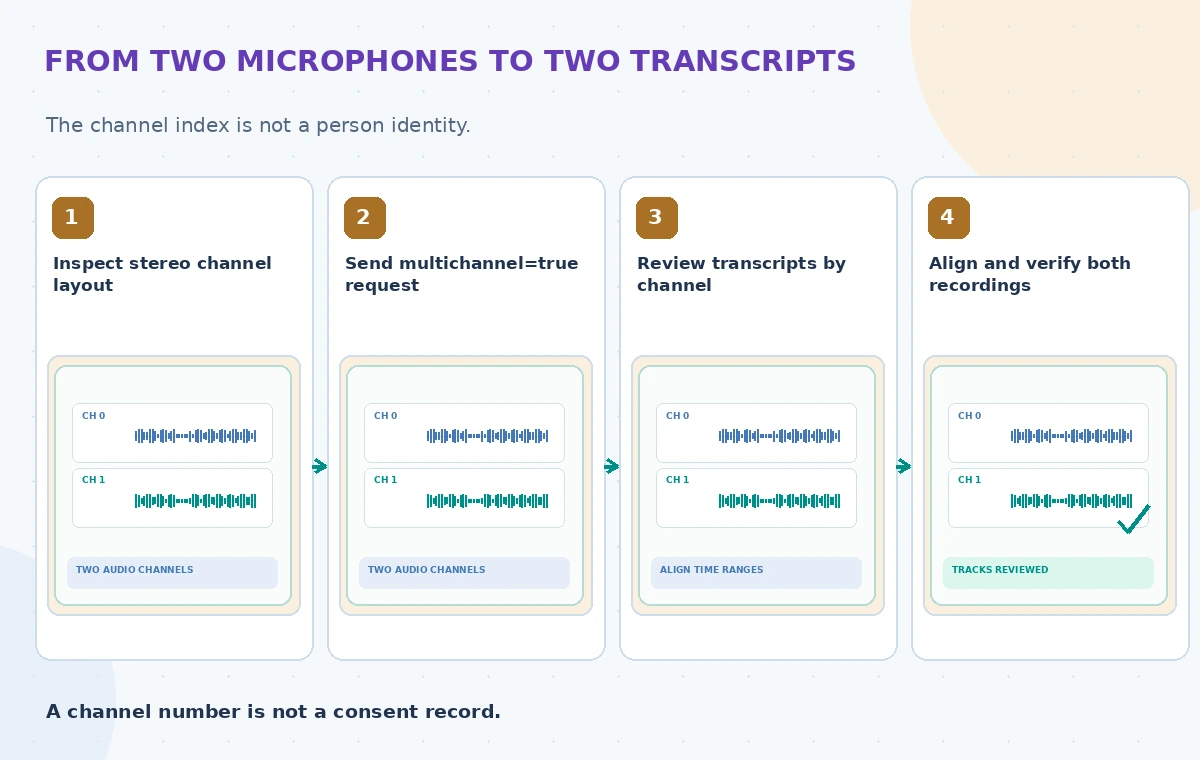
Keep a stable channel map in separate editorial metadata: channel 0 can be ‘left mic, presumed host,’ while channel 1 is ‘right mic, presumed guest’ until verified. If the team uploads a mono mix, no setting can reconstruct a reliable original microphone split. Model choice, language options, audio formats and processing costs should be confirmed against the current Deepgram documentation before processing restricted material.
Distinguish physical channels from diarized speakers
Multichannel analysis separates signal paths; speaker diarization estimates changes between voices. They solve different problems. One channel can contain two speakers, and one person’s voice can appear across multiple channels through cross-talk. A user interface that assigns one immutable person to every channel can therefore create misattributed quotations, even if the transcript words are accurate.
If further speaker attribution is needed, consult the current Deepgram diarization model documentation and test on representative audio. Do not rely on an old example using diarize=true without checking current parameter guidance. Maintain a human-editable attribution table for segments whose speaker remains uncertain. An automated speaker number is not a name, consent record or proof that a person said a disputed statement.
Align times without merging voices prematurely
Keep start and end times relative to the original recording for each channel. Build a combined listening view sorted by timestamp, but preserve channel identity in the backing data. When two people talk simultaneously, the archive should allow two overlapping segments instead of deleting one. Simple sequential concatenation can make it look as though an answer followed a question when both occurred at once.
For a hypothetical exchange, the host asks about a flood while the guest begins replying before the question ends. Show both audio lines side by side and indicate their overlap. If a channel drifts or was edited independently, reconcile it with the original master before aligning transcripts. The final transcript should identify editorial synchronization assumptions, not silently stretch timestamps to look clean.
Compare mixed speech, raw channels and reviewed attribution
The first state shows a mono mix where two voices compete in one waveform and channel provenance is unavailable. The intermediate state shows two channel transcripts but with arbitrary speaker names assigned directly from channel numbers. The reviewed state displays the separate tracks with verified mic assignments and visible uncertainty flags at overlapping sections. These are diagrams of a recommended method, not before-and-after Deepgram accuracy evidence.
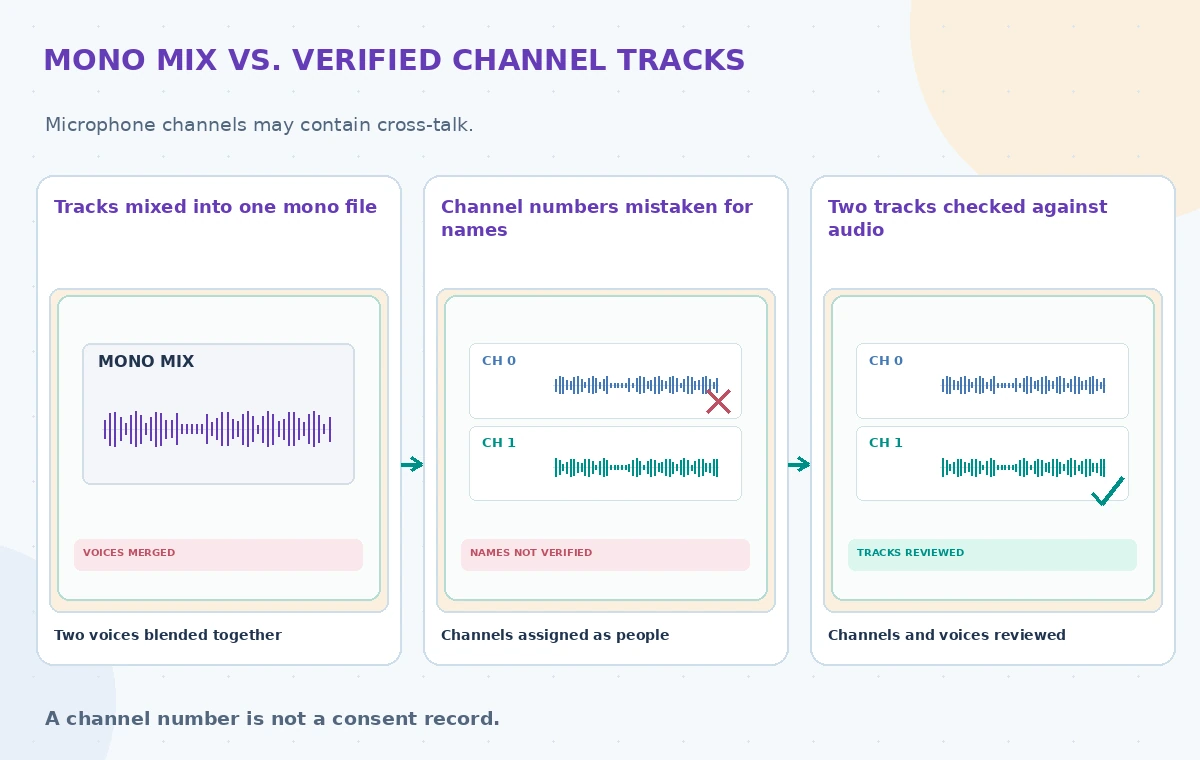
Make the distinction visible to readers: two channels can simplify review, but accuracy depends on recording quality, model behavior and human verification. Do not invent an improvement percentage or claim the API proves identities. If one channel contains a visitor speaking unexpectedly, keep ‘unknown speaker’ until the archive’s source evidence supports a label.
Review names, safety remarks and sensitive details
Listen to every passage with a contested name, date, quotation or safety-relevant claim. Compare the words, channel assignment and time range with the recording. Automated formatting or redaction can change how an utterance appears, so keep an untouched transcript revision alongside a release version. For oral histories, hesitation, laughter and interruptions may carry meaning and should not be casually edited away.
Apply the collection’s consent conditions before distributing either channel separately: a private aside recorded on an open mic may be audible even if the speaker did not intend it for publication. Remove personal contact information from public copies only through an approved editorial process, and maintain restricted masters according to retention requirements. Channel separation is not privacy protection by itself.
Construct a two-track regression fixture
Prepare permitted sample audio with clean turn-taking, strong overlap, bleed, a swapped left-right export, a short silence on one channel and a third voice near a mic. Define expected channel mappings and disputed segments in advance. Review the resulting channel array and timing for each scenario, noting which errors are caused by the recording rather than the transcription service.
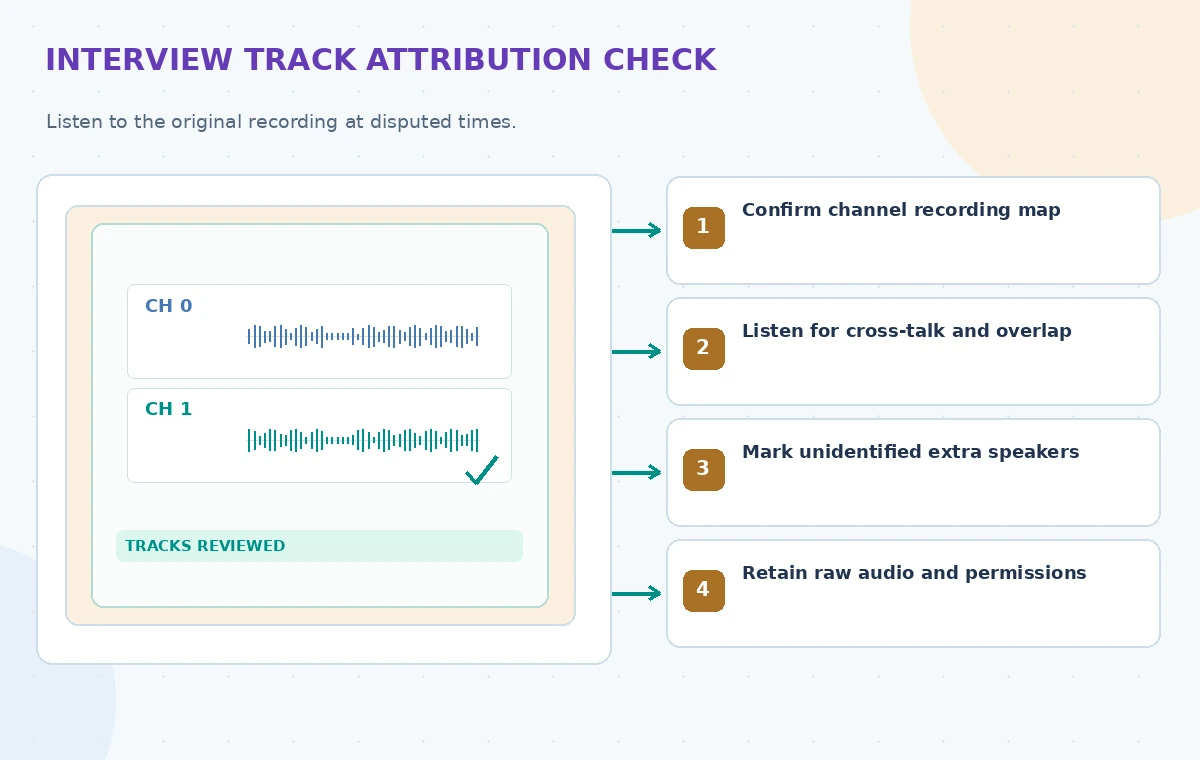
Check a failure where both tracks contain a copy of the same microphone feed. If the interface displays two identical transcripts as two people, that is an intake problem. Also test the upload path for wrong codec or channel count. Preserve request parameters, file hashes and model version for reproducibility. This guide reports no live test results or empirical Deepgram error rate.
Publish the quote with source and channel provenance
An archive-ready transcript should include an asset ID, channel label, verified speaker where known, word timing, transcription revision, reviewer and release status. Display two simultaneous turns without forcing them into false sequence. Where consent allows audio publication, let readers jump from a quotation to its original time position. Do not treat the transcript as a legal attestation of authorship or identity.
Recheck Deepgram model support, per-feature options and billing at the time of use. Keep human review mandatory for quotations, names and uncertain voices. The useful outcome is not a magically separated conversation but a transparent connection between each sentence, the correct signal path and the original sound.
How We Research
We researched this November 2026 article from named official documentation: Deepgram: Pre-recorded audio API; Deepgram: Media input settings; Deepgram: Multichannel versus diarization. We compared documented request parameters and operational limitations with a hypothetical community organization use case, then designed independent human review and regression checks. Images are original fictional educational diagrams, not product screenshots, actual measured benchmark charts or verified customer cases. We did not submit live API requests, upload personal files, process museum assets or measure vendor accuracy. Implementers must verify current endpoint versions, access controls, region support, pricing and retention before deployment. Factual and rights-sensitive results require review of primary sources.
Frequently Asked Questions
No. It transcribes channels separately. Identity must be confirmed from recording notes and the audio.
Channel processing alone cannot separate them reliably; review the audio and consider diarization where appropriate.
No. Channel separation requires actual source channels with distinct signal content.
Yes. Preserve overlapping ranges instead of inventing a sequential conversation.
Yes, subject to consent and retention rules. The master is essential for checking disputed passages.