
Define phrase search as a finding aid, not proof
A local historian needs to locate the phrase “the north bridge” in a recorded oral-history interview. Reading a full transcript may be slow, but a Deepgram pre-recorded audio request can include the `search` parameter to report candidate matches with timestamps and supporting snippets. A match is an invitation to listen, not evidence that a speaker referred to a particular bridge or granted permission to quote the recording. Context, uncertainty, recording quality, and rights restrictions remain part of the archival task.
Use a fictional interview with two similar expressions: “the north bridge” and “the old bridge.” Preserve the original media, the consent record, and a stable recording ID before any third-party upload. Ask the rights custodian whether that material may be processed by a cloud service and shared with the researchers who will see results. The educational diagrams in this article illustrate a hypothetical sequence; they are not a real Deepgram response or a measured retrieval benchmark.
Submit a pre-recorded request with a specific query
Deepgram’s documented pre-recorded Listen endpoint accepts audio or a remote URL and exposes the `search` option. Supply the exact word or multi-word phrase that the researcher wants to locate. Keep the chosen model, language, and request parameters with the result so later reviewers can reproduce the attempt where supported. Do not confuse a search query with keyterm prompting: the latter aims to influence recognition of terminology, while search is intended to find a phrase in submitted audio.
For a rights-sensitive archive, prefer a controlled upload path and minimize access to the source file. Validate remote URLs and expiry requirements; never give an API a public link to embargoed media just for convenience. Record the query as user input in a protected research log, and avoid logging unrelated interview details in a shared help-desk ticket. Different recordings and model configurations may yield different candidate matches, so maintain source provenance with every request.

Interpret hits, snippets, and timestamps
A search response can report the requested query and candidate hits, including a start time, end time, confidence, and snippet. Those fields make it possible to jump to a likely point in the recording. They do not identify the speaker conclusively or settle a disputed historical fact. A snippet may omit preceding words that negate or qualify the phrase, and a timestamp may place the researcher near a passage rather than describing the full conversational turn.
Display the query above the returned hit list and tie each hit to the recording ID, time range, model configuration, and access level. Keep confidence as an algorithmic signal, not a percentage probability of historical truth. If a hit is returned near another similarly pronounced phrase, the archive should treat both as candidates until the original audio is replayed. Never convert the search hit into a standalone published quotation or metadata claim automatically.
Build a visual comparison that shows false matches
For a teaching example, depict one audio segment in which the speaker says “north bridge,” one in which the speaker says “old bridge,” and a final segment in which the speaker corrects themselves. A model can surface an ambiguous candidate in the middle example even though the exact words differ. The diagram should use different waveforms or labeled time spans to show why a flagged match must be replayed, not copy one result card three times with different background colors.
Present the reviewed state as a staff decision linked to a playable source excerpt and surrounding context. If a phrase was said as a question, memory lapse, or quotation from someone else, preserve that nuance. Use a neutral flag such as “needs listening,” not an unearned “verified” marker for candidate hits. Confidence numbers, if shown in an educational image, must not resemble actual measured output; the safer representation is a qualitative candidate badge.

Check neighboring speech and speaker attribution
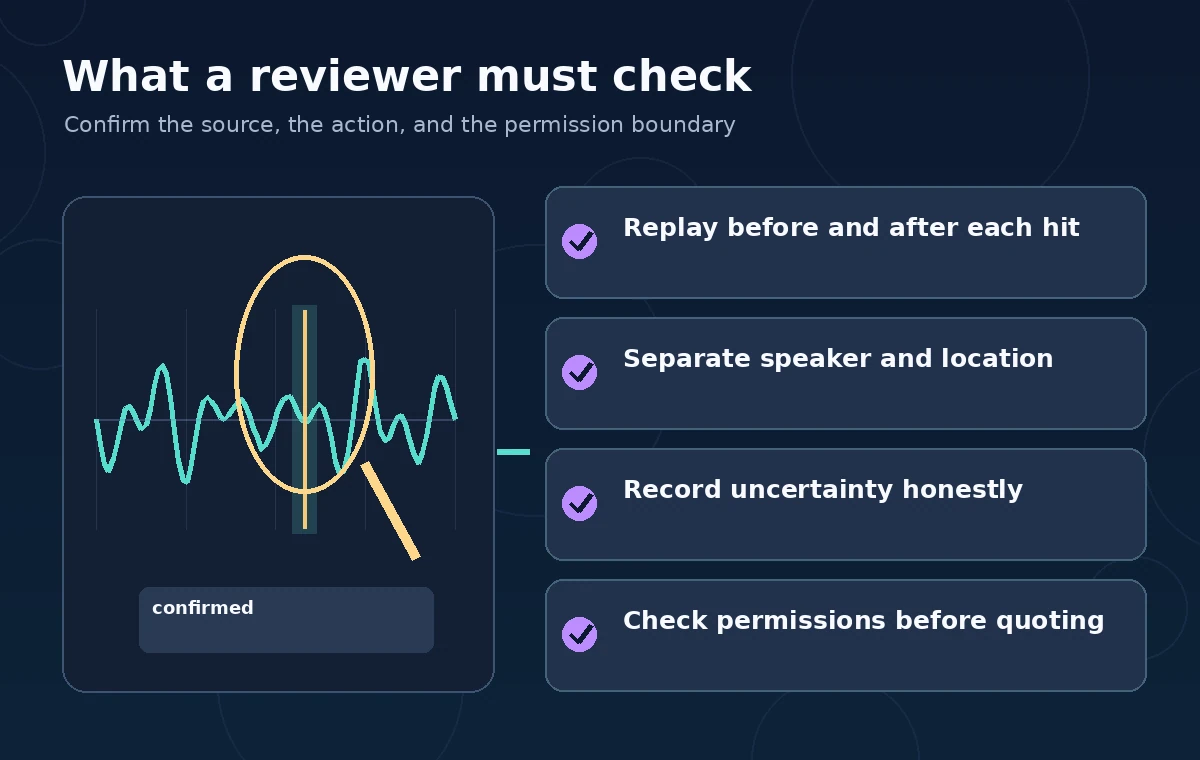
Open audio before and after each candidate hit. The speaker may use sarcasm, repeat a story, interrupt another participant, or say “I never crossed the north bridge.” A search that finds the words cannot infer the historical meaning. When speaker identity matters, the archive should compare known recording metadata and listen to the voices; do not assume that word search includes diarization or establishes identity by itself.
Maintain a review form with fields for exact audible wording, confidence in the human transcription, conversational context, a source timecode, and a decision about whether the passage may be described publicly. A second reviewer should check contested place names or sensitive allegations. If the audio is degraded, record that the phrase could not be confidently confirmed instead of forcing a positive or negative result. A missing hit is not evidence that the speaker never discussed the subject.
Consider omissions, homophones, and recordings with noise
Place names are particularly vulnerable to recognition errors. A word like “North” might be a surname, a cardinal direction, or part of a road name; background music or tape hiss further complicates matching. Search should be one retrieval method among transcript browsing, catalog keywords, and direct listening. If users rely on only a single exact query, they may miss variants, spelling differences, or passages spoken in a different language.
Plan separate queries for documented aliases, but do not use a broad query as a substitute for understanding the research question. Preserve what was searched and record whether a relevant segment was located manually despite no API hit. This gives the archive an honest view of false negatives. Check the provider’s current model and supported-language matrix before interpreting a failure, especially for multilingual oral histories or unusually old audio formats.
Design an evaluation with ground-truth time ranges
A sensible local evaluation set contains consented excerpts with verified target phrases, close-sounding alternatives, negations, and silence. Have human reviewers annotate time ranges independently of the service. Compare whether the service returns an inspectable candidate and whether staff can correctly accept or reject it after listening. Measure missed passages separately from wrong matches and note how much surrounding context reviewers needed to make a decision.
Do not invent retrieval percentages or claim a model “hears” with human certainty. The workflow here supplies a test design and illustrative visual states only. Preserve the difference between audio-search precision and editorial reliability. A service can be useful for locating passages yet still be unsuitable for automatically drafting public historical claims. Evaluate the net benefit in reviewer time only after actual recordings have been tested with permission.
Publish traceable references, not raw hit lists
After human approval, a catalog note may say where a topic was discussed, linking to a permitted clip or timecode and recording identifier. Avoid publishing an embargoed URL, a private speaker’s name, or a speculative quote because the search response contained a plausible hit. Keep raw responses, corrected transcripts, and rights decisions according to the archive’s retention policy, with access separate from the public catalog.
Before production, confirm Deepgram’s current supported models, request limits, storage practices, pricing, and processing permissions. Review the API reference for the `search` parameter again if the integration changes. The durable outcome should be a transparent finding aid: each proposed match can be replayed, assessed against the source, and documented with its uncertainty. Search accelerates discovery; it does not replace the historian or the original recording.
How We Research
For this November 2026 article, we checked named original vendor documentation: Deepgram: Pre-recorded API reference; Deepgram: Pre-recorded audio guide; Deepgram: Keywords versus Search. We compared current documented request and response fields with a fictional institutional workflow and designed review steps that distinguish API outputs from editorial or security approval. The illustrations are original instructional concept diagrams, not real vendor dashboards or measured tests. We did not submit live API requests, ingest personal files, run an actual deployment, collect real user consent or measure vendor accuracy. Product availability, model support, pricing, security settings, retention and regional eligibility may change; implementers must check current sources and organizational policy before processing sensitive materials. All factual claims and permission-sensitive results require independent primary-source review.
Frequently Asked Questions
No. The result identifies a likely time range. The researcher must listen to the original recording and review the surrounding words.
No. Search aims to locate a requested phrase in audio, while keyterm prompting aims to improve recognition of terminology.
No. Noise, speech variation, accents and model errors can cause false negatives; supplementary listening may be required.
No. It is a model signal for a candidate match, not proof of an event, speaker identity or consent to quote.
Include the accessible source recording identifier, reviewed timecode, exact supported wording, rights status and reviewer notes.