
A neighborhood seed bank needs short labels for hundreds of packets, each with an approved variety identifier, known planting instructions and a separate status for facts awaiting horticultural review. Gemini Batch API can process requests asynchronously, but the returned copy must never be attached to the wrong source row. The examples here are invented teaching data, not a claim that Google processed a batch. The useful question is not merely whether a job finished; it is whether each generated paragraph still belongs to the correct variety and preserves uncertainties.
Decide which fields are authoritative before batching
Start with a small record model: packet ID, variety name, source-approved description, geographic adaptation note, planting-depth status and review owner. A field marked ‘unknown’ must remain unknown in the label. Do not ask a language model to calculate planting depth from an appealing photograph or from another packet’s instructions.
Export a frozen input snapshot for this batch, including a source-version identifier and an explicit approval state. A label may be readable and grammatical while still being factually wrong. Attach the editor’s approval to the source record, not to the fact that an API request was accepted.
Choose asynchronous work for the right reason
Google documents Batch API as an asynchronous route for tasks that do not need an immediate response. It supports inline requests and file-based job input. A public website that must answer a visitor right now should use an appropriate interactive route instead of treating a batch job like a live conversation.
Prepare a limited pilot with fictional packet data first. Confirm the model supports the requested input and output shape; availability, processing times, quotas and prices can change. Record the chosen model and request configuration so that an editor can later explain why two batches produced different wording.
Make request keys survive every transformation
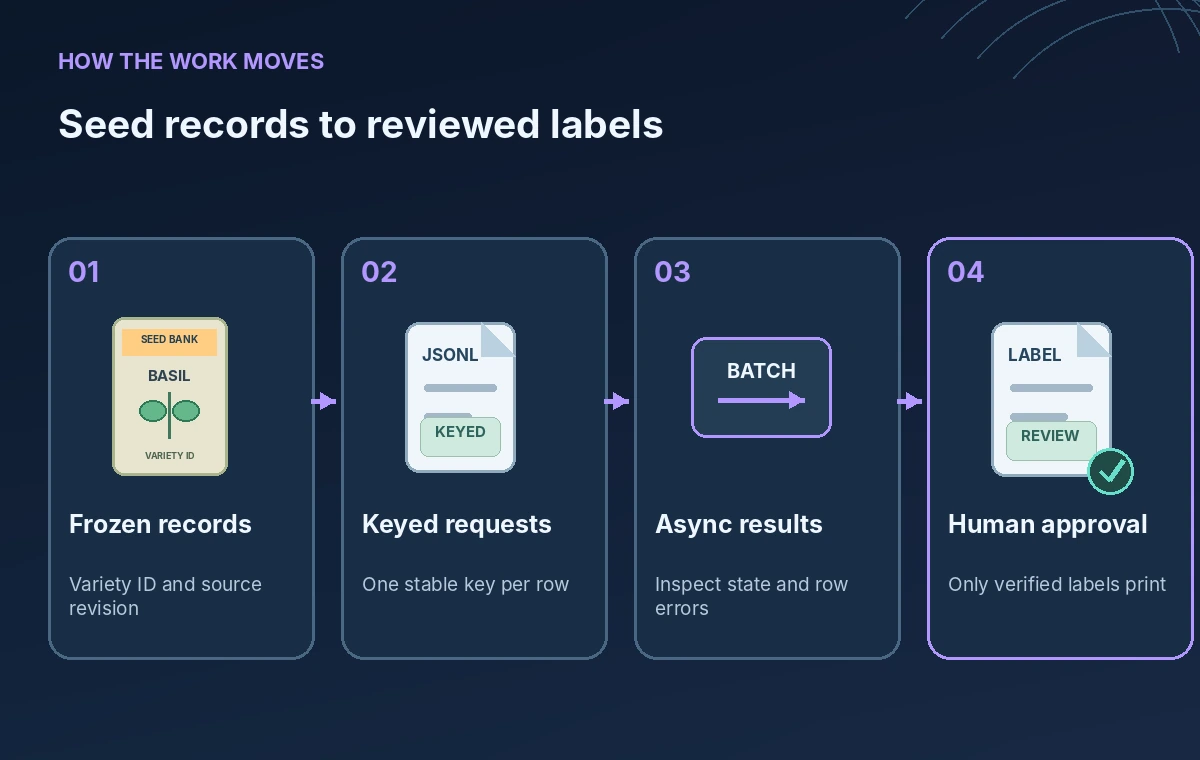
For file jobs, Google’s examples show JSONL entries with a key and request payload. Use a stable packet ID such as ‘SEED-C14’ as the lookup key rather than relying on the position of an output line. Store one source record per key, reject duplicates before upload and save a checksum of the input file.
A request for marigold seeds should not inherit the label meant for basil simply because a worker sorted results differently. Keep source ID, model response, job ID and editorial state as separate fields. If a response omits the expected identifier, stop that row rather than silently guessing its intended target.
Monitor the job state without assuming publication
Treat job creation, active processing, completion, failure and cancellation as distinct lifecycle events. Google documents a batch resource that can be inspected by name. A successful batch lifecycle is only an operational state; it says nothing about horticultural correctness, brand copy or legal approval.
If the job terminates unsuccessfully, preserve its logs and known state. Do not resubmit the whole input automatically while an earlier result may still be recorded by your application. Idempotent import logic should ignore a response already associated with the same approved key and job version.
Compare a mistaken label with a controlled result
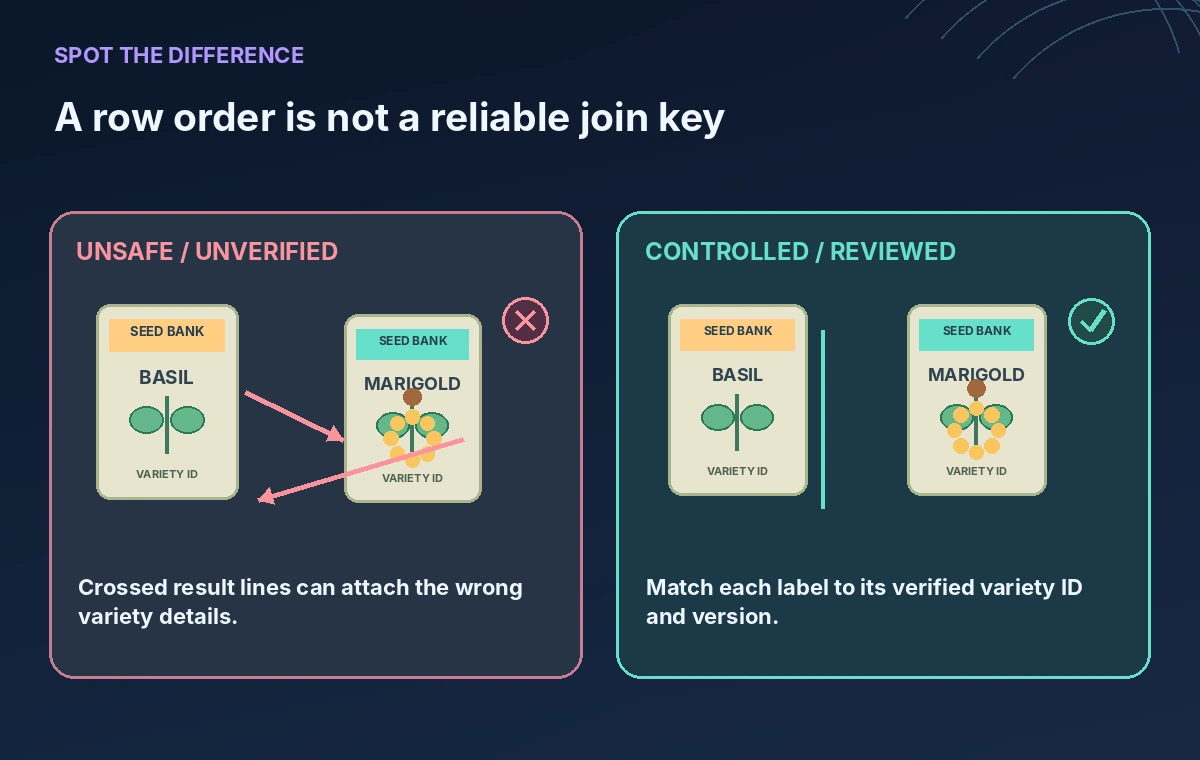
An unsafe merge places a ‘sow one inch deep’ line from one variety next to an unrelated packet whose depth remains unverified. A safer comparison shows three separate rows: the approved source data, the generated draft and the editor’s decision. An empty generated claim is not a reason to fill a missing fact from a neighboring packet.
Use a diff view that emphasizes variety ID, numerical values, units and negations. Review batches by sampling common cases and deliberately inspecting rare cases with missing fields. For gardening information, the release reviewer should follow the seed supplier’s actual guidance rather than blindly trusting natural-language fluency.
Handle partial results and individual failures
Every output row should be classified independently: accepted for review, needs repair, invalid key or failed response. It is possible for one row to be unusable even though the job is otherwise finished. Design a retry queue containing only unresolved keys, and keep a clear link to the earlier attempt.
Do not delete evidence of a failed attempt to make the dashboard look clean. A seed bank might receive a new cultivar description after the original job; in that case, increment the source version and create a new draft rather than pretending that the old batch used the updated source.
Build a release ledger with clear ownership

A practical ledger might have columns for packet ID, source revision, draft content, reviewer, approval time and release location. Put the illustration of these states beside the actual article instructions so readers understand which step changes publication status. An API return is never the approval event.
Check that a change to one label cannot shift all later labels in a CSV export. Verify with a deliberately shuffled output fixture, a missing-response fixture and a repeated-key fixture. Those tests are recommended design checks, not tests we claim to have performed in Google services.
Close the loop with explicit human review
Before printing, have a subject editor compare each candidate to the real seed record and any authoritative supplier material. Flag uncertain growing zones, depth figures, dates and safety notices for a human decision. Print only an approved version that can be traced back to its source row.
This procedure is about organizing AI-assisted copy, not validating germination or regional gardening advice. Confirm present-day Gemini model support, batch job constraints, retention and pricing in the vendor documentation. Archive the batch manifest and final approvals so that a future correction changes the intended label alone.
How We Research
For this November 2026 guide, we reviewed these named primary sources: Gemini API Batch API, Google Gen AI SDK batch documentation. We compared the documented feature names, input and output behavior, supported workflows, platform restrictions and the product documentation about permissions or uncertainty. The seed bank, museum, library and volunteer examples are fictional. We did not run the vendors’ APIs, convert a real voice, inspect a real mailbox or measure performance or quality. All twenty original diagrams across the batch are conceptual, not screenshots or proof of tested results. Check current availability, plans, pricing and regional policies on the official sites before deployment, and have the relevant human expert verify any facts before publication.
Frequently Asked Questions
Never build a data merge on assumed output position. Use stable request keys where supported and verify every returned row before joining it to source records.
No. Completion means processing ended; it does not prove that variety names, quantities or planting advice are accurate.
Prefer a controlled retry of unresolved records after checking the original job state and avoiding duplicate imports.
Only a verified external source and human approval should establish a planting depth. Keep unknown fields explicitly unresolved.
No. All example rows and diagrams are hypothetical instructional designs.