
A neighborhood library plans to update its webpage about an unexpected building closure. Old search results include the schedule from a prior holiday, a volunteer blog post and a newer official notice. A developer wants to use Perplexity Agent API Web Search to assemble a research brief, not to publish a closure statement automatically. This article follows Perplexity’s current Agent API documentation rather than an obsolete Sonar Chat Completions tutorial. The workflow uses invented library examples, with a clear boundary between retrieved evidence and approved service information.
Start with the authoritative source hierarchy
Specify which organization owns the closure decision: the library system, municipal facilities office or emergency notice page. Keep a table of official domains and responsible staff. Third-party calendars and community forum posts may provide leads, but they should not override a dated official closure notice.
Ask a precise question such as ‘Is the East Branch closed on the stated date, and where does the official notice say so?’ A broad query about holiday hours can surface an unrelated branch or the same month in a different year.
Use the supported Agent API interface
Perplexity recommends the Agent API for new projects and documents web_search as a tool in the request’s tools array. The tool may search as part of the agent’s work; the application still needs to inspect the sources. Earlier Sonar Chat Completions support changed in September 2026, so do not copy old endpoint examples into a new integration.
Keep model choice and effort settings explicit and record the request date. API availability, SDK versions, billing and tools can evolve, so confirm the present quickstart before deploying. The fictional case makes no claim that any particular API model was called.
Constrain domains without confusing reputation with authority

The web_search tool documents search_domain_filter for domain or URL inclusion and exclusion. For a library closure, try an allowlist of official library or local government domains when a narrow authoritative search is appropriate. Do not assume that a result is official just because a .gov page links to it.
If the search returns no official result, broaden discovery carefully but retain source labels. A domain filter narrows retrieval; it does not guarantee that a cached or historical page reflects the current situation. Always read the original notice and identify which branch it covers.
Use date filters as a clue, not a verdict
Perplexity documents recency values and separate publication-date and last-updated filters. A source updated yesterday may still describe a closure from last year, and a page created long ago might host a current rolling service alert. Compare the actual event date in page content to the user’s requested date.
Store publication date, update date, observed event date and retrieval timestamp in distinct fields. Where dates conflict, mark the answer unresolved and ask an authorized staff member. The article’s timeline graphics illustrate this distinction but do not depict measured search results.
Compare an old listing with the current notice
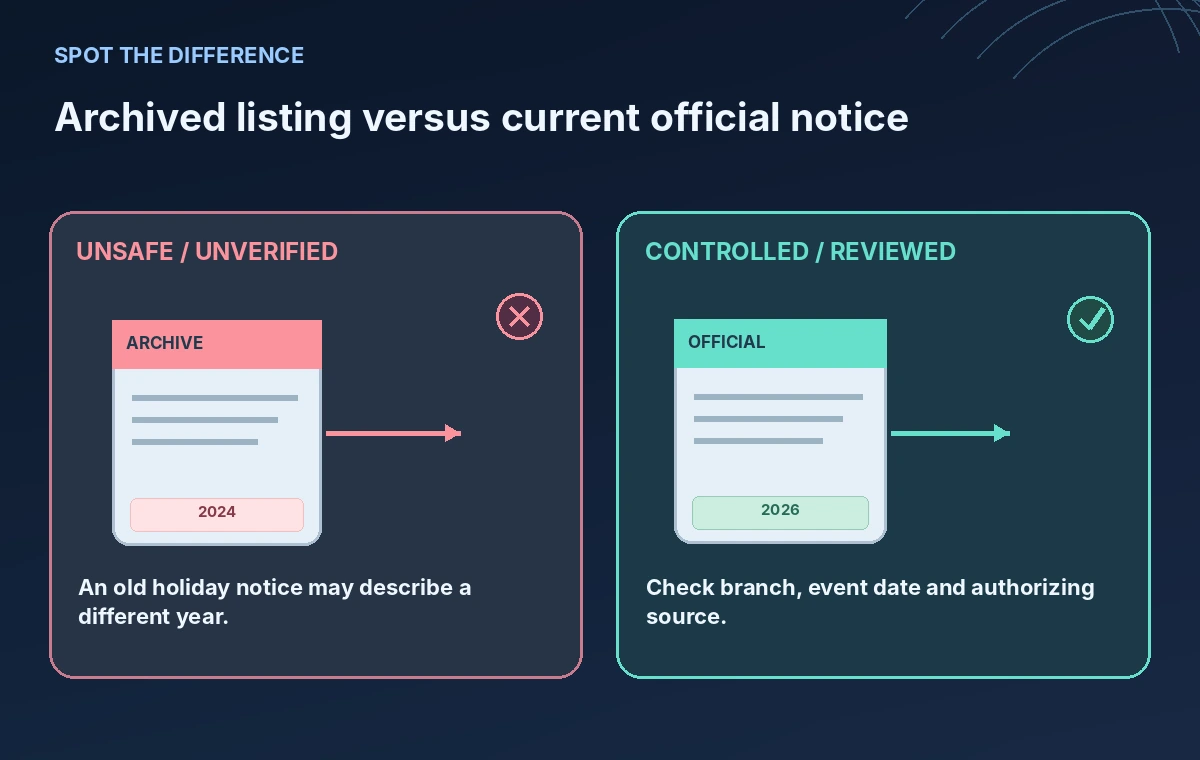
In the misleading path, a volunteer blog’s ‘closed Monday’ headline is attached to this week’s schedule without reading its archived year. In the checked path, the candidate is compared with a current official notice that names the exact branch and dates. This is a source reconciliation step, not a ranking contest.
A result snippet alone may cut off essential qualifiers such as ‘except the study room.’ Open the original source before drafting a visitor message. Keep accessibility and emergency exceptions intact, especially when a closure notice contains an alternate entrance or relocation instructions.
Inspect tool outputs as structured evidence
The Agent API returns typed output and can surface search results separately from the final answer. An application should store the cited URL and enough metadata to reopen it, then distinguish verbatim source claims from the model’s synthesis. Do not treat a neatly formatted answer as if it were an official library announcement.
Where a source is unreachable, label it as unverified instead of inferring its content from a preview. Consider a separate URL-fetch step for documents the editor needs to read. Never generate a fake publication date or describe a cached snippet as a live operational confirmation.
Require staff approval before updating public pages

An approval card can contain branch name, closure start and end, verified source link, reviewer name and a fallback contact method. Only a designated library employee should publish the result. If the dates are uncertain, the safest copy may be a short advisory to check the official service-alert page.
Test the workflow against lookalike branch names, an archived holiday notice, an event calendar with an unannounced update and an inaccessible official page. A successful search call must not automatically close the library in its website database.
Maintain freshness and a correction trail
A closure can change within hours, so define a recheck frequency aligned with the library’s operational process. Record when an editor last verified the notice and how they will correct it if staff reopen early. Keep old copies for audit without allowing them to outrank current status.
Review Perplexity’s current web_search filter syntax and billing terms before implementation. This is a hypothetical editorial workflow, not a live search benchmark. Search can help find and organize evidence; it cannot replace the local authority that actually decides whether the building is open.
How We Research
For this November 2026 guide, we reviewed these named primary sources: Perplexity Agent API Web Search, Perplexity Migration from Sonar. We compared the documented feature names, input and output behavior, supported workflows, platform restrictions and the product documentation about permissions or uncertainty. The seed bank, museum, library and volunteer examples are fictional. We did not run the vendors’ APIs, convert a real voice, inspect a real mailbox or measure performance or quality. All twenty original diagrams across the batch are conceptual, not screenshots or proof of tested results. Check current availability, plans, pricing and regional policies on the official sites before deployment, and have the relevant human expert verify any facts before publication.
Frequently Asked Questions
Perplexity recommends the Agent API for new projects; its documentation explains the September 2026 Sonar support changes.
No. It limits sources, but a page from an official domain may still be archived or outdated.
The first records when a page appeared; the second describes the actual operational event. They must be checked separately.
This workflow deliberately requires an authorized library editor to verify sources and approve publication.
No. The branches, dates and comparison are illustrative, not an operational status report.