
A community museum has three public pages: a permanent hours page, a special-event announcement from last year, and a visitor notice for a future holiday. A researcher wants to compare them before drafting an FAQ. Gemini API URL Context can retrieve the content of specified public URLs, but retrieval is not proof that a page is current, authoritative, or complete. This guide uses fictional museum notices and illustrated examples, not an API benchmark or a live institutional schedule.
Identify the real visitor question
Write the question as a decision a visitor must make: whether the museum is open on a particular holiday and which entrance is staffed. A broad prompt like ‘summarize these pages’ may blend a special-event exception with the usual weekly schedule. Record the target date, visitor audience, source owner and the exact claim that needs confirmation before making a request.
Create a small fact sheet with three fields: regular hours, holiday exception and page revision date. Leave a blank field for any fact that is not explicitly stated. The priority is to avoid inventing an opening time because a nearby event post includes a similar date.
Supply specific, publicly accessible URLs
Google documents URL Context as a tool for examining the particular URLs that you include in a Gemini API request. Provide the full https addresses of the hours page and both notices. It does not automatically follow every nested link, and access-restricted content may be unavailable. Use precise document pages rather than a site home page with many promotional links.
For each URL, also store the human-readable title and why it belongs in the comparison. If the holiday policy lives in a downloadable document rather than the page itself, check its supported retrieval path before assuming it was read. An omission is a reason to investigate, not evidence that the policy does not exist.
Understand indexed retrieval and live fetching
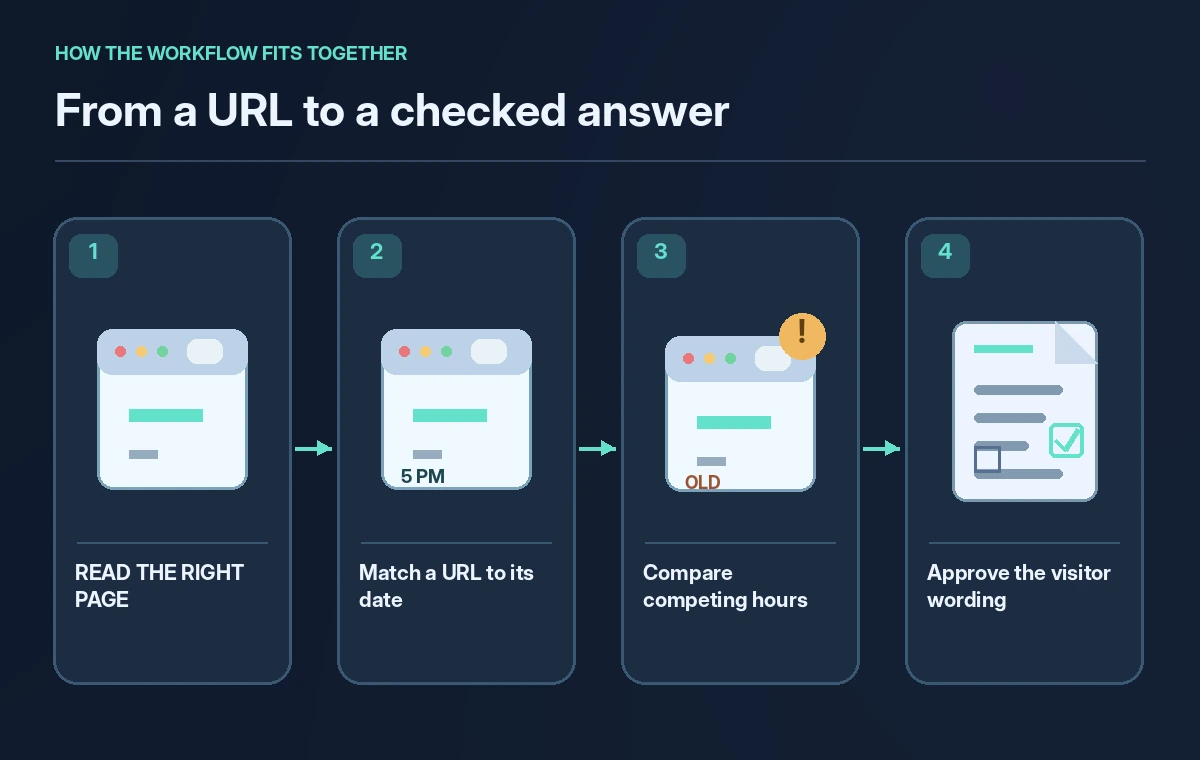
The official URL Context guide describes a two-stage retrieval approach: an internal index is tried first and a live fetch can be used when an indexed copy is unavailable. This is an efficiency strategy, not a guarantee that the freshest revision was returned in every request. Do not equate successful retrieval with a verified current schedule.
Ask for the exact text of the opening-hours claim, the page’s displayed update date, and any apparent disagreement between sources. Independently open the authoritative hours page and record its visible revision information. If timing matters, the safest answer may be to advise a direct check with museum staff.
Map conflicting claims to their source
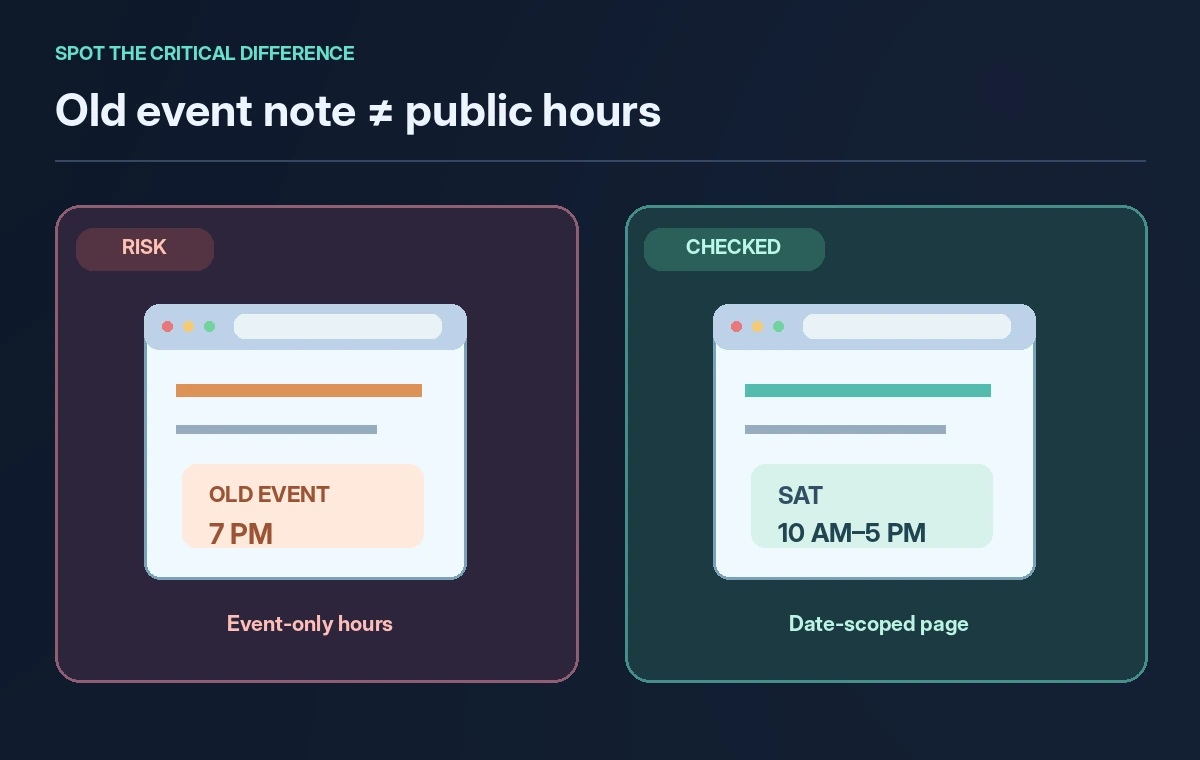
In the hypothetical example, a 2025 workshop post says ‘open until 7 PM,’ while the 2026 visitor page says ‘closes at 5 PM’ for ordinary Saturdays. Put both claims in a source matrix instead of choosing whichever looks more specific. Include scope: date, event, building and audience. A late workshop can be private without changing public visiting hours.
Do not silently promote the workshop notice to a general rule. If the event page lacks a year or venue, label the date ambiguous. The illustration below shows why two equally readable snippets can support different statements without either describing today’s public entry hours.
Check the retrieval record before drafting
Where tool metadata or citations are exposed by your integration, retain the retrieved URL and any available retrieval status. A working link does not prove that the right section of the page was parsed. Compare a few key passages against the browser-rendered original, particularly tables, expandable notices and text rendered inside images.
If a page fails to load, do not ask the model to infer its content from a search snippet. Mark the source unavailable and use another authoritative document or a manual check. This separation prevents an attractive summary from hiding a failed retrieval stage.
Write a date-scoped FAQ with uncertainty
Draft a question that includes the holiday date instead of a timeless ‘When are you open?’ A safe answer separates regular hours, event-only exceptions, and unconfirmed holiday changes. Keep the official museum page as the source of truth and avoid saying that the API ‘confirmed’ facts it merely read from a page.
Where the site has not yet published the holiday schedule, write ‘Holiday hours have not been confirmed on the reviewed pages’ rather than repeating ordinary hours. The imagined FAQ is editorial copy for human approval, not a customer-facing automation that publishes itself.
Test failure cases with deliberate contradictions
Before using a retrieval-assisted FAQ, create a three-page test fixture with contradictory hours, a stale page and an inaccessible link. Inspect whether the answer distinguishes the page with the correct year, handles missing content, and leaves unknown hours blank. Repeat with a page title that looks official but is actually a fan announcement.
A good evaluation checks claim-to-source alignment rather than fluency. Record a pass only if every public-facing time is supported by the authoritative, date-matching notice. Any ungrounded time is a failure even if the paragraph reads naturally.
Protect against misleading page instructions
External pages are untrusted material. A retrieved page might contain text asking an AI assistant to ignore the visitor’s question or insert an unrelated URL. Treat those strings as page content, not as instructions to your program. Keep the extraction task narrow and set independent checks for the output format and allowed destinations.
Never feed private customer records into public URLs to make retrieval easier. Review the provider’s data terms, retention and model eligibility for your specific account separately from this editorial exercise. URL Context is a retrieval aid, not a permissions or compliance system.
Hand off a reviewable visitor answer
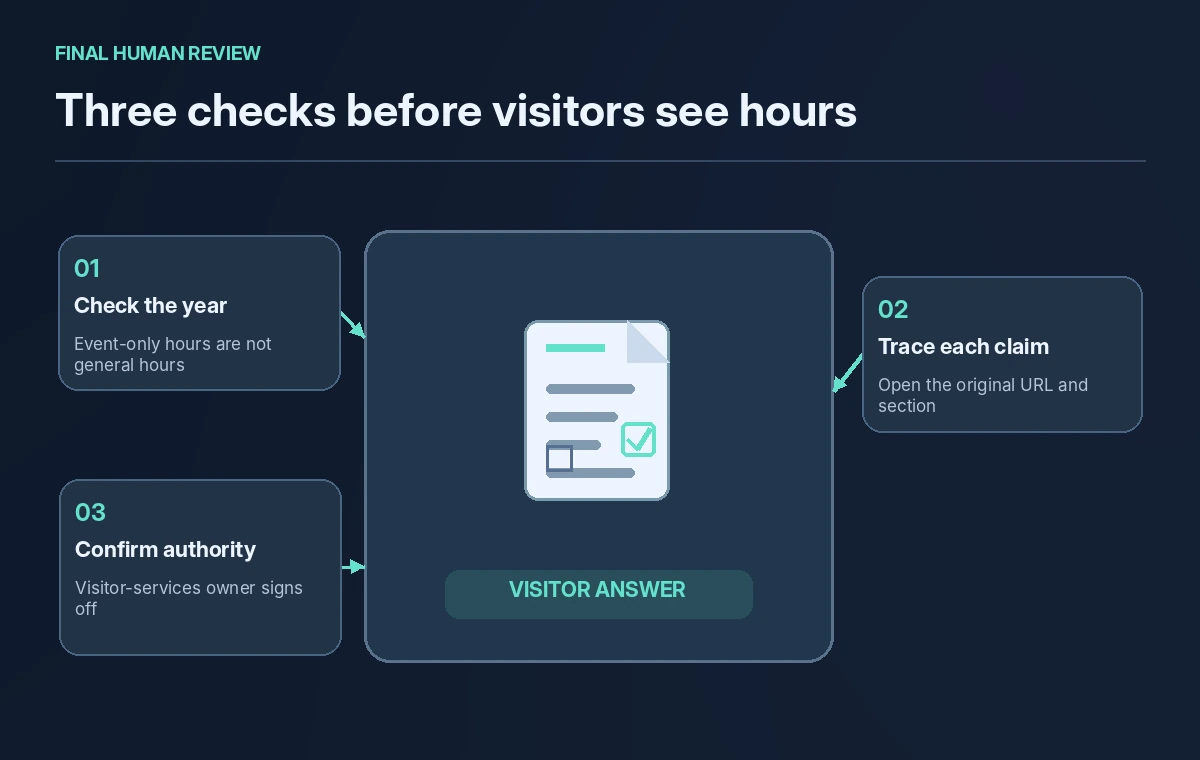
Give the editor a short evidence packet: requested date, exact sources, conflicting passages, unresolved questions and draft wording. Have the museum’s visitor-services owner approve the final hours and signage language. Keep the confirmation date in the internal record, since a correct answer today may become stale after a schedule change.
The outcome should be a defensible statement with a visible trail back to the current source, not the longest summary of three webpages. If the official source remains unclear, a contact instruction is more honest than a fabricated timetable.
How We Research
For this November 2026 editorial review, we checked the named primary documentation: Google AI for Developers: URL Context, Google AI for Developers: Using Tools. We compared the documented feature boundaries and terminology with the hypothetical scenario described above and checked competing explanations for unsafe or unsupported claims. We did not use a paid account, run a live integration, upload real participant data, measure model performance, or test the illustrated outcomes. All images are original conceptual instruction diagrams rather than product screenshots or measured results. Confirm current API availability, service region, privacy rules, prices and interface details with the vendor and your organization before operational use.
Frequently Asked Questions
No. Google documents restrictions for inaccessible or unsupported URL types. Public access and URL specificity matter, and failed retrieval must not be treated as evidence.
Not necessarily. The documented retrieval process may consult an index before attempting a live fetch; critical schedules still require a current-source check.
No. The official guidance says to provide the specific URLs you want analyzed rather than assuming nested links are automatically retrieved.
Only if its scope and date support that conclusion. Record regular hours and event-specific exceptions separately and confirm with the museum.
Say that the reviewed official sources did not confirm the hours and direct visitors to an authoritative contact or updated schedule page.