
AI content optimization should begin with a specific reader problem, not a request to stuff more terms into a page. A page that ranks for an irrelevant query or gives a polished but incomplete answer is not successful just because a scoring dashboard displays green. The more useful question is what visitors still need after reading the existing draft and which changes the source evidence actually supports.
This guide gives you a repeatable one-page change plan: identify intent, capture the current state, check claims, propose a small set of revisions, and evaluate the result. It is not a traffic-growth promise, a ranking experiment, or another list of SEO platforms. Use an approved assistant for drafting suggestions, but keep editorial judgment and publication rights with people.
Choose one URL and define the visitor task
Pick a page with a clear purpose: helping a buyer compare products, teaching a specific setup, or answering an eligibility question. Write the expected outcome in one sentence. For a comparison, the visitor may need a decision matrix; for a tutorial, a failure-recovery step could matter more than adding another introduction. An assistant can suggest missing subquestions, but only your audience data and page review can establish priority.
Before changing a word, save the canonical URL, publication date, existing headings, current internal links and any approved source packet. Record the main query group if you have reliable Search Console information. If no performance data is accessible, mark that field unavailable. Invented baseline numbers make later success claims impossible to audit.
Audit the answer, not merely the keyword frequency
Read the page as a first-time visitor and highlight each place where the answer becomes vague, unsupported or hard to follow. Ask whether the headline matches the actual material, whether the opening delivers the promised answer, and whether different user scenarios are distinguished. A short comparison table or a worked example may solve a real problem; repeated synonyms usually do not.
Google Search Central emphasizes helpful, reliable, people-first content and meaningful original value. This is a quality framework, not a formula guaranteeing rankings. Ask an assistant to map each paragraph to the reader question it answers. Remove repetition and irrelevant detours only after verifying that essential limitations, caveats and citations will remain intact.
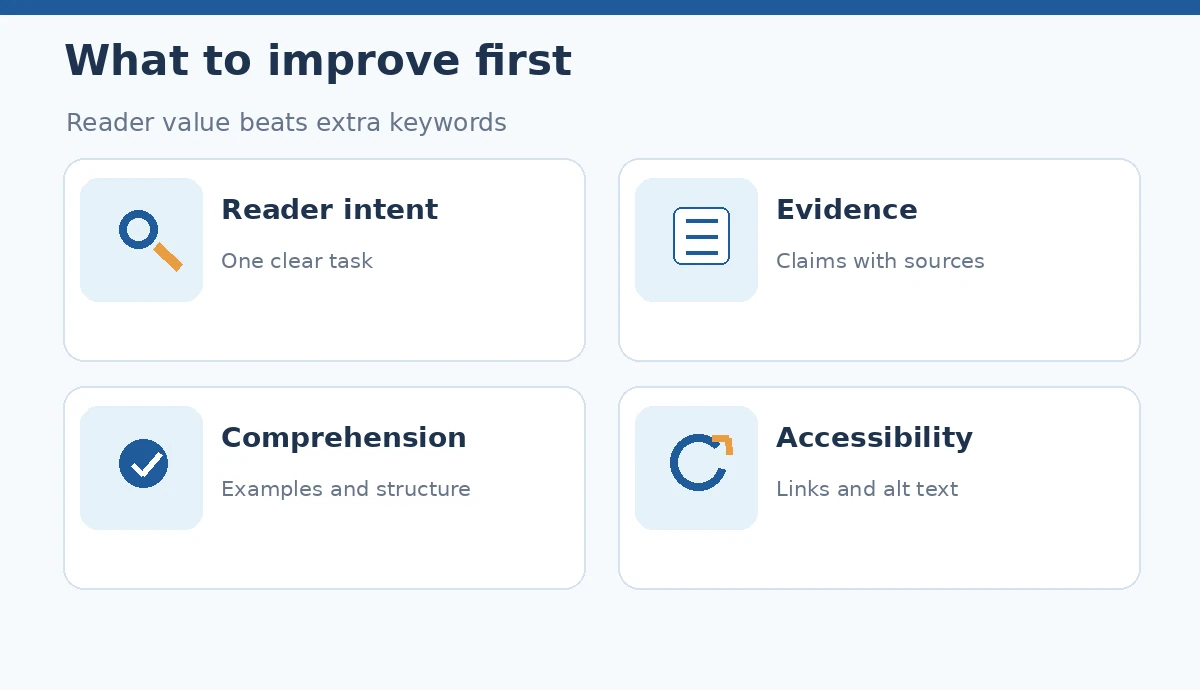
Create a claim ledger before rewriting
Extract sentences containing product functionality, dates, security assurances, prices, limits or legal claims. For each, record the exact wording, a current primary-source URL, the date reviewed and an action: retain, qualify, update or delete. If a source only describes an enterprise feature, do not generalize it to free users. If a claim is unsupported, rewrite it as a question to verify rather than inventing a confident answer.
AI can help flag potential factual statements, but it cannot supply evidence by repeating its own output. Open official documentation and compare the wording directly. A product help page may describe the feature but not your own testing, so separate documented capabilities from firsthand observations. An outdated fact can be more harmful to readers than a missing topical phrase.
Use AI to propose bounded, visible edits
Give the model an approved paragraph, the intended audience and the verified source packet. Ask for a shorter alternative, an explicit list of facts it changed, and a rationale for every new assertion. Limit the instruction to one section at a time. This prevents a wholesale rewrite that accidentally erases a crucial qualification or changes the original scope of the article.
Maintain a before-and-after diff, ideally with a line for reviewer notes. Divide edits into factual fixes, structural clarifications, accessibility or formatting improvements, and optional style changes. An editorial owner approves the final text. When the assistant suggests a new statistic or quotation, require a verifiable original source or decline the addition.

Improve headings, examples and search snippets
Make headings describe specific decisions or tasks rather than loosely repeating the target keyword. Replace a generic claim such as “AI saves time” with a worked process that identifies input, output, failure risk and review. Check descriptive link anchors, meaningful image alt text, and whether the page reads well on a narrow screen. These are practical usability improvements even when search traffic does not change.
Google says snippets are commonly generated from visible page content and may also use the meta description. Write an accurate, page-specific description, but do not promise that Google will display that exact text. The goal is consistency between the result preview, heading and real answer; clickbait that the page cannot satisfy weakens user trust.
Publish with a change log and a rollback path
Record every consequential change: removed claims, new sources, changed section headings, corrected links and image updates. Verify that the page still answers its original task and that internal links point to actual published destinations. Preview the rendered page and check the mobile layout, not just the editor. Preserve the prior version so you can restore important material if a change turns out to be incorrect.
Avoid changing several unrelated site-wide factors at once if you want to interpret results. A content refresh can coincide with search algorithm changes, seasonality and competitor updates; none is automatically caused by your edits. Record uncertainty rather than attributing every ranking movement to one AI-assisted rewrite.
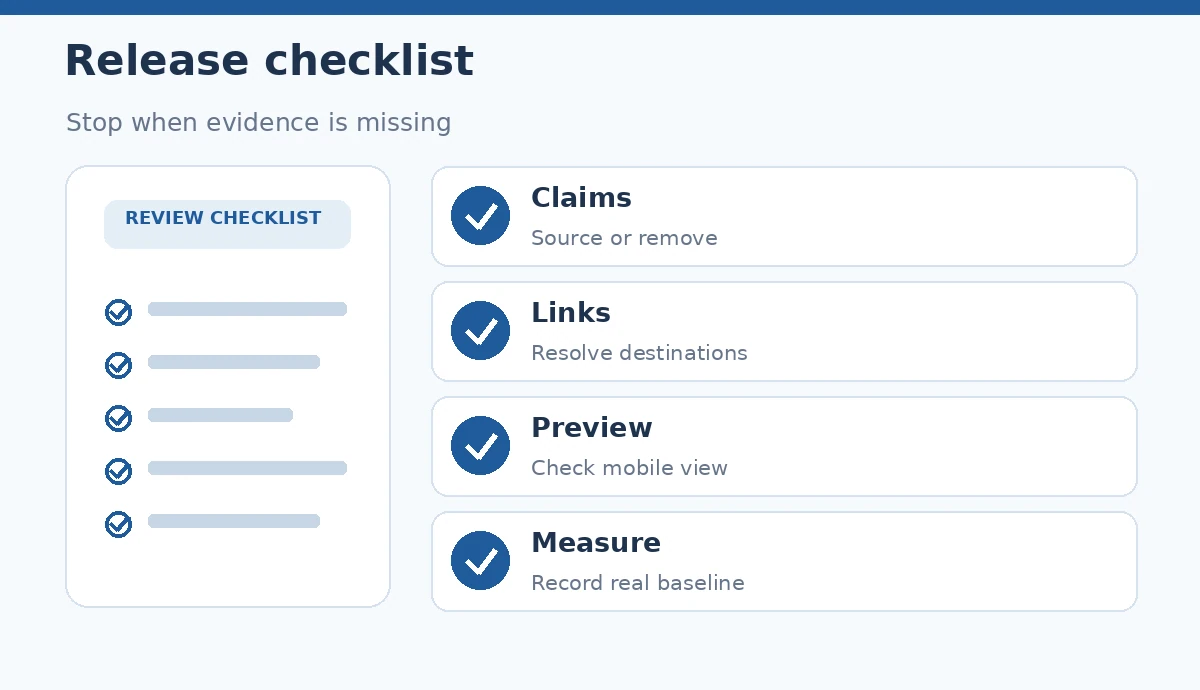
Evaluate the outcome with a limited scorecard
After publication, review a consistent period of available analytics and Search Console data. Track relevant landing queries, engagement signals where reliably measured, and whether users now complete the page’s intended task. Where volumes are small, qualitative user questions or a structured editorial review can be more honest than numerical conclusions. Keep the measurement window and any known external changes in the change log.
The release passes when readers can find a complete, sourced answer; the approved claims remain accurate; and the updated page has no broken references. Traffic improvements are welcome but not guaranteed. If a page already meets its purpose, the right optimization decision may be to leave it alone until a real reader or factual need arises.
How We Research
We reviewed Google Search Central’s people-first content guidance and its documentation about search snippets on October 26, 2026. This article is an editorial workflow built from those primary sources, not a claim of Google endorsement. We did not test search rankings, measure a real site update or use a private analytics account.
Frequently Asked Questions
No. A third-party score can guide an edit, but search visibility depends on many factors and is not guaranteed by any particular tool.
For high-stakes or source-heavy pages, section-level proposals and a visible diff are easier to verify than an unreviewed full replacement.
No. Google often builds snippets from page text and may use a meta description when appropriate. Write for accurate expectations, not control of a specific snippet.
Qualify or remove the claim until it can be supported. Never invent a test result or infer that an unverified feature is generally available.
Compare the page with its original reader task, inspect verified data over a consistent period, and document uncertainties such as seasonality or concurrent site changes.