
“AI SEO tools” describes several different jobs. A site owner might need to identify aging pages, analyze one existing article or monitor whether content still serves its search intent. A product that improves a draft’s topic coverage is not automatically the right product for auditing hundreds of URLs. Likewise, a higher content score does not establish a causal ranking gain.
This guide separates three vendor-documented paths: Surfer Content Audit, Clearscope Content Inventory and Frase’s Optimize Existing workflow. It is not a hands-on head-to-head performance test and includes no invented ranking lifts. The unique artifact is a buying rubric connecting each content-repair job to the type of signal and reviewer handoff it needs.
Start with the audit question, not a list of tool names
Define whether you want to find pages needing attention, analyze a known underperforming article or standardize a repeatable refresh process across a team. For a small blog with five pages, a spreadsheet and Google Search Console may be enough. A larger library with several editors may benefit from a workflow that imports URLs, reports changes and assigns fixes. The appropriate software follows the scope.
Write a one-page requirement: pages in scope, available first-party data, target regions, desired update cycle, number of reviewers and permission constraints. Make clear whether you are evaluating technical SEO, content coverage or AI-search visibility. No single content-grading platform should be described as a replacement for crawl diagnostics, analytics and factual editorial review.
Surfer Content Audit: surfacing existing-page opportunities
Surfer’s official Content Audit material describes using Search Console data and SERP analysis to identify pages needing attention. Its help content discusses content scores and monitoring, which may be useful when the central problem is choosing what to revisit next. Check the current plan, required GSC connection and how it handles the actual pages in your site before committing to a subscription.
A Surfer score is a model of on-page content characteristics, not a guarantee of search demand or conversion. If its suggestion recommends adding text that duplicates a better canonical page, resist the recommendation. The right reviewer should still inspect actual user questions, missing information, source accuracy and whether the editorial update has a distinct purpose.

Clearscope Content Inventory: organized monitoring across pages
Clearscope documents Content Inventory as a way to monitor published pages and combine Search Console metrics with its content analysis. That makes it worth investigating when an editorial team struggles to maintain a single view of which pieces are current, which need attention and how pages relate to their assigned topics. Its fit depends on your workflow, not on the number of features in a product list.
An inventory can show signals but cannot decide whether an old factual statement is true. It also cannot certify that a revised section preserves the author’s expertise. Pair inventory alerts with an owner, an evidence checklist and change history. Ask the vendor how imported pages, permissions and current plan access work rather than assuming every advertised feature exists in every tier.
Frase Optimize Existing: repair a known article
Frase’s current help documentation includes an Optimize Existing workflow, which can suit a writer who already knows which page needs improvement. The official product materials describe importing existing content, comparing it with relevant search results and identifying potential topic gaps. This is a more focused task than establishing a complete sitewide audit program.
The danger is treating an optimization prompt as an order to add every competitor subtopic. A better process is to list actual reader questions, keep valid sections and add only information your evidence supports. Run an overlap check against your existing content first. If a paragraph belongs on a different canonical article, use an appropriate internal link rather than stuffing both pages with the same answer.
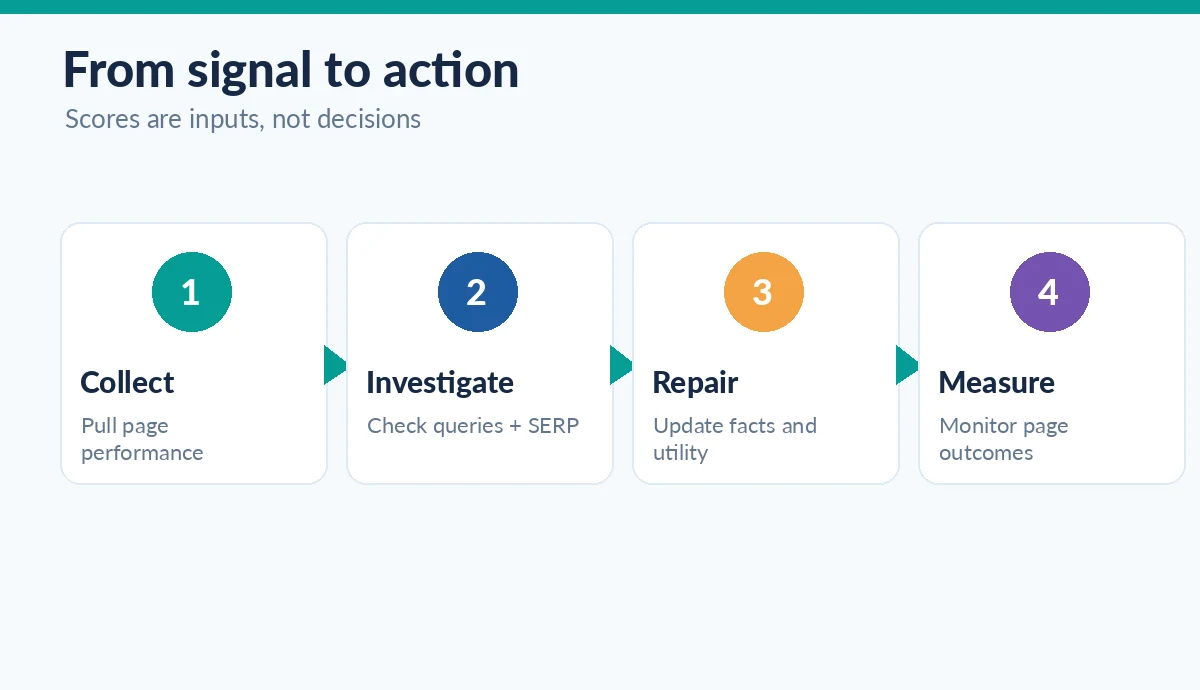
Compare coverage signals with real reader evidence
Google Search Console provides page- and query-level performance data. Use that baseline for the period you are investigating and label anomalies instead of assuming a tool’s score explains them. A page could lose clicks because the query mix changed, the audience shifted, the SERP layout changed or a fact on the page is stale. Content-score movement is only one clue in a larger diagnosis.
When the tool flags missing headings, ask whether the missing answer genuinely helps readers. Check current original sources for any newly proposed figures or vendor details. If the best remedy is a quick screenshot update and a changed setup step, an automated 2,000-word rewrite would create unnecessary editorial risk. Define a specific, testable repair for each URL.
Use an honest comparison sheet before paying
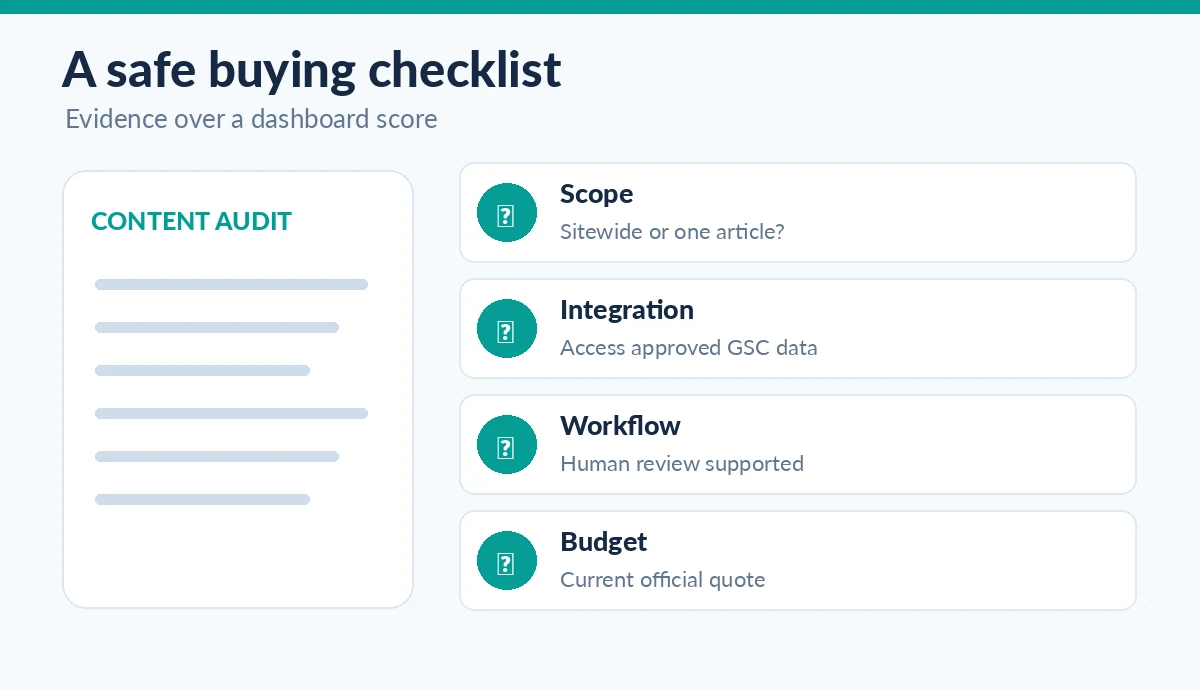
Create columns for audit scope, data sources, page-import behavior, reviewer workflow, integration and the official current price or quote. Mark unknown fields as “confirm with vendor.” For example, Surfer may be a fit for surfacing candidate refreshes, Clearscope for content-inventory monitoring and Frase for targeted in-editor optimization. These are workflow classifications, not measured performance rankings.
Run a low-risk trial on one existing public page if the current product offer allows it. Ask whether the proposed changes are supported by real sources and whether the tool maintains a useful before/after review path. Do not upload confidential documents until access permissions and data handling have been approved. A service that increases editing overhead may not solve the stated problem.
Close the loop with ownership and measurement
Turn audit findings into a work queue with a named page owner, reason for change, required evidence and a due date. Keep the original version and record what changed. After publishing, monitor search signals and reader feedback without promising that scores or ranking will improve. If the improvement is factual accuracy or a restored link, it can be worthwhile even without immediate traffic growth.
Decide on a maintenance cadence according to content volatility. Fast-changing product pricing needs more attention than a stable explanatory guide. Reassess the tool choice when the number of editors or pages changes. Good content audits are editorial systems supported by software—not a purchase that automatically produces trustworthy rankings.
How We Research
We compared primary documentation for Surfer Content Audit, Clearscope Content Inventory, Frase Optimize Existing, and Google Search Console, checked October 26, 2026. This is a documentation-based workflow comparison. We did not purchase plans, benchmark tools on a shared website, or claim traffic lifts or SEO score improvements.
Frequently Asked Questions
Define the required sitewide inventory, first-party data access and team workflow. Surfer and Clearscope document audit or inventory approaches; verify current access and fit.
Its Optimize Existing workflow is designed around an identified article. Confirm that it supports your source, approval and editor workflow before buying.
No. Vendor scores summarize selected signals; they do not establish causality or account for every search, audience and site factor.
They may use or supplement GSC information, but first-party Search Console data remains important for understanding your actual pages and queries.
No. Check factual sources, reader intent, duplication and meaning changes, then obtain editorial approval before release.