
A highly cited paper may be important because scientists replicated it, challenged it, developed a competing explanation or simply cited its methods. Raw citation totals erase those differences. Scite’s Smart Citations feature attempts to restore the surrounding sentence by labeling citation statements as supporting, contrasting or mentioning. The labels can help prioritize reading, but they are not independent judgments of truth.
This guide is a close-reading method for those citation statements. It differs from a general Scite review and from a pricing guide: the goal is to decide what a particular later paper actually says about an earlier finding, and which follow-up source deserves full-text examination.
Understand the three citation labels
Scite describes Smart Citations as machine-classified citation statements, not classifications of entire scientific papers. Supporting means that the context appears to supply supportive evidence; contrasting means it appears to dispute or qualify the cited result; mentioning covers references without an obvious support-or-contrast relationship. Each category is attached to a citing passage, so a single publication may include more than one kind of statement.
The labels are retrieval cues. A “supporting” sentence about a related population does not automatically validate the original claim in your setting, and a “contrasting” sentence may reflect differences in methods rather than a definitive refutation. Read the excerpt, its surrounding paragraph and the cited paper’s original conclusion before adding it to an evidence judgment.
Search by the exact study, not by a fuzzy claim
When possible, start with a DOI, complete title or stable identifier. This reduces the risk of confusing two papers with similar names or different publication versions. Open the report page and confirm authors, year and journal. If you are working from a preprint, identify whether a later journal version exists and whether citations are distributed between records.
Record the date you looked up citation context. Coverage changes as new documents are indexed or publishers share text. A current label distribution is a snapshot of what the system can see, not a permanent census of every study that discusses the finding.

Read the citing excerpt and its surrounding argument
Start with statements labeled contrasting because they may identify important limitations, replication failures or competing results. Open the surrounding text rather than copying the isolated sentence. Check whether the author is criticizing the exact claim in question, an interpretation of it, a measurement approach, or another related work cited in the same passage.
Then sample supporting statements too. Ask whether they provide independent data or merely say that the older study was influential. A method paper can be cited as the origin of a technique without validating its substantive findings. The same discipline should apply to mentions: a neutral-looking sentence might be relevant when read in context.
Distinguish citation context from study quality
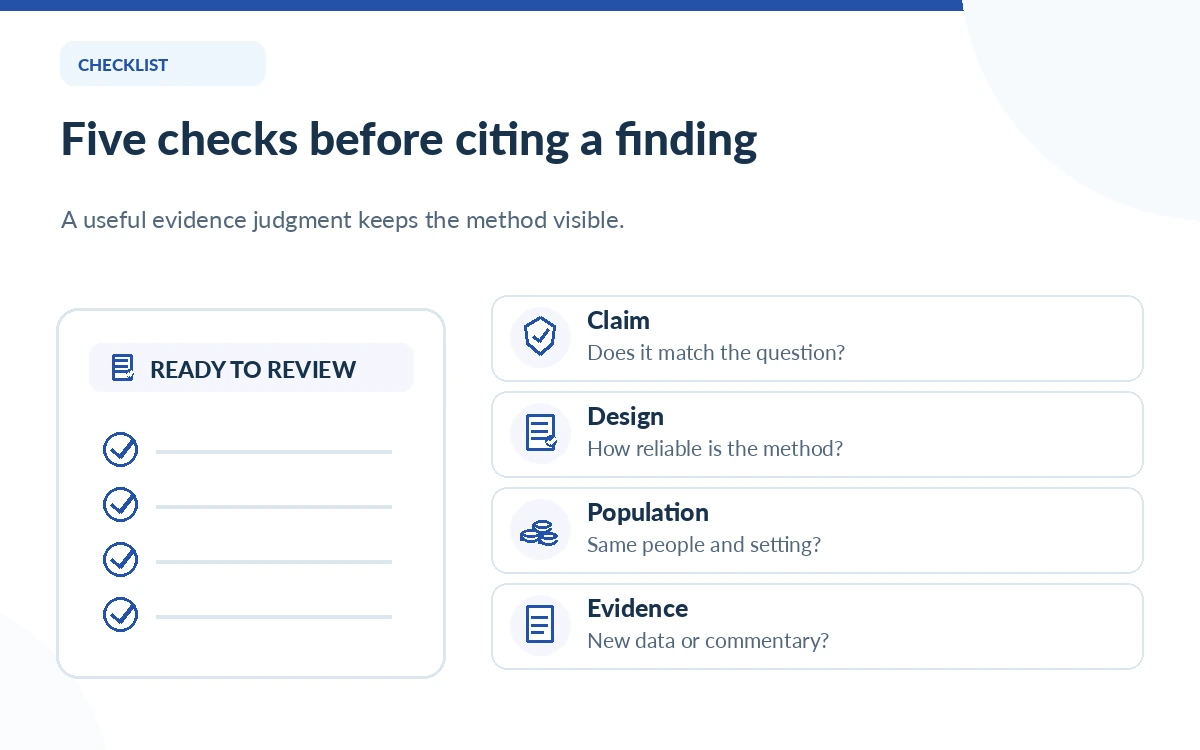
Citation labels do not substitute for a risk-of-bias assessment. A single large replication with strong methods may matter more than ten superficial references, and a critical commentary may raise a point without conducting new research. Check study design, sample, measurement validity, confounding, effect sizes and uncertainty intervals before deciding how much weight to give a later statement.
When evidence points in different directions, make a small comparison matrix showing population, methods, result, limitation and the exact claim being compared. If the studies investigate different outcomes, resist forcing them into a single yes/no verdict. A useful literature review explains why apparently contradictory findings might coexist.

Check automated classifications for mistakes
Scite says its system uses machine learning to label citation contexts. Such classification can be wrong when a sentence contains negation, quoted criticism, hedging or several claims. For example, “We did not replicate A, although B remained robust” can support one result and contrast another. A three-way label may not capture which proposition the sentence addresses.
If a label seems inconsistent with the excerpt, note the discrepancy and read the full source. Do not adjust published counts by guesswork or claim a formal Scite accuracy rate you have not verified. Treat the machine output as a search aid that directs careful reading rather than an authoritative adjudicator.
Create a claim-specific evidence log
For each claim you intend to cite, record the original DOI, citing article DOI, citation category, excerpt, surrounding interpretation and your own quality assessment. Mark whether the citing article presents new evidence or only a conceptual discussion. Preserve enough context for another reader to reproduce your interpretation, especially in contested fields.
An example entry might say, “Contrasting label; later observational sample uses a different age group; authors caution about generalization rather than rejecting the entire intervention.” That description is more informative than “one paper disproves it.” Keep source dates and full bibliographic records so the log is useful even if Scite’s interface or counts change.
Know when to leave Scite and read the primary literature
Use the platform to choose which citing papers require closer inspection, then obtain the originals through open-access links, your institutional library or legal document delivery. For important clinical, legal or policy conclusions, involve qualified experts and review current practice guidelines. Smart Citations alone cannot establish consensus or justify an intervention decision.
If the research question is about a field rather than one influential paper, combine citation-context checks with a comprehensive search and a structured review of the studies themselves. Good scholarly attribution connects a precise claim to relevant evidence; it does not substitute a proprietary badge for the reasoning behind the conclusion.
How We Research
Our October 26, 2026 source check used Scite’s primary Smart Citations feature description and explanation of citation types and sections, supplemented with Embry-Riddle’s academic research guide to Scite. We did not score a sample of citations or test classifier accuracy; passages and interpretations in this guide are methodological examples.
Frequently Asked Questions
It is an automated label attached to a citing statement interpreted as supporting the cited finding. It is not proof that the original paper is valid or that every result in the citing paper agrees.
The citing passage appears to dispute or qualify some claim from the cited work. Read its context to identify which claim, population or method is being challenged.
No. Mentions can show a study’s methods, background influence or relationship to a field. A neutral label simply does not imply clear support or contrast in the classified passage.
No. Counts reflect documented references and classification coverage, not study quality, independence or total evidence. Important interpretations require methods review and the primary sources.
No. It helps locate relevant citation context. For consequential claims you still need to inspect the original paper, later evidence and study limitations.