
Scite Assistant can help a researcher find and discuss literature without starting from a blank search box. The useful outcome, however, is not an elegant paragraph. It is a set of claims connected to identifiable studies, with enough context to tell whether the evidence applies to the question. That distinction matters in fast-moving fields and in topics where plausible answers conceal substantial disagreement.
This guide focuses on Scite Assistant as a question-answering interface, not a replacement for the existing LabFin Scite review or its Smart Citations explainer. Scite says Assistant draws on its scholarly index, while Reports, Search and Smart Citations provide additional ways to inspect citation context. The workflow below separates discovery, evaluation and writing so readers can reproduce their decisions.
Begin with a narrow, answerable research question
A prompt such as “Does exercise improve health?” gives the assistant too much room to choose a population, intervention and outcome. Ask instead what randomized studies say about a defined intervention and outcome in a specified population over a given period. Record those boundaries in a notes file before submitting the prompt. In some disciplines a PECO or PICO structure is helpful, but a plain sentence with equivalent detail works too.
For example, a materials scientist might ask which controlled experiments compare two surface treatments for corrosion resistance in marine environments. Ask for study type, measured endpoint, limitations and citations rather than a single confident verdict. Narrow questions make it easier to spot when a source is only adjacent to the topic rather than evidence for the precise claim.
Use Assistant to map claims, not to declare a winner
Have Assistant return a short list of distinct propositions with a supporting source for each. Request the difference between established findings, preliminary signals and open questions. If the answer blends human trials, animal experiments and theoretical papers, ask it to separate the categories. A tidy synthesis can obscure incompatible research designs, so do not average the conclusions in your head.
A useful output format is “Claim | Study | Population or material | What was measured | Qualification.” This is an editorial prompt pattern, not a claim about an exclusive Scite export feature. Ask follow-up questions specifically about missing evidence, conflicting estimates and whether the cited articles address the same intervention or construct.
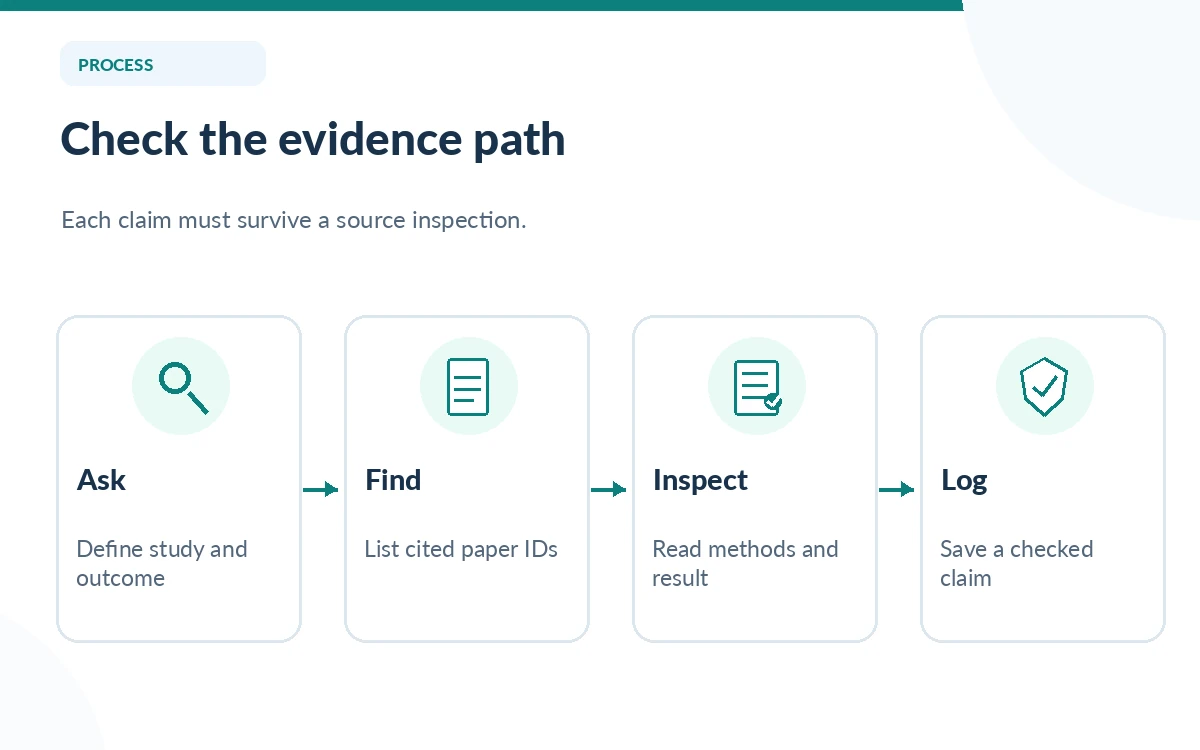
Open the cited study and verify its actual finding
Scite says Assistant links answers to scholarly sources. Treat those links as an opening of the verification process, not its completion. Inspect the title, date, authors, methodology, endpoint and relevant paragraph or table of every pivotal citation. Check whether the result is in an abstract only, a full manuscript, a preprint or a published study. Access to a reference does not guarantee that the answer interpreted the study correctly.
Consider a paper reporting an association in a retrospective cohort. If the assistant writes that an intervention caused the outcome, the wording exceeds the design. Rewrite the statement as an association, note confounding and distinguish adjusted from unadjusted results. If you cannot obtain the underlying text, mark the claim as unverified rather than implying that the citation link itself proves it.
Use Smart Citations and Reports as a second lens
Scite categorizes citation statements as supporting, contrasting or mentioning. A contrasting citation is a useful investigation cue, but it is not automatically proof that the cited article is false. Likewise, a high supporting count is not a quality score: many papers may refer to a common benchmark without independently reproducing its result. Read the citing statements and inspect the citing works.
Open a Report for a pivotal paper and look at contrasting statements, later methods, populations and publication dates. Ask whether a cited disagreement concerns the same outcome or merely a different assumption. If a retraction or editorial concern appears, verify its status with the journal or publisher. Keep citation context and study quality appraisal as separate columns in your notes.
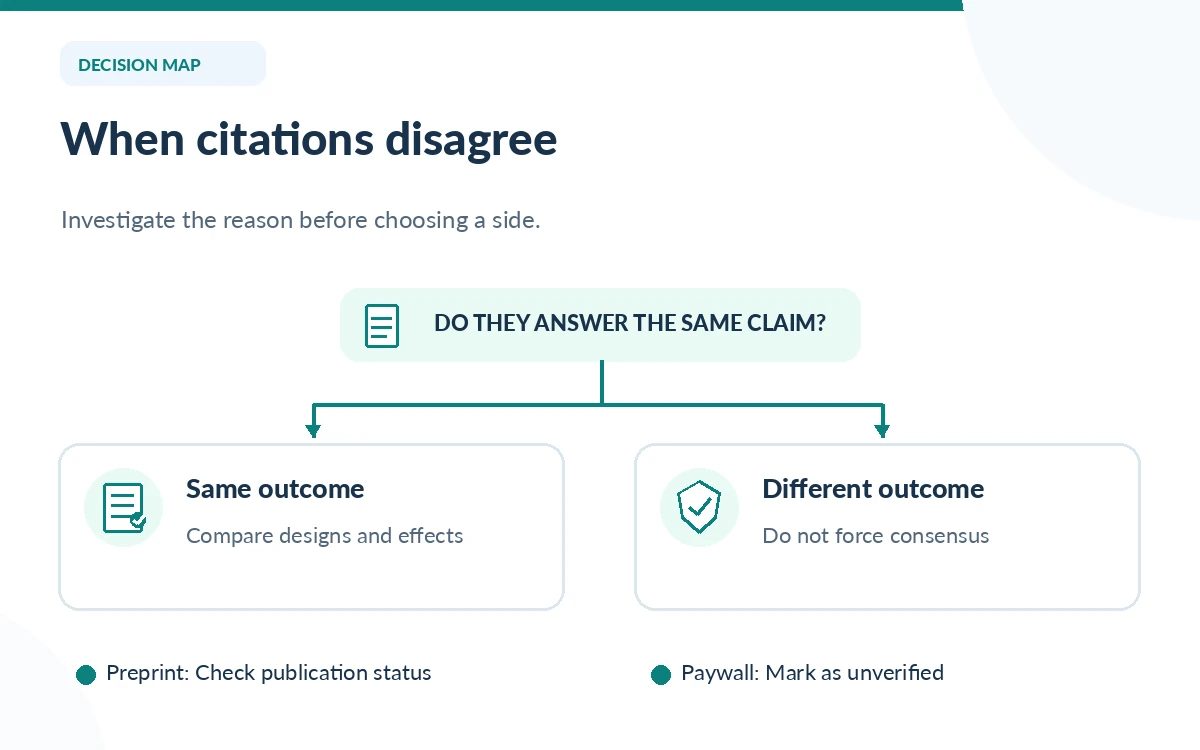
Build a compact evidence table and disagreement log
Create one row per claim rather than one row per AI answer. Track the quoted proposition, exact source, DOI or stable URL, study design, setting, result, key limitation and your own verification status. Where two studies disagree, describe the difference in populations or methods. Do not record “science disagrees” if the apparent conflict disappears after checking different endpoints.
Use three verification states: independently checked against the paper, pending full-text access, and unsupported by the cited passage. Store a correction note each time you change Assistant’s wording. An honest evidence log can be modest in size; twenty properly checked sources are preferable to hundreds of citations imported without review.
Handle citations, paywalls and sensitive material responsibly
Scite advertises coverage of publisher-partner full texts that may not be otherwise accessible. That does not mean every reader can reuse full copyrighted articles or reproduce large excerpts in a public report. Cite the bibliographic item and paraphrase in your own words. Follow institutional access rules and check whether confidential drafts or unpublished data may be uploaded under your organization’s policies.
Never paste participant-level personal information, protected health data or unpublished collaborator material simply to receive a faster answer. For clinical, legal or safety-critical questions, a domain expert must independently evaluate the original research. An assistant cannot substitute for preregistered review methods, ethics approval or a complete assessment of bias.

Finish with a transparent, bounded summary
Present what the checked studies answer, what they do not answer and which conclusions depend on assumptions. Separate a brief plain-English conclusion from a source ledger. Include search date, keywords or prompt, selection choices and the remaining uncertainties. If the research question is high stakes, explain where a formal systematic search should replace the quick discovery workflow.
For a team handoff, deliver the claim table, the list of PDFs or DOI links you were allowed to collect, and the disagreement log. A colleague should be able to trace a statement back to its paper without recreating the conversation. This is the practical value of Scite Assistant: accelerating discovery while preserving human responsibility for the final inference.
How We Research
We checked Scite’s official features documentation for Assistant, Reports, Search, Smart Citations and Reference Check on October 26, 2026, and compared its described citation classifications with our existing vendor information. We did not conduct hands-on accuracy tests or validate Scite’s index-size claims independently. All prompt examples, logging fields and verification rules are editorial workflow recommendations; they are not claimed results of a benchmark.
Frequently Asked Questions
Scite describes Assistant as scholarly-source-grounded, but index coverage and publication status can vary. Check each cited paper for peer review, preprint status and relevance rather than assuming every citation carries the same evidentiary weight.
No. The label describes the context in which another paper cited the work. Read the citing statement, examine study quality and check that the cited outcome matches the claim you are evaluating.
No. It can assist discovery and first-pass synthesis, but a systematic review needs a documented strategy, inclusion rules, duplicate screening where appropriate, risk-of-bias appraisal and reproducible decisions.
Use lawful institutional access or an author-available version if one exists. Mark claims as pending verification until the necessary method and result can be reviewed. Do not pretend a citation is equivalent to seeing the full study.
Keep a claim-level table with source links, study design, claim wording, limitations, verification status and corrections, plus the date of your search. This is more useful for review than an unannotated transcript.