
Scite helps researchers evaluate the context of scientific citations. Before paying for it, the practical questions are not just “How much?” but “Which features do I need, how will renewal work, and does my university already provide access?” A research tool’s value depends on the number of important claims it helps you examine, not on how many papers you can open in a month.
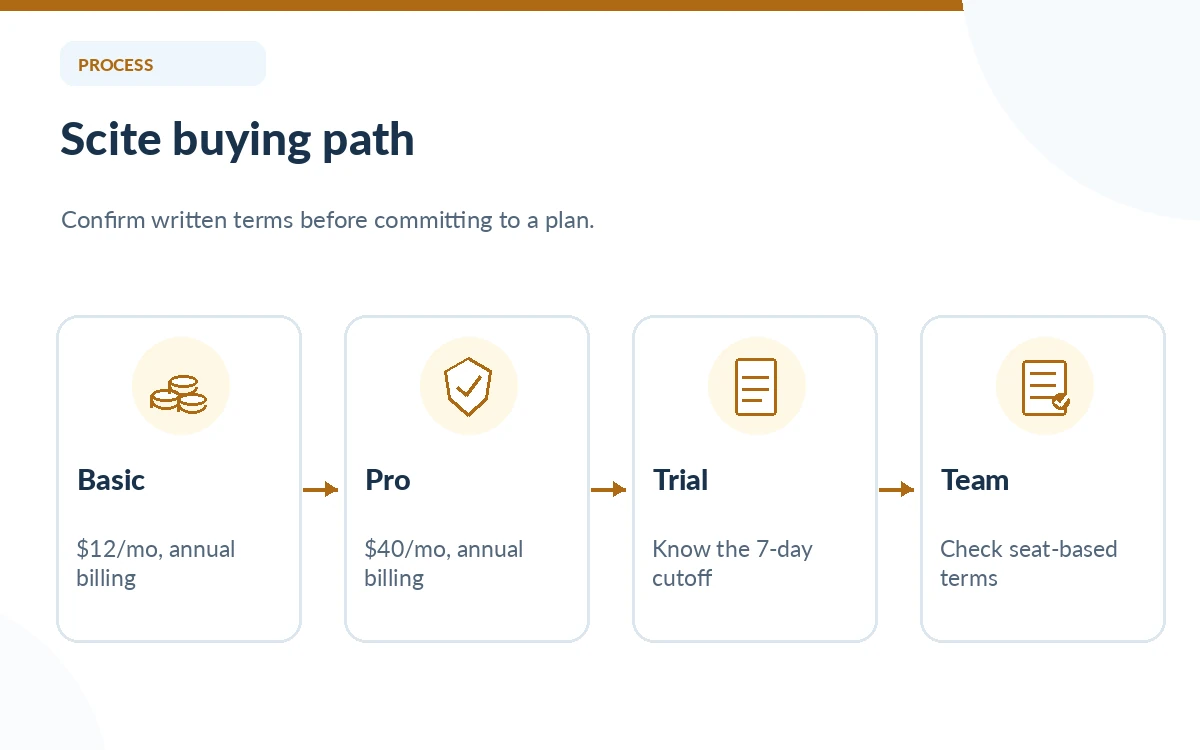
On October 26, 2026, Scite’s official checkout displayed Basic at $12 per month and Pro at $40 per month with the Billed yearly option selected. Those are monthly equivalents under annual billing, not verified month-to-month checkout rates: the corresponding twelve-month totals are $144 and $480 before any taxes or discounts. Scite also offers a seven-day trial and Enterprise quotes. Check the selected billing term and final payable amount before subscribing.
Compare Basic and Pro at the published annual-billing rates
At the official Scite checkout, Basic is shown at $12 per month with yearly billing selected, or $144 for twelve months at that reference price. It includes Assistant and Search access, Smart Citation reports, 250 MCP credits per month, citation alerts and collections up to 1,000 papers. Basic is a workable starting point when the main need is to inspect citing statements and evaluate published research.
Pro is displayed at $40 per month with yearly billing selected, corresponding to $480 over twelve months. The checkout lists Basic features plus API access, 2,500 MCP credits per month, larger collections of up to 10,000 papers and additional datasets. It mentions a limited-time $60 API credit, which should not be treated as a permanent benefit. The page did not establish a separate month-to-month rate in the accessible view, so check the toggle and payable subtotal directly.
Decide between individual and organizational access
Choose Basic when full-text research search, citation contexts and modest MCP usage cover the work. Choose Pro only when API access, larger collections or the expanded monthly MCP allowance will be used. Scite describes Smart Citations as citation statements classified as supporting, contrasting or mentioning; that feature is listed under Basic too, so buying Pro is not necessary just to see Smart Citation reports.
The checkout offers adding seats with Pro access under one bill and describes Enterprise as custom-priced for institutions. It also lists features such as administrative access methods, pooled organizational usage and additional datasets for Enterprise. Ask for an actual written proposal covering active seats, campus access, privacy, cancellation and usage rules; an individual-plan figure is not a guaranteed institutional rate.
Check student and academic discount rules
The Scite pricing FAQ describes a discount process for students and academics who recommend the service to their institution, using the vendor’s support or sales contacts. It does not establish a universal discount percentage for everyone. Get the qualification rules, applicable plan, duration and renewal rate in writing before treating the discount as part of your budget.
Also check the institution’s library database list. Some universities license academic research services centrally; others do not. If access is provided through a campus arrangement, confirm whether it works off-campus, how long it persists after graduation and whether API rights are included. Avoid paying privately before checking an entitlement that may already exist.
Verify API access as a separate purchasing need
Scite lists API access on Pro, not Basic, alongside 2,500 MCP credits per month versus Basic’s 250. Its FAQ says subscribers create a key from the API section, while higher-volume usage and data licensing require discussion with sales. These numbers describe included MCP credits, not an assurance of unlimited API requests or content redistribution. Verify the current limits and data rights before integrating the service.
If an organization wants to screen citations automatically, model its expected monthly lookups and decide which outputs it needs to store. An automation that continuously polls the same DOIs may have costs and licensing implications absent from an ordinary personal search workflow. Do not let an unspecified public rate stand in for an integration quote.

Use the trial as a structured fit test
During the trial, choose five papers your team already understands: one foundational article, one heavily debated claim, one recent study, one review and one obscure but relevant paper. Inspect citation context rather than only counts. Record whether the classified excerpts help you decide which full texts to read next and whether an institutional source already covers the same need.
Keep a simple decision sheet with feature, task, result and limitation. You are not trying to prove that Scite correctly classifies every citation in a week. You are checking whether the workflow supports your actual research habits, how much manual verification is required, and whether it justifies a recurring charge.
Budget the full subscription commitment
At the displayed annual-billing rates, Basic totals $144 for twelve months and Pro totals $480, a $336 difference before taxes or promotional adjustments. That calculation uses Scite’s stated monthly equivalents and the annual-billing selection; it is not a promise about separate month-to-month rates. If you need the tool for only a short project, inspect the monthly billing option before choosing a yearly commitment.
Include staff time spent verifying excerpts, reference-management work, campus procurement steps and any requested data integration. For a team, separately model active seats and occasional reviewers. A nominally inexpensive license that forces repeated manual exports may not minimize the total cost of delivering a documented literature assessment.
Know how to cancel or upgrade safely
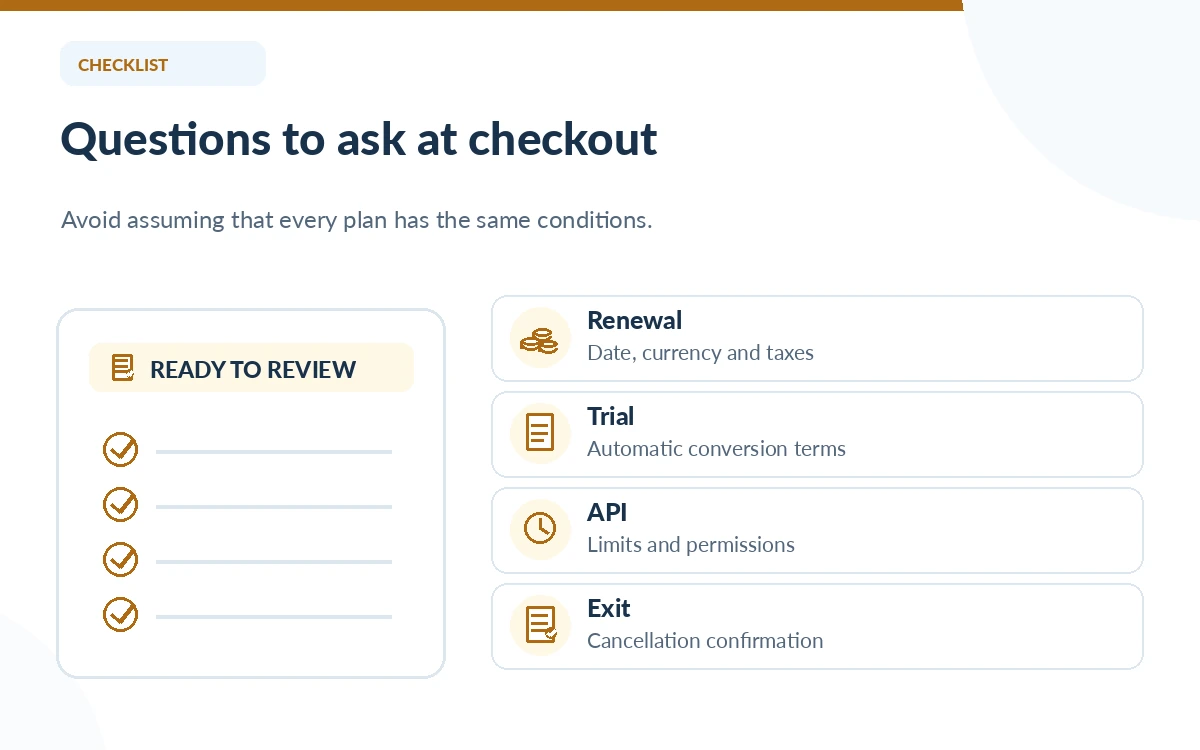
Scite’s pricing FAQ points users to the Subscription area to cancel a plan and says plan upgrades take effect immediately. Verify the account’s actual cancellation confirmation, trial cutoff time and any nonrefundable charges or contract-specific differences. Save the confirmation email or screenshot without sharing access credentials.
Before cancelling, export any permitted research outputs and update your citation manager. A citation count or Smart Citation classification may change over time as coverage expands, so document the retrieval date. Keep the original scholarly sources in your bibliography rather than relying on a paid tool’s interface as your permanent evidence archive.
How We Research
We checked Scite’s official checkout pricing display, pricing and trial FAQ, and features documentation on October 26, 2026. The visible yearly-billing selection displayed Basic $12/month and Pro $40/month as annual equivalents; calculations use those specific terms. We did not complete a purchase, independently test premium features or verify month-to-month rates.
Frequently Asked Questions
The official checkout displayed $40 per month with annual billing selected, equivalent to $480 for twelve months before taxes. The separately selectable month-to-month rate was not verified in this check.
Scite’s official pricing FAQ describes a seven-day premium trial. The plan selected during sign-up is charged after the trial unless cancelled before it ends, subject to the displayed account terms.
Its FAQ describes a student and academic discount process linked to recommending Scite to an institution. Eligibility, rate and applicable term must be confirmed with the vendor.
Basic lists Smart Citation reports and 250 monthly MCP credits; the separate API-access feature is listed on Pro, which also shows 2,500 MCP credits per month. Check licensing and actual API usage rules.
Scite describes cancellation in the account Subscription section. Verify the effective date, renewal status and any contract-specific terms, and keep a confirmation record.