
A citation icon can make an AI-generated answer look reliable before anyone has read the source. Yet a link might lead to a press release about a different feature, an old pricing page or an academic article that does not support the sentence beside it. The problem is not simply made-up references; it is the quieter gap between a real webpage and an overconfident interpretation of that page.
This guide is for editors, analysts, students and buyers who already have an AI search response and want to decide what can safely be used. It focuses on claim-to-source verification, not on ranking search products. The process works with Perplexity, ChatGPT Search, Google AI Mode and other answer engines, but the exact source controls vary by product.
Break the answer into testable claims
Paste the answer into a working document and underline every statement that someone could reasonably challenge: dates, prices, feature availability, study outcomes, product compatibility and causal claims. Split sentences with several facts into individual rows. “Plan X supports three team features and costs Y” is at least four checks, not a single citation task.
Create columns for claim, citation URL, source type, publication date, supporting passage, verification status and correction. Keep claims in the author’s original words until checked; changing the wording too early can hide what the tool asserted. Flag high-impact statements first, especially those affecting money, safety, legal obligations or business decisions.
Confirm that the link actually opens the claimed source
Open the citation in a normal browser tab. Check whether it loads, redirects to an unrelated page, shows a login wall or reaches an article whose title only resembles the subject. Record the final URL rather than copying a short redirect blindly. If access fails, mark the sentence as unresolved; do not assume the tool has seen material that you cannot inspect.
Use the publisher’s own document where possible. For a software limit, the vendor’s help center is more direct than a third-party listicle. For a scientific effect, read the original study rather than a press summary. If the claim is about a law or government process, use the responsible government publication and check the jurisdiction.

Match the supporting passage, not just the topic
Locate the exact sentence, table row or document section that carries the relevant detail. A page about enterprise security does not necessarily establish that a particular plan includes a particular control. A study of one patient group does not prove the same benefit in another. Ask: Does the passage actually say this, and does it concern the same population, product version, location and time?
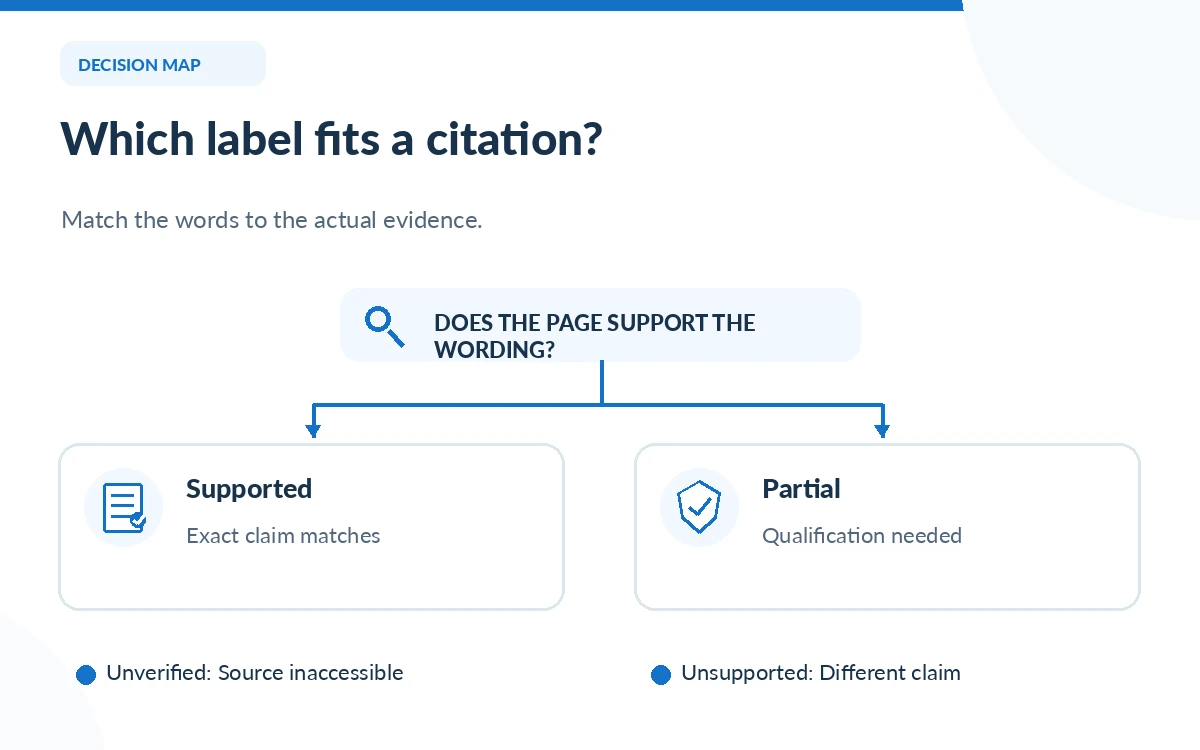
Assign one of three statuses: supported as written, partly supported or not supported. For a partially supported claim, rewrite it with the correct qualification. If a source says “may improve,” do not turn that into “proven to improve.” When several sources differ, cite their disagreement and the context rather than selecting the most convenient sentence.
Check timestamps, versions and pricing context
AI product pages evolve quickly. Look for publication date, last-updated date, regional eligibility and plan names. Pricing may depend on annual versus monthly billing, taxes, seat counts, usage or region. A cached help page can describe a feature no longer available to new subscribers. Save the date you checked the official page and avoid a timeless claim based on a temporary promotion.
For breaking news, distinguish the time an event happened from the time a story was posted. An article updated today can describe something that happened months ago. For research papers, distinguish submission, preprint and formal publication dates. If a newer original source overrides an older one, record which assertion changed so an editor can update the draft responsibly.
Audit numbers, comparisons and causal language
Recalculate arithmetic from the stated units and scope. “Per million tokens” cannot be compared with a monthly subscription unless you model usage. A study’s absolute risk change cannot be converted into an individual prediction without assumptions. When the source reports a range, confidence interval or small sample, include it instead of quoting only the most dramatic number.
Watch comparative adjectives such as “fastest,” “cheapest” and “most accurate.” They require a date, defined test set and competing group. Unless you actually ran a replicable test or cite one whose methodology fits the claim, change “fastest” to the narrower feature or use case you can demonstrate. Do not borrow a benchmark for a different model or product tier.
Use a two-source escalation rule for important claims
Not every ordinary detail warrants a second source. But for high-stakes or disputed claims, seek a genuinely independent corroborating source, preferably a primary document or a qualified research synthesis. Two blog posts repeating the same press release are not two independent confirmations. A second source is most valuable when it tests the same issue through different evidence.
If the sources conflict, log what differs: definitions, date, sample, access permissions or reporting incentives. Leave an unresolved label when needed. The goal is not to force an answer but to prevent uncertain information from becoming an apparently settled fact. A clear unresolved row is an acceptable research result.

Publish with a visible audit trail
Before publishing, remove or qualify unsupported claims, preserve sources with descriptive anchors, and add a checked-on date where the topic changes rapidly. Write a brief methodology note describing whether this was a source audit or a true product test. If an article includes AI-assisted synthesis, say which claims were independently checked rather than suggesting that every generated idea was tested.
Keep the working sheet, screenshots only when lawful and useful, permanent links, and a small change log. Recheck vulnerable statements during scheduled updates: prices, terms, limitations and availability. A citation-aware workflow is successful when another reader can trace the conclusion without needing access to your private chat history.
How We Research
We used OpenAI’s ChatGPT Search guidance, which explicitly warns that citations can be incomplete, outdated or incorrect, and Perplexity’s Pro Search guidance, which also advises source validation, checked October 26, 2026. We did not run an accuracy study. The status rubric, audit table and escalation rules are reproducible editorial procedures proposed here, not vendor-confirmed guarantees.
Frequently Asked Questions
No. It means a link is displayed. You must open the page, find the relevant passage and confirm that it supports the exact sentence in the proper context and time frame.
Mark the claim partly supported or unsupported, correct the wording and preserve a note explaining the difference. Do not leave the original claim with a citation that merely mentions the same topic.
No. Routine claims can often use one authoritative primary source. For consequential, controversial or unusually precise claims, independent corroboration and methodological scrutiny are prudent.
Open the official plan page and record billing period, currency, region, seat minimum, discounts and usage conditions. Avoid publishing a number without its date and scope.
It can help locate passages, but that does not create independent verification. A human should compare the passage with the claim and confirm important dates, units and context outside the generated summary.