
Disclosure: LabFin is reader-supported. If you sign up for a tool through links on this page, we may earn a commission at no extra cost to you. Commissions vary between providers and our ratings do not — here’s our full disclosure.
Claude for writing rests on two things in 2026: its models and its document tools. Claude Opus 5.5, available on paid plans, placed first on Arena’s creative-writing board of September 25, though on only 487 votes. On September 16, Anthropic added Claude Docs, a way to write living documents, which its release notes list on every plan. For more, our page on Claude vs Jasper covers strong prose for one writer against a brand platform for teams.
The limits are real too. Usage runs on five-hour sessions and weekly caps without published numbers, and Fable models cost extra on Pro. Drafts also train Anthropic’s models by default. This guide covers what each plan offers writers, how Claude ranks and what happens to your drafts.
Claude for Writing: The Short Answer
Claude for writing is worth paying for on Pro if voice and long drafts matter most. Pro costs $20 a month or $200 a year and unlocks Opus 5.5, and Claude shows no ads on any plan. Free writes with Sonnet and Haiku models and includes Claude Docs and up to five projects. Our guide to avoiding overuse of AI in writing also sets out five rules that keep your voice.
Check the limits and the data settings first. Anthropic publishes no message counts, and with training on it keeps chats for five years. Writers who need a larger editor or a cheaper tier may prefer ChatGPT, as our guide to ChatGPT for writing explains.
What Claude Offers Writers
Documents. Anthropic’s release notes of September 16, 2026 describe Claude Docs as a new way to write living documents with Claude and a team. The same notes say artifacts, including Claude Docs, are available on every plan, including Free. Anthropic’s pricing table, though, did not list them for Free when we checked.
Voice and context. Claude’s Styles menu lets you build a custom style from a sample of your writing, guides from Guideflow and MemoryLake show. For Claude for writing in your own voice, that style then applies across conversations. Projects keep reference files and instructions together, with up to five on Free.
Research. On paid plans, Research runs multi-step web searches and returns cited answers. It can also read Gmail and Google Docs when connected, Anthropic’s help article says.
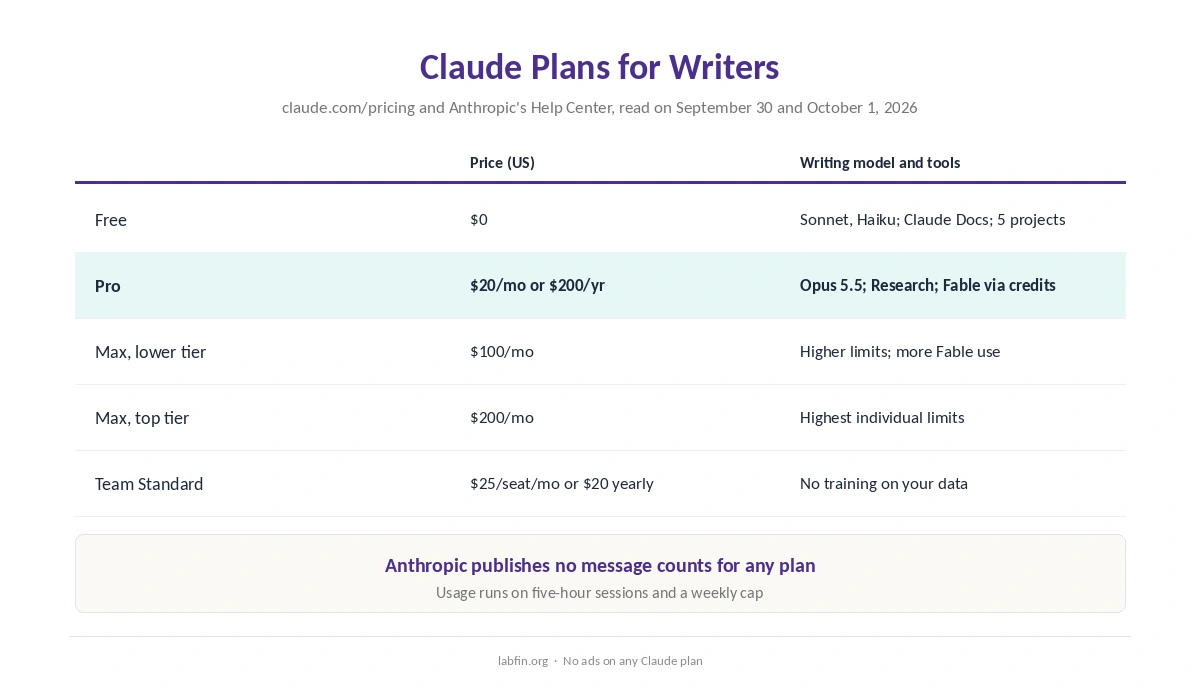
| Plan | Price (US) | Writing model and tools |
|---|---|---|
| Free | $0 | Sonnet and Haiku; Claude Docs; up to 5 projects; no ads |
| Pro | $20/mo or $200/yr | Opus 5.5; Research; Fable through usage credits |
| Max, lower tier | $100/mo | Higher limits; Fable up to half the weekly limit |
| Max, top tier | $200/mo | Highest individual limits |
| Team Standard | $25/seat/mo, or $20 yearly | No training on your data by default |
Which Model You Write With
Free runs Sonnet and Haiku models. Anthropic made Sonnet 5 the default on Free and Pro from June 30, 2026, and released Sonnet 5.5 on September 28. The pages we read did not yet say which Sonnet each plan now runs. Pro adds Opus 5.5, and Fable models run through usage credits on Pro.
Context is generous on paper: Free offers up to 1M tokens, depending on the model, according to Anthropic. In practice, the five-hour session window and weekly cap decide how much of a long manuscript you can work through in a day.
How Claude Ranks on Writing Boards
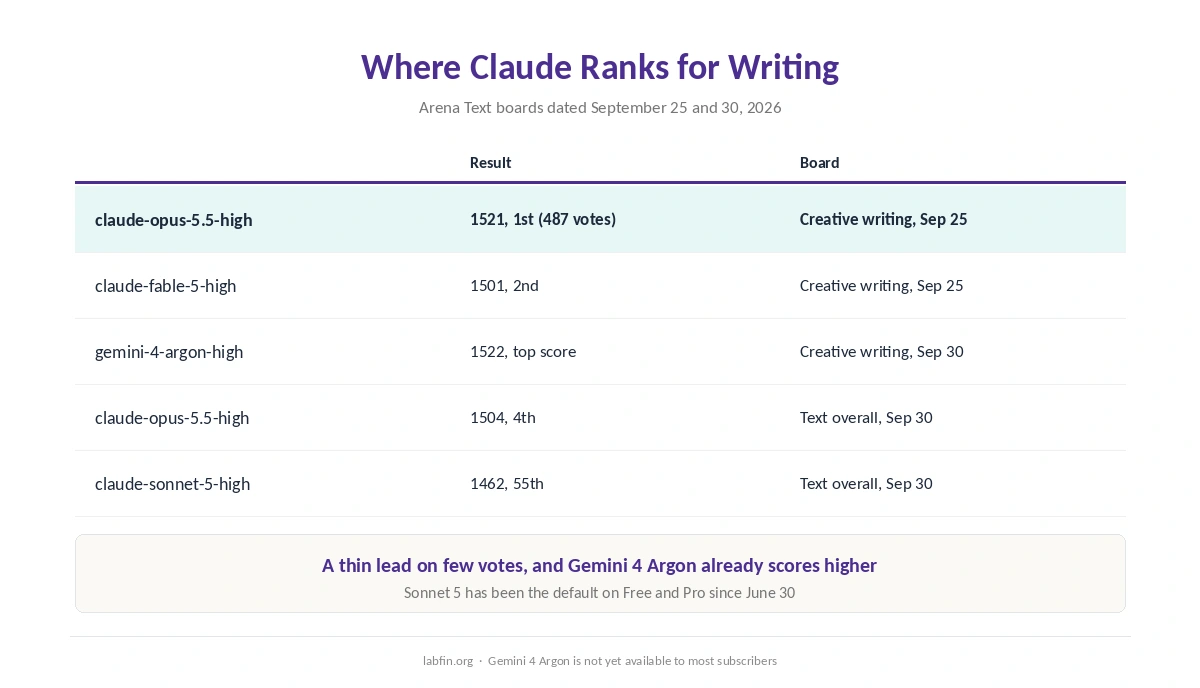
Claude’s models led Arena’s creative-writing board of September 25, 2026. Opus 5.5 placed first at 1521 on 487 votes, with a margin of 29 points, and Fable 5 placed second at 1501. Google’s best entry was fourth and OpenAI’s 14th, as our list of the best AI for writing covers.
⚠️ That lead is thin and may not last. On Arena’s creative-writing board of September 30, Google’s unreleased Gemini 4 Argon posted a higher score, 1522. On the general text board that day, Opus 5.5 placed fourth, and Sonnet 5, the free plan’s default since June, placed 55th.
Your Drafts: Training, Retention and Ownership
On Free, Pro and Max, your drafts train Anthropic’s models by default. Turning off Help improve Claude stops that. With training on, Anthropic keeps chats for five years; with it off, for 30 days. Feedback you send on a response is kept for five years either way.
Anthropic’s consumer terms assign you all of Anthropic’s rights in outputs, if any. The US Copyright Office said in January 2025 that prompts alone do not make you the author of AI output. Your own edits and arrangement, though, can be protected. This is not legal advice, so ask a lawyer about publishing contracts.
Where Claude Runs Short for Writers
Limits are the main friction. Anthropic publishes no message counts, and heavy drafting days can end at the session cap. Fable models cost extra on Pro, and Claude has no plan cheaper than Pro for writers who want Opus. Our Grammarly vs Claude for editing comparison covers which fits which job.
Claude also stops at reading your mail. Its documented Gmail support is for Research, not for writing inside the inbox. Gemini writes inside Gmail and Copilot inside Outlook, as our list of the best AI for email writing explains. Our Claude vs Gemini for writing comparison also weighs price and data terms.
Who Should Use Claude for Writing, and What to Use Instead
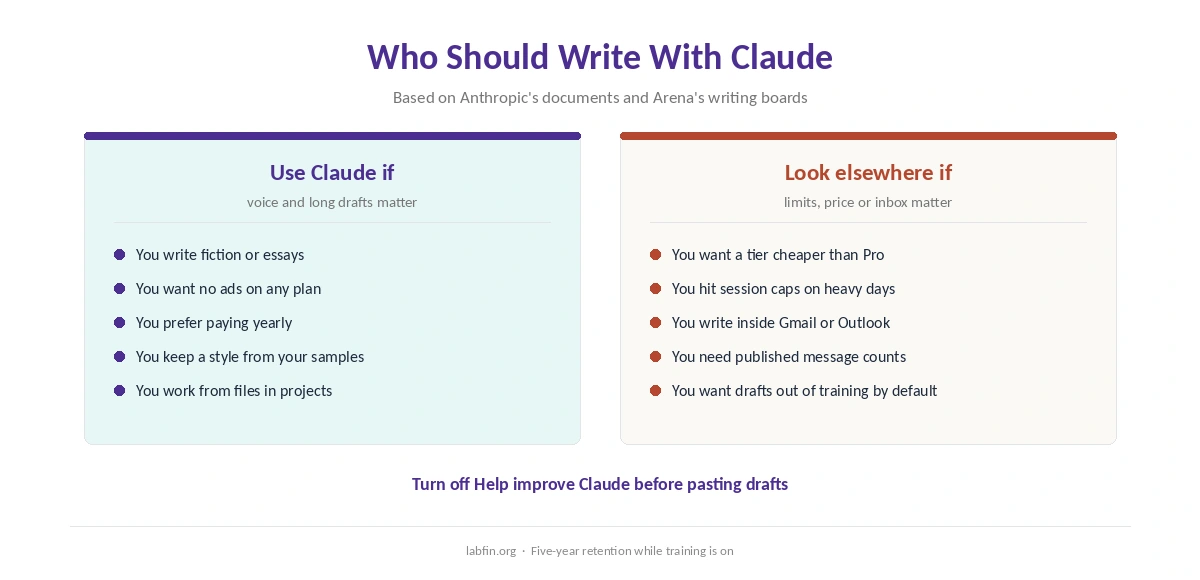
Claude suits writers who care about voice and work on long pieces. Opus 5.5’s creative-writing result, Styles, Projects and Claude Docs fit fiction, essays and reports, and no plan shows ads.
Other tools fit other needs. ChatGPT offers a cheaper Go tier and a full-screen editor, as our ChatGPT vs Claude comparison sets out. Gemini writes inside Gmail and Copilot inside Word, and our list of the best Claude alternatives covers the rest.
How We Research
This guide draws on Anthropic’s own documents, read on September 30 and October 1, 2026, including its release notes and consumer terms. Rankings come from Arena’s boards of September 25 and 30, 2026, and plan details from our Claude review.
We run no writing tests of our own and show no sample outputs, since those would age with every model update. Our criteria live on our about page.
Claude for Writing FAQ
On Arena’s creative-writing board of September 25, 2026, Claude Opus 5.5 placed first, though on 487 votes. Its limits and training defaults are the main trade-offs.
Pro, at $20 a month or $200 a year, unlocks Opus 5.5 and Research. Free writes with Sonnet and Haiku models and includes Claude Docs.
A way to write living documents with Claude and a team, added on September 16, 2026. Anthropic’s release notes list it on every plan, including Free.
On Free, Pro and Max, yes, by default. Turn off Help improve Claude; with training off, Anthropic keeps chats for 30 days instead of five years.
Anthropic’s terms assign you its rights in outputs, if any. The US Copyright Office says prompts alone do not make you the author, so copyright covers your own edits and arrangement.
The Verdict
Claude for writing is worth it on Pro for writers who value voice, long drafts and no ads. Opus 5.5 led the creative-writing board in late September, and Claude Docs, Styles and Projects support longer work.
Plan Claude for writing around the session limits, and turn off Help improve Claude before pasting unpublished work. Recheck the boards too, since Gemini 4 Argon already scores higher. If you need a cheaper tier or an inbox writer, compare the alternatives first. Our page on Claude for SEO covers the Semrush connector and which Anthropic crawlers to allow.