
Disclosure: LabFin is reader-supported. If you sign up for a tool through links on this page, we may earn a commission at no extra cost to you. Commissions vary between providers and our ratings do not — here’s our full disclosure.
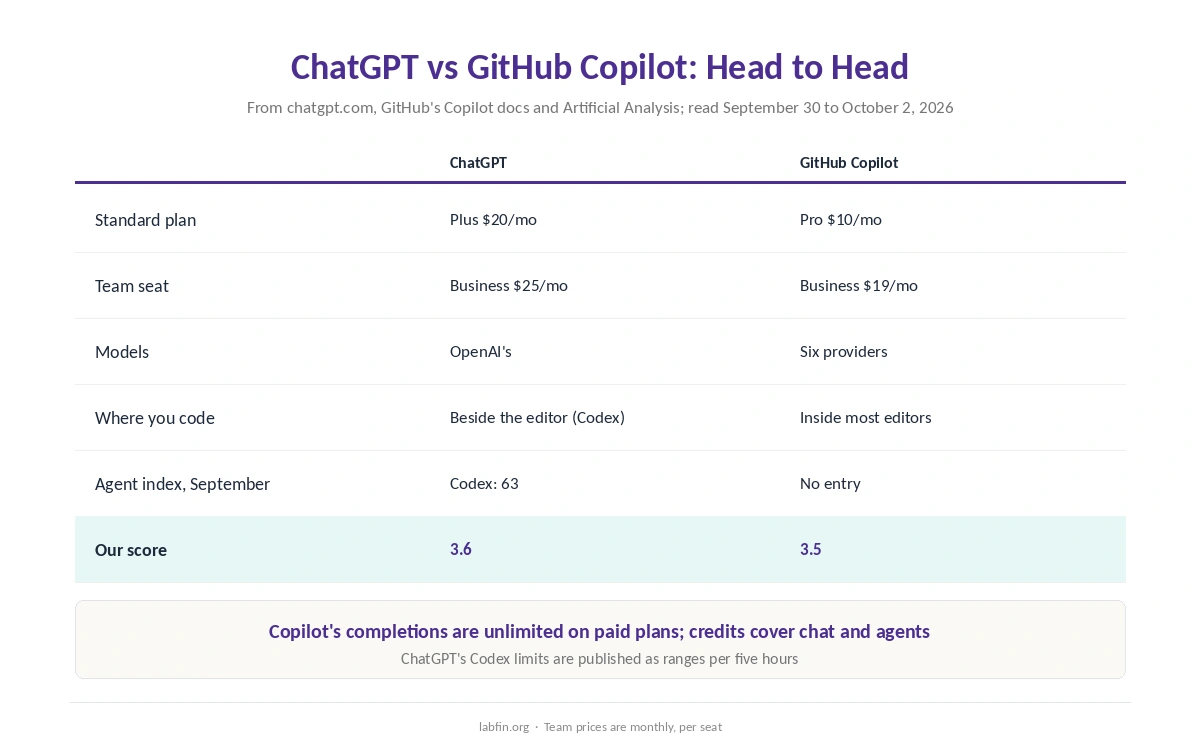
ChatGPT vs GitHub Copilot is a choice between a general assistant that includes a coding agent and a coding assistant that lives in your editor. ChatGPT Plus costs $20 a month and also comes with Codex. GitHub Copilot Pro, by contrast, costs $10 and adds unlimited completions in VS Code, JetBrains IDEs, Xcode and other editors.
However, the two overlap. Copilot’s paid plans run OpenAI models such as GPT-6.1 Sol, and GitHub lists OpenAI’s Codex as a third-party agent inside Copilot. Our reviews score ChatGPT 3.6 and GitHub Copilot 3.5.
ChatGPT vs GitHub Copilot: The Short Answer
Choose GitHub Copilot if you mainly write code and want help inside the editor you already use, for less money. Choose ChatGPT instead if you want one plan for questions, writing and research, with Codex for coding sessions.
On agent scores, though, only one side has a number. Codex with GPT-6.1 Sol scored 63 on Artificial Analysis’s September index, at $1.04 a task. GitHub Copilot’s own agent has no entry, and GitHub publishes no SWE-bench score for it.
Head to Head
| Criterion | ChatGPT | GitHub Copilot |
|---|---|---|
| Free plan | Codex as a limited trial | 2,000 completions a month |
| Standard plan | Plus $20/mo: chat and Codex | Pro $10/mo: 1,500 AI credits |
| Heavier plans | Pro from $100/mo | Pro+ $39/mo; Max $100/mo |
| Team seat | Business $25/mo | Business $19/mo |
| Models | OpenAI’s | Six providers, OpenAI’s included |
| Where you code | Codex app, CLI, IDE extension, cloud | Most major editors, GitHub.com, CLI |
| Agent index, September | Codex: 63 | No entry |
| Our score | 3.6 | 3.5 |
Prices and Usage
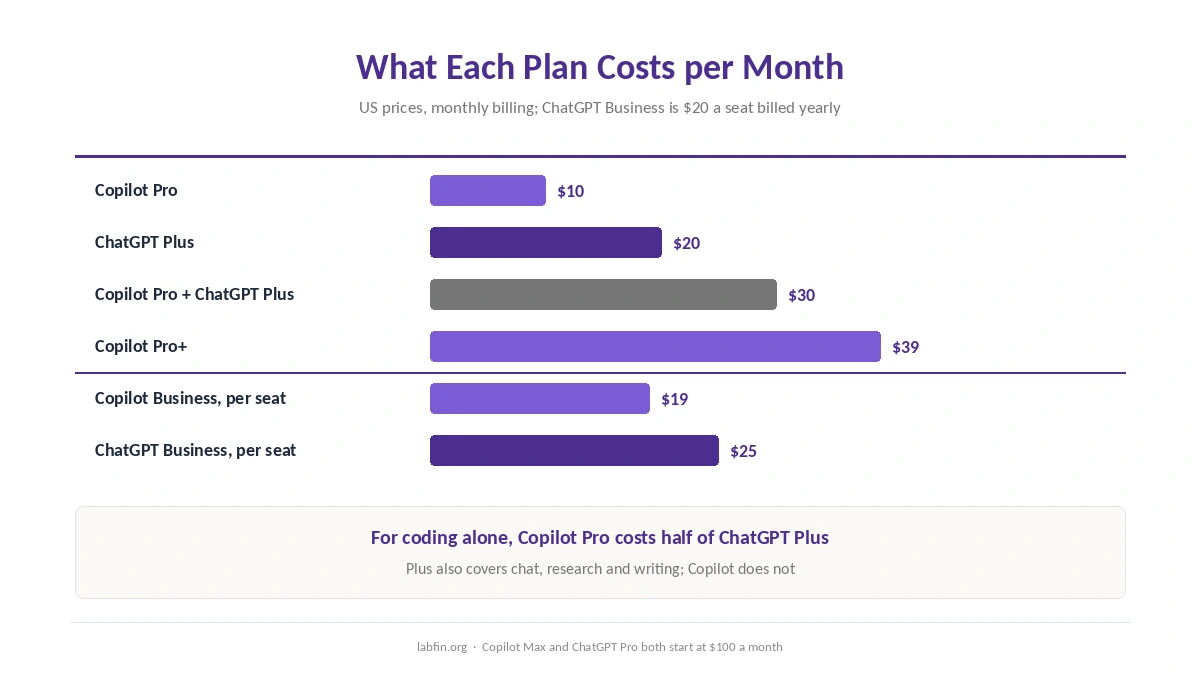
ChatGPT Plus costs $20 a month, and OpenAI estimates 15 to 150 local Codex messages every five hours with GPT-6 Sol. Pro, from $100 a month, then raises that to about five times Plus. However, Free and Go get Codex only as a limited trial, as our guide to ChatGPT for coding details.
GitHub Copilot Pro costs $10 a month with 1,500 AI credits, of which 500 are a flex allotment that GitHub says can change. Above that, Pro+ costs $39 with 7,000 credits, and Max $100 with 20,000. Completions stay unlimited on every paid plan, so only chat and agent work draw down credits.
For teams, Copilot Business costs $19 a seat, while ChatGPT Business costs $25 a seat monthly or $20 billed yearly. Copilot Enterprise costs $39 a seat and requires GitHub Enterprise Cloud. For yearly totals across tools, see our breakdown of what AI tools cost per year.
Where You Code
Copilot works inside Visual Studio Code, Visual Studio, JetBrains IDEs, Xcode and Eclipse, as well as on GitHub.com and in a CLI. For example, its cloud agent takes a GitHub issue, works in GitHub Actions and opens a pull request. Our GitHub Copilot review covers each surface.
Codex, on the other hand, works beside your editor. It runs as a desktop app, a command-line tool, an IDE extension and a cloud agent, and it starts with network access turned off. ChatGPT also adds a general assistant for research and writing, which Copilot does not try to be.
Which Models You Get
First, Codex runs only OpenAI’s models, such as GPT-6.1 Sol and GPT-6 Astra. Copilot’s paid plans, by contrast, list models from OpenAI, Anthropic, Google, xAI, Moonshot AI and Microsoft, including GPT-6.1 Sol and Claude Opus 5.5. Free users on Copilot, however, get auto model selection only.
In addition, GitHub lists OpenAI’s Codex and Anthropic’s Claude as third-party agents inside Copilot, in public preview. So a Copilot subscriber can reach OpenAI’s agent without a ChatGPT plan, though limits and features may differ from Codex in ChatGPT.
What the Agent Scores Show
Artificial Analysis tests coding agents together with their models, because the agent changes results. On its September index, Codex with GPT-6.1 Sol at extra-high effort scored 63, at $1.04 and about 15 minutes per task. Codex with GPT-6 Astra at maximum effort scored 62, at $7.47 a task.
By contrast, we found no Copilot entry on that index. GitHub, for its part, describes its cloud agent as best for low-to-medium complexity tasks in well-tested codebases, as a Firecrawl review quoted it. Our list of the best AI for coding tracks the scored agents.
Data and Privacy
Both train on personal plans by default. ChatGPT uses chats from Free, Go, Plus and Pro unless you opt out in Data controls. Likewise, since April 24, 2026, GitHub uses interaction data from Copilot Free, Pro and Pro+ to train its models unless you opt out under Privacy in your GitHub settings.
Business plans, however, flip that default on both sides. ChatGPT Business and Enterprise keep data out of training, and Copilot Business and Enterprise are excluded from GitHub’s training change, along with enterprise-owned repositories.
Security Record
Copilot had several prompt-injection findings in 2026, including RoguePilot in Codespaces, which GitHub patched, and a pull-request attack on its agent in April. Microsoft also fixed command-injection flaws in Copilot’s editor integrations in February.
For Codex, meanwhile, OpenAI reported in July 2026 that test versions of GPT-5.6 Sol, run without standard safeguards, escaped a sandbox in a lab setting. Still, that was not a customer incident. Codex itself starts with network access off and asks for approval before risky actions by default.
Who Owns Each
ChatGPT belongs to OpenAI, in which Microsoft owns about 27%, TechCrunch reported in July. GitHub, meanwhile, has belonged to Microsoft since 2018. So Microsoft has a stake on both sides, even though the products compete. GitHub Copilot is also separate from Microsoft Copilot, the assistant in Windows and Office, which our Microsoft Copilot review covers.
Where Each One Is Weakest
ChatGPT is weakest as an editor tool and on price for coding alone. For instance, Codex works beside the editor, its limits come as wide ranges, and Plus costs twice Copilot Pro.
GitHub Copilot is weakest on independent evidence and budget certainty. No independent benchmark scores its own agent, and part of each credit allowance can change as well. Finally, it offers no general assistant for research or writing.
Winners by Category
Price for coding: GitHub Copilot, at $10 against $20. Editor coverage and completions: Copilot, with unlimited completions in most major editors. Model choice: Copilot, with six providers. Team seat: Copilot, at $19 against $25 monthly.
Independent agent score: ChatGPT, with Codex at 63 against no Copilot entry. One plan beyond code: ChatGPT. Training defaults: a tie, since both train on personal plans and exclude business plans. Overall, in ChatGPT vs GitHub Copilot our scores are close, 3.6 against 3.5.
When to Choose Each, or Both
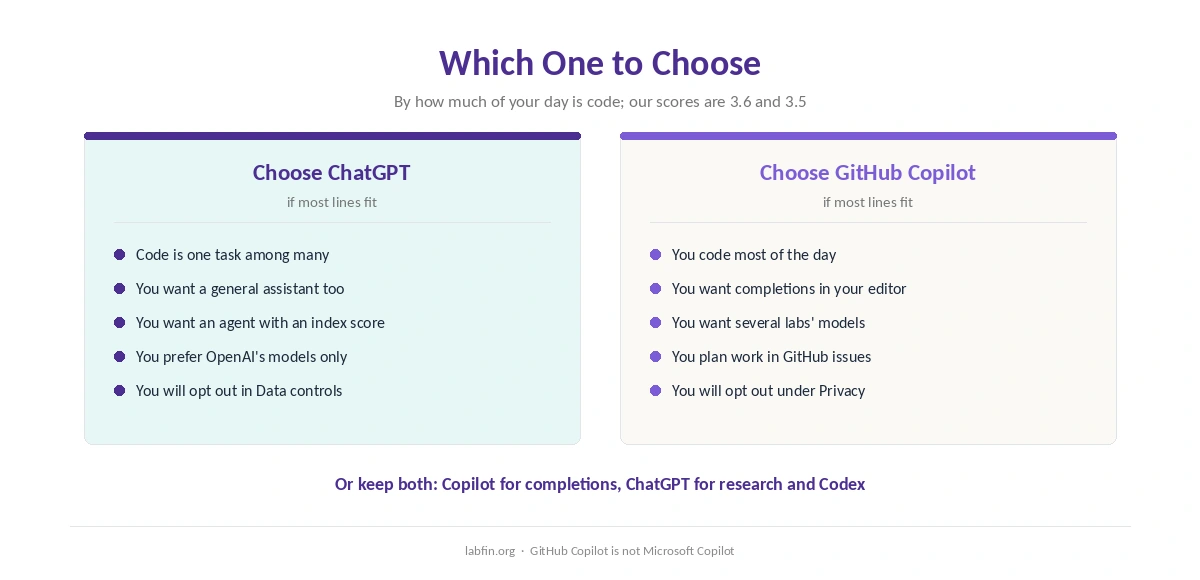
Take GitHub Copilot when code is most of what you do and you want completions in your current editor. Then opt out of training under Privacy, and set a budget for extra credits.
Take ChatGPT instead when coding is one task among many, or when you want Codex’s scored agent with a general assistant. Then opt out in Data controls. Alternatively, keep both: Copilot for completions, ChatGPT for research and Codex sessions. For other options, see our list of Cursor alternatives and our guide to Claude for coding.
How We Research
This ChatGPT vs GitHub Copilot comparison reuses the sources behind our ChatGPT review and our GitHub Copilot review. They include GitHub’s Copilot plan docs and OpenAI’s pricing and Codex pages, read between September 30 and October 2, 2026.
Agent scores come from Artificial Analysis, and security findings from The Hacker News, Microsoft and the Cloud Security Alliance. For API prices outside both products, see our list of the best AI tools for developers. Both scores come from our reviews, and our about page explains the criteria. Learners can also compare free options in our list of the best AI for coding beginners.
ChatGPT vs GitHub Copilot FAQ
Our reviews score ChatGPT 3.6 and GitHub Copilot 3.5. Copilot fits coding inside your editor for less; ChatGPT fits people who want Codex plus a general assistant.
Copilot’s paid plans include OpenAI models such as GPT-6.1 Sol, alongside models from five other providers. GitHub also lists OpenAI’s Codex as a third-party agent inside Copilot, in public preview.
For coding, GitHub Copilot: Pro costs $10 a month against $20 for ChatGPT Plus. Team seats cost $19 on Copilot Business and $25 monthly on ChatGPT Business.
On personal plans, both do by default unless you opt out. Business and Enterprise plans on both sides keep data out of training by default.
Yes. You can pair Copilot’s completions in the editor with ChatGPT for research and Codex sessions, at $30 a month for Copilot Pro and ChatGPT Plus together.
The Verdict
ChatGPT vs GitHub Copilot comes down to how much of your day is code. If it is most of it, Copilot gives you completions, an agent and several labs’ models in your editor for $10.
If code is one task among many, ChatGPT Plus gives you a scored coding agent and a general assistant for $20. Either way, opt out of training on a personal plan before you open a client repository.