
A hypothetical local archive records an interview with an oral historian on one microphone and a former boat builder on another. The stereo file contains a question and answer that briefly overlap. Amazon Transcribe channel identification can generate channel-specific transcription, but its labels describe audio channels, not verified personal identities. Staff must still confirm which microphone belonged to whom.
Identify the actual audio routing
Before transcribing, inspect the recording in an editor. Confirm that microphone A is recorded to the left channel and microphone B to the right, rather than both microphones being mixed into each channel. Merely exporting a file as stereo does not create meaningful source separation. Make a short test recording and label the audio routing in production notes.
For the fictional boat-builder interview, the historian’s track is left and the guest’s track is right. Those labels are tentative until checked against the actual session setup. If a cable was swapped halfway through recording, one channel number cannot safely stand in for a named person across the entire interview.
Obtain recording and transcription permissions
Document participants’ consent to recording, storage, transcription and eventual publication as applicable. Archival interviews can include family names, addresses and sensitive stories even when the recording is intended for public education. Decide which sections require restriction or redaction, and verify that using a cloud transcription provider fits the archive’s agreements.
Store the original recording with controlled access and maintain a separate editorial copy. Do not publish a raw transcription simply because the service processes it successfully. Participants may have agreed to an internal archive copy but not to a searchable website transcript. Check local law and the institution’s release forms.
Enable channel identification for the source
AWS documents channel identification for files with two channels and notes that Amazon Transcribe does not currently support more than two audio channels for this feature. In a batch job, turn on Channel identification in audio settings or use the corresponding request setting. Confirm language, file format, output location and account permissions from the current documentation.
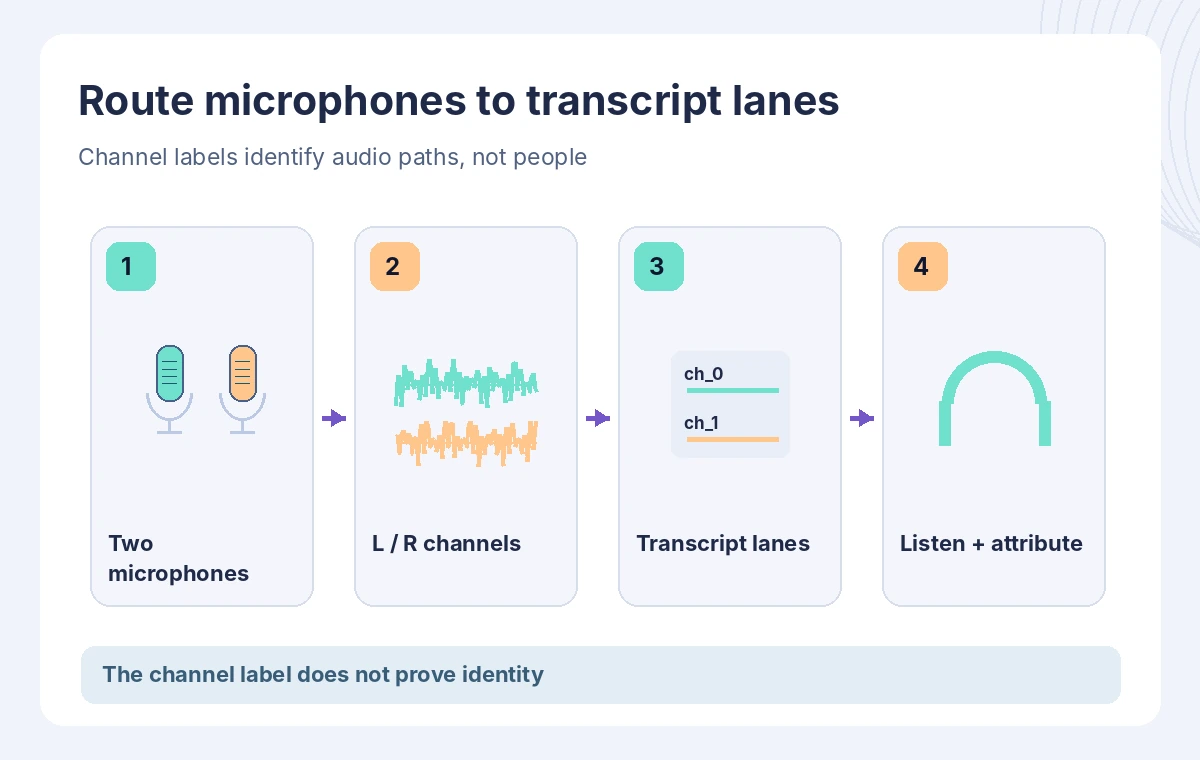
Do not confuse channel identification with speaker diarization. A channel is an audio path; speaker labels attempt to distinguish voices within audio. With two dedicated microphones, channel attribution can be especially helpful, but it does not prove who wore each microphone or whether two people occasionally shared the same one.
Read ch_0 and ch_1 as technical labels
AWS describes channel labels ch_0 and ch_1, with the channel_labels output grouping utterances and items with timestamps. Map ch_0 to a person only after confirming the original routing. In the conceptual process diagram, two microphones lead to left and right waveforms, then separate transcript lanes and finally a human attribution review.
Write a simple mapping note: “ch_0 = historian, verified from slate at 00:12,” rather than letting the system rename the labels automatically. If the file was edited or channels were swapped, document the boundary and do a manual review around the edit. Never infer identity from the perceived gender or accent of a voice.
Handle overlap without flattening it
The interview may include the guest speaking while the historian finishes a question. AWS notes that timestamps can overlap for two channels. That overlap is not inherently a transcription error. Preserve it in the working transcript and listen to the segment before deciding whether the publication format should use simultaneous lines, brackets or an explanatory note.
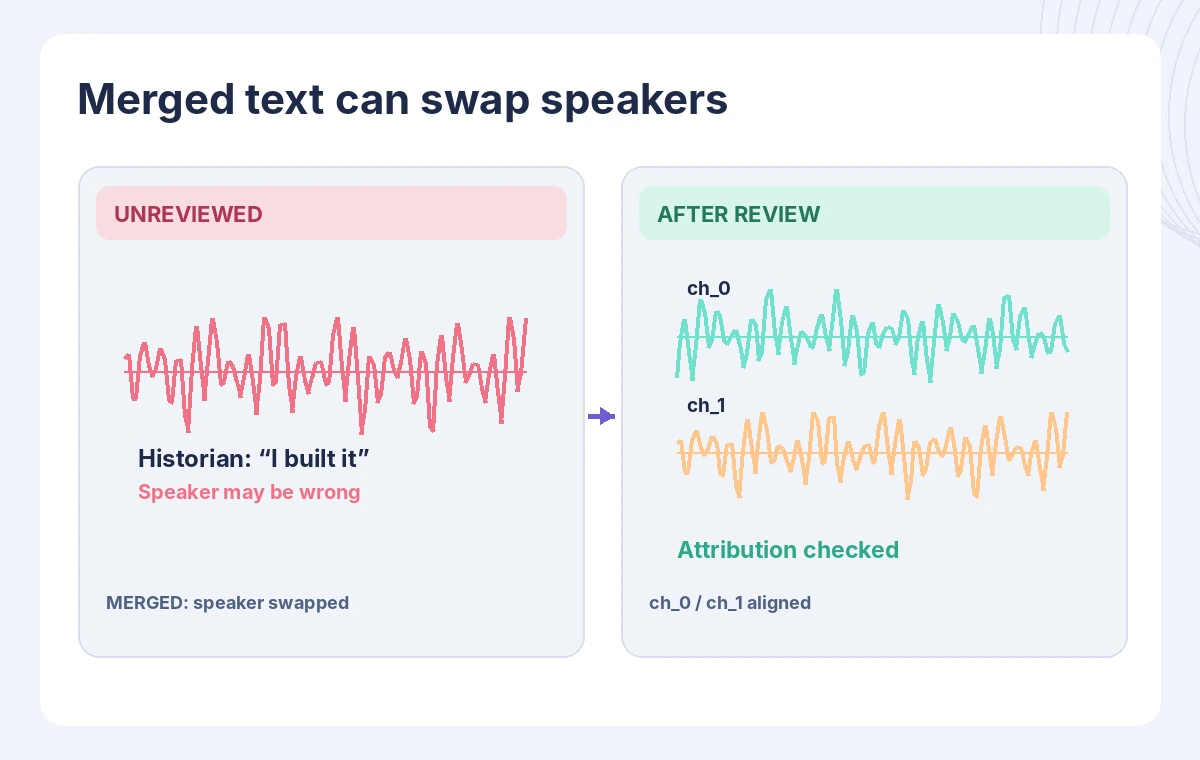
A merged, line-by-line text view can place one response before a question has finished. The comparison illustration shows a merged text lane falsely assigning a short phrase, contrasted with separate channel strips that preserve time. These are pedagogical waveforms, not measured vendor results.
Inspect uncertain words and proper names
Traditional boat-building vocabulary, location names and personal names may be unfamiliar to a speech model. Listen to each uncertain span and compare it with the archive’s name authority records. A high confidence value or plausible spelling is not a substitute for verification. Mark genuinely unintelligible audio as such rather than guessing an impressive-looking term.
Keep an annotation log with timestamp, tentative wording, final correction and reviewer initials. If the guest says “not seaworthy,” be especially careful not to drop the word “not.” Small function words can reverse meaning in a technical or historical statement. A transcript should represent the recording, not an editor’s expectations.
Use the channel strips as a verification aid
Align each paragraph in the transcript to the original audio time. For ch_0, verify the historian’s prompts; for ch_1, verify the guest’s responses. Look for low-level bleed of the other microphone, clipped words at turns and segments where a channel is silent but the displayed text continues. Check several representative segments before approving the full file.
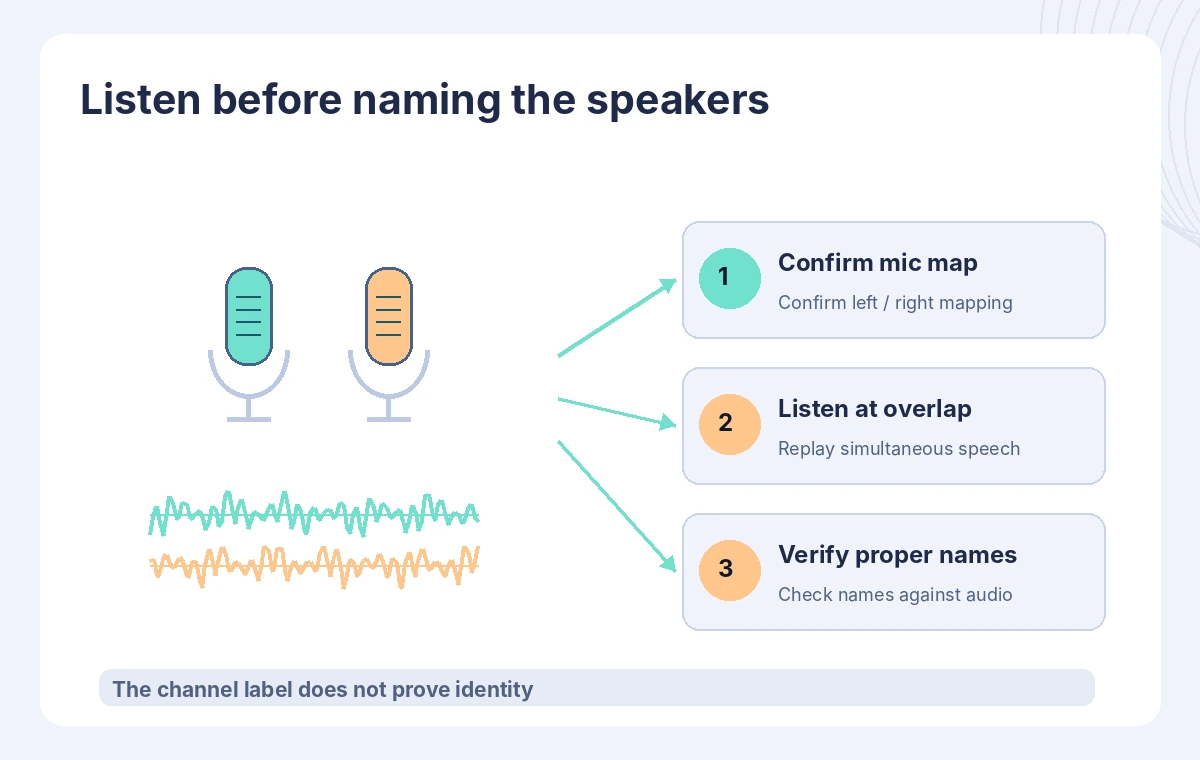
The audit diagram shows a headset, two waveform lanes and three callouts: microphone map, overlapping timestamps and proper-name review. It teaches where to inspect; it does not claim the sample file was run through Amazon Transcribe. Actual audio may require repairs or alternate processing when one source is heavily contaminated.
Build a readable but honest transcript
For public release, add a short note on conventions: how overlapping speech is represented, whether nonverbal sounds are omitted and what “[inaudible]” means. Do not silently rewrite conversational answers into polished historical claims. Preserve uncertainty and give readers a way to find the corresponding recording if access rights permit.
A second person should check the published excerpt against the sound file, particularly the interviewee’s name and any controversial claim. Protect restricted passages while keeping editorial placeholders distinct from actual quoted speech. Search indexing should use the approved transcript rather than preliminary machine output.
Check media settings and release boundaries
Reconfirm the service’s current quotas, retention behavior, IAM access, supported encodings and region before sending a real interview. Cost and availability can change. Keep raw audio, machine output and approved transcript clearly separated, with stable identifiers and a policy for deleting temporary processing copies.
The final release gate asks: Were both channel identities verified? Were overlap and critical words reviewed? Does consent cover the intended audience? If any answer is missing, delay publication rather than fabricating certainty. This guide describes an illustrative workflow, not a completed field test.
How We Research
For this November 2026 guide we consulted the product developers’ primary materials: AWS Amazon Transcribe multi-channel audio guide, AWS Transcribe settings reference. We compared documented feature definitions, workflow boundaries, source or state handling, and restrictions on availability. We did not run these vendor APIs, visit an actual museum workshop, deploy a website, or test an interview recording. The people, dates, objects, permissions and outcomes in the examples are fictional; the drawings are original conceptual explanations, not product screenshots or benchmark results. Editorial checks and approval stages are recommended procedures, not guarantees supplied by the service. Review current provider documentation, billing, regional availability, privacy terms and the organization’s own policies before applying the process to sensitive records or live users.
Frequently Asked Questions
No. Channel labels identify audio paths. Verify microphone routing and the speakers for that specific recording.
The cited channel-identification documentation describes support for up to two channels, not three.
No. The channels can legitimately have overlapping timestamps when both participants speak at once.
No. Recording, processing, storage and publication permissions remain separate obligations.
No. The interview, sample waveforms and transcript comparisons are conceptual.