
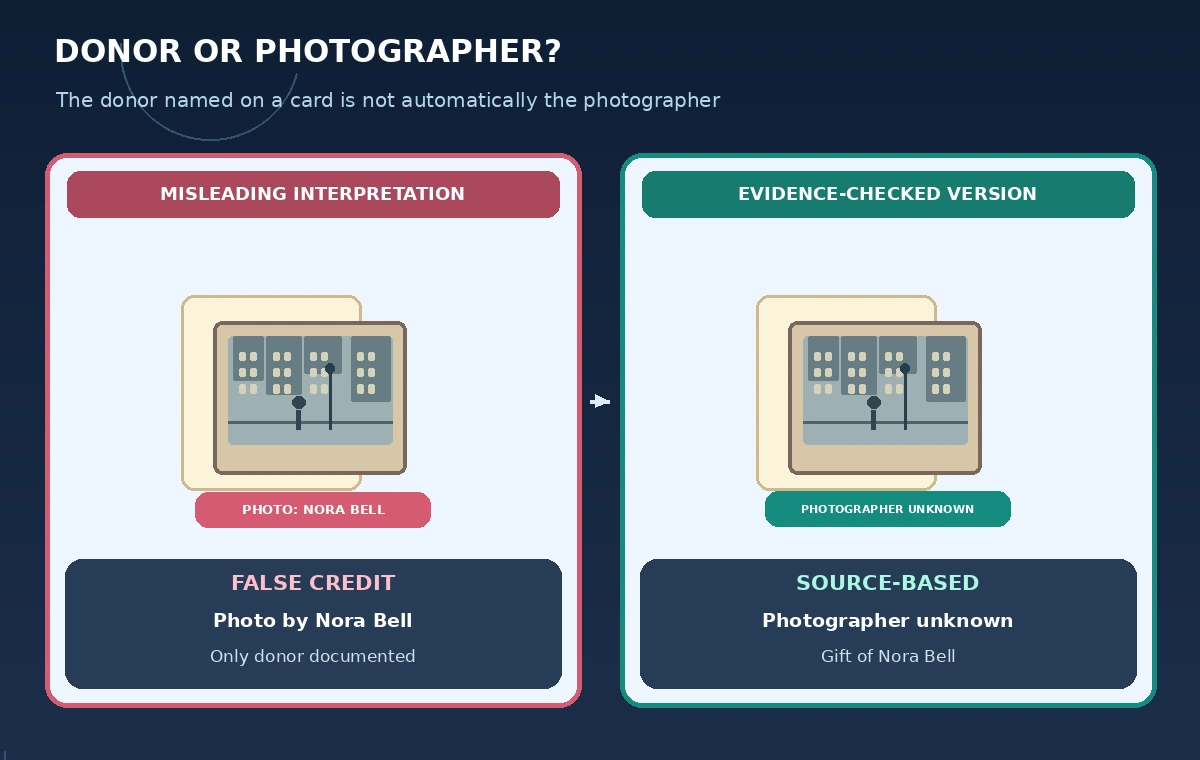
A small museum wants to label a black-and-white street photograph. A donation card names Nora Bell as the person who gave the print to the museum; a separate exhibition draft casually calls her the photographer. Those are different claims. An AI answer that merges them into “Photo by Nora Bell” could insert an invented credit into the public record.
OpenAI File Search lets an application using the Responses API search uploaded material stored in a vector store. It can surface passages relevant to a question and return file citations, but retrieval is not a substitute for archival judgment. This guide designs a controlled, fictional caption-checking workflow. It does not describe a live accuracy test or a real museum collection.
Start with the exact claim the caption must support
Write down three separate fields before asking the model anything: what the image shows, who physically donated the print, and who created the negative or original photograph. The donation card might reliably establish the second field while saying nothing about the third. A useful draft caption can state the documented subject and date range while leaving the photographer unidentified. Do not convert a missing creator field into an inferred person merely because a name appears nearby.
Create a small decision sheet with statuses “documented,” “conflicting,” and “unknown.” These statuses should travel with the final text. A named photographer requires a trustworthy source that actually assigns authorship, not a loose association in a file name or an exhibition script. Use synthetic names and catalog IDs when testing this workflow so a false generated answer cannot leak into a real accession record.
Prepare source documents so names have clear roles
Split the training collection into the donation card, accession description, digitization log, and previous exhibition draft. In each file, retain the document title, responsible department, revision date, and any original record number. A scan with poor handwriting needs manual transcription review before indexing; otherwise the retrieval tool may faithfully recover a transcription error. Include a small source note explaining who wrote each document and why it should or should not establish authorship.
Keep the approved record separate from drafts. The draft label is useful evidence of what was previously printed, but it cannot independently validate its own attribution. If there are two conflicting accession exports, record which one is authoritative rather than combining them into a plausible composite. Remove information that the assistant does not need, especially donor contact details and private correspondence, before creating searchable uploads.
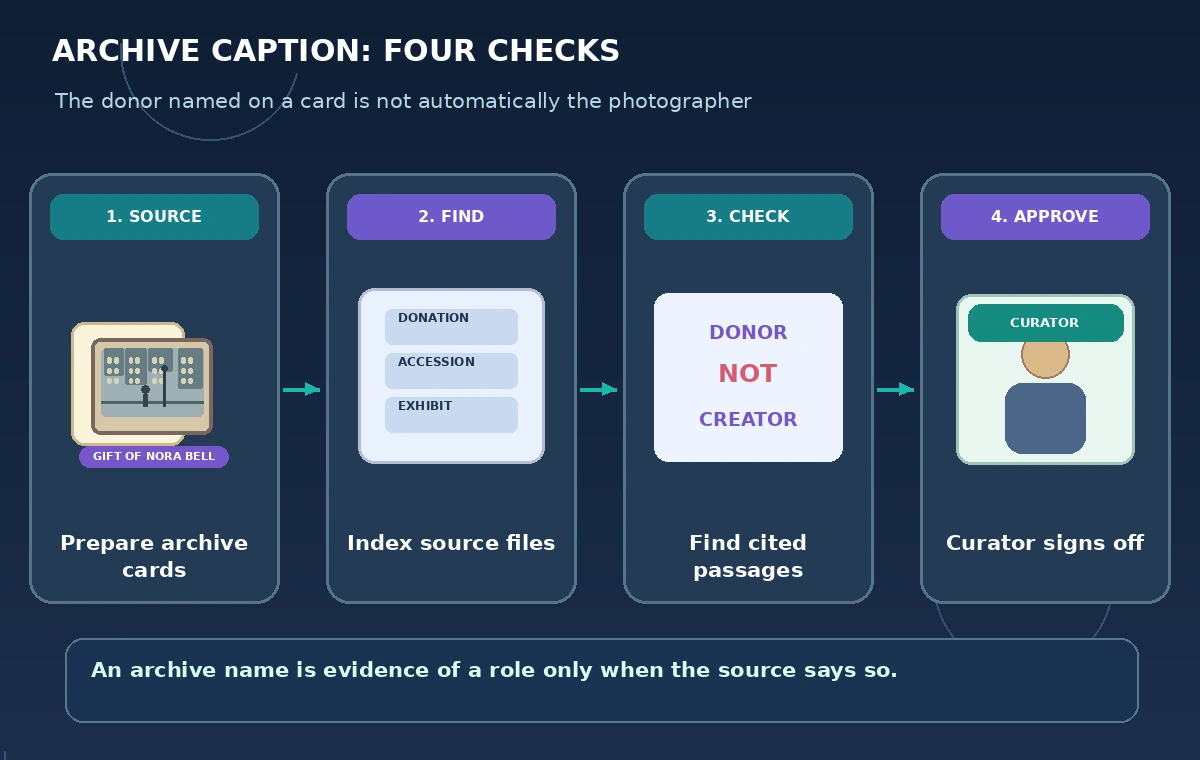
Create a vector store and wait for indexing
OpenAI documents File Search as a hosted Responses API tool, backed by vector stores containing uploaded files. Files are chunked and indexed for semantic and keyword retrieval. Upload the prepared documents, associate them with the intended store, and confirm that their indexing status is completed before testing any question. A file listed in an upload queue is not proof that its contents can already be retrieved.
For a real integration, store the vector-store ID outside article copy and track document versions in the application database. If an approved card is replaced, check that the new version has been indexed and that stale material is no longer being used. Removal and search availability may not be instantaneous, so important corrections deserve a deliberate refresh-and-verification step. Never put real API keys or collection identifiers into a public tutorial.
Ask for evidence with role-specific questions
Instead of “Who took this photograph?”, ask the application to find passages explicitly identifying the photographer, separately list passages that identify the donor, and explain when no creator can be established. Ask for the source file and supporting excerpt for each claim. File Search is best used to gather candidate evidence; the human editor should read the passage within the underlying document before accepting it as a credit.
A structured evidence table can have columns for claim, source document, excerpt, source role, and editorial decision. In the fictional example, “Nora Bell donated the print” may be supported by the donation card. “Nora Bell photographed the scene” remains unsupported. Do not force the model to fill every cell; an empty photographer field is a meaningful outcome, not a failure to complete the table.
Inspect citations and retrieved results rather than fluent prose
OpenAI describes file citations in model output and an option to include file-search results in the API response using the include parameter. Those features help an application expose the source trail, but a citation can still support a weaker claim than the sentence suggests. Check whether the quoted passage uses words such as “gift of,” “collection of,” “attributed to,” or “photographed by.” These phrases cannot be treated as interchangeable.
For the first rollout, review every proposed attribution against the exact page or record. Maintain a separate deterministic list of required fields and compare it with the assistant’s answer. If the assistant cites only a later label rather than the accession card, mark the proposed attribution for review. The diagram contrasts a false creator credit with a caption that faithfully distinguishes donation from authorship.
Handle gaps, contradictory dates, and ambiguous names
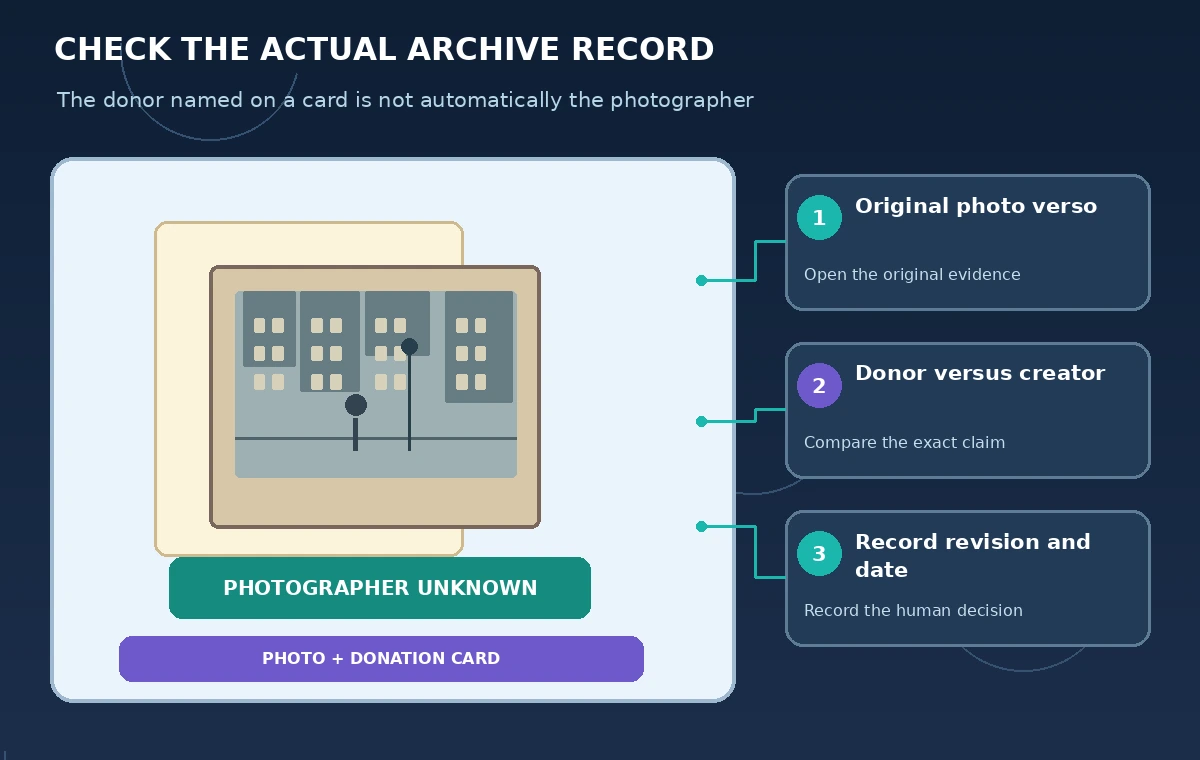
A second letter might mention “N. Bell” without clarifying whether it refers to the donor, a relative, or a photographer. The assistant must not resolve that ambiguity by matching surnames. Record the unresolved candidate and ask an archivist which records could confirm identity: a negative sleeve, signed print verso, or catalog ledger. Search can narrow the reading workload; it does not confer historical certainty.
Likewise, a date printed on a donation card might mark acquisition, not exposure of the photograph. Give the date field its own evidence trail. A safe public caption may say “Undated photograph, donated in 1984,” where the two time facts remain separate. If the museum later obtains a stronger attribution, update the caption through the normal catalog revision process, preserving a note about the earlier uncertainty.
Protect private records and manage indexed material
Vector stores are hosted collections of uploaded content, so determine whether the records may be sent to the chosen service under institutional policy before upload. Redact private addresses, personal contact information, and restricted accession notes when they are irrelevant to the question. Manage storage and expiration settings deliberately rather than assuming every file disappears after the response is generated. OpenAI documents vector-store expiration policies and storage considerations.
Give the application an authorized collection scope: one archive subset is not permission to search every department’s material. Record which uploaded versions support each published caption and who approved it. If the team cannot identify or remove a restricted file, do not deploy the system. Data governance and access controls are separate from whether the generated English sounds historically convincing.
Publish only after the curator can reproduce the evidence
Before release, have the responsible curator open the original images and records, read each cited passage, and approve the final caption. A practical review sheet should flag unsupported creator names, donor-versus-photographer confusion, acquisition-versus-exposure dates, and documents awaiting transcription correction. Keep a manual override that lets staff write “photographer unknown” without an AI-imposed completion requirement.
This tutorial reviewed official OpenAI documentation about hosted file search, indexing, citations, retrieval, and vector-store lifecycle. No API calls, archival uploads, retrieval benchmarks, or actual photographs were tested. The records and diagrams are invented teaching materials; their purpose is to show how a transparent source-checking workflow can prevent an appealing but false historical credit.
How We Research
For the November 5, 2026 documentation review, we consulted these named official sources: OpenAI API: File search; OpenAI API: Retrieval and vector stores. We compared their stated feature capabilities and eligibility limits with the workflow described above. We did not run the named service or test real customer records; all cases, outputs, and diagrams are hypothetical. Check current product documentation, plan access, and organization policies before use.
Frequently Asked Questions
No. It retrieves relevant passages. A curator must interpret the documents and approve any attribution.
Confirm that indexing has completed before treating it as part of the searchable collection.
A donor may own or give a print without creating the original image. The evidence for each role is different.
No. Keep it unknown and record what additional evidence would be needed to resolve it.
No. The names, documents, results, and illustrations are fictional workflow examples.