
Why a visitor kiosk has a cold-start problem
An exhibition kiosk may answer visitor questions about a small collection of approved objects. When the application starts, the same long interpretive guide, permitted source excerpts, and answer-format rules will be needed for many later questions. The first visitor should not have to wait unnecessarily while the same context is prepared from scratch, but the application cannot predict the actual question.
OpenAI documents prompt_cache_options.prewarm as a way to prepare a reusable prompt cache prefix before generating a response. It is relevant to supported GPT-5.6-and-later models in the Responses API. Preparing a prefix is not permission to invent a tour answer, access private accession records, or claim that a service latency improvement was measured.
Understand what prewarm actually does
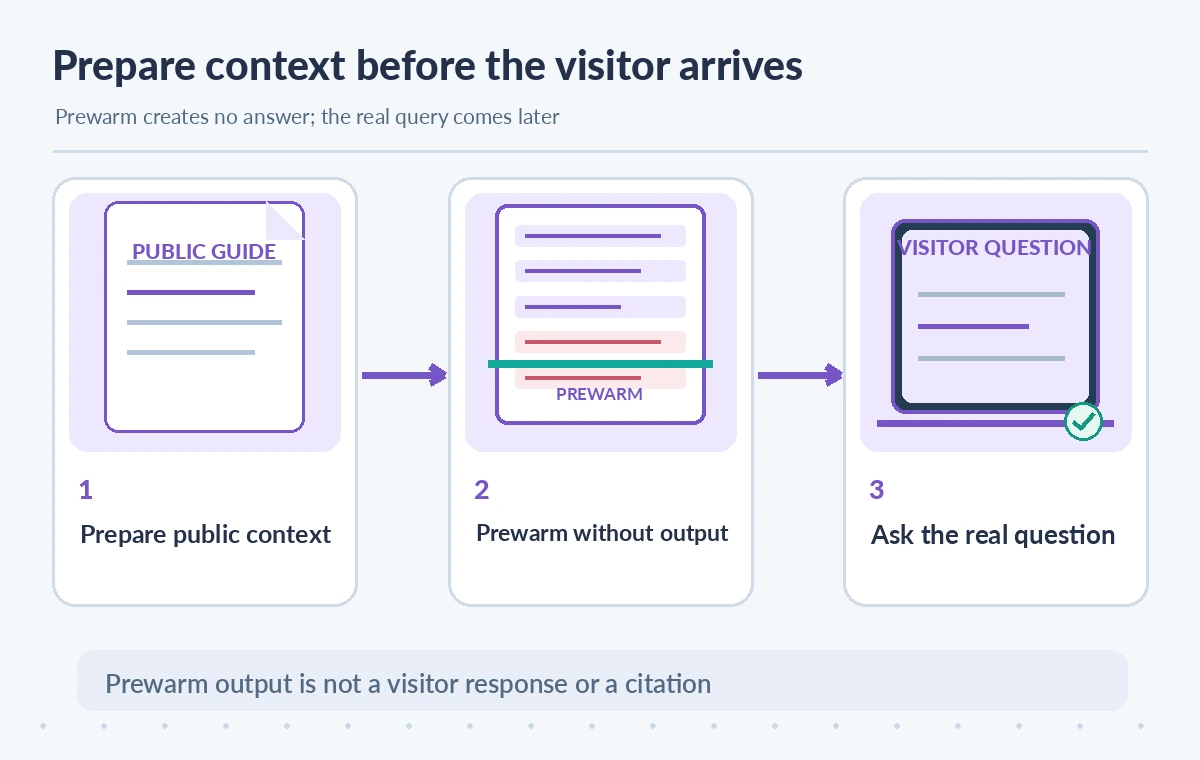
The Responses API reference describes prewarm as a boolean inside prompt_cache_options. When set to true, it prepares prompt caching without generating output, overriding the generate field to false. The application makes a preparatory request, then issues the actual generation request with the same prefix and prewarm omitted or false. It should not display the preparatory response as a visitor-facing answer.
The guide recommends preparing shared instructions, tool definitions, or reference material before a user sends a request. A prewarm call does not create a finished caption or a citation. It also does not promise a cache hit for every subsequent request. Eligibility, prefix matching, model configuration, time gap, and the chosen breakpoint mode all matter.
Build the source-approved prefix first
For a fictional natural-history gallery, assemble a versioned public fact sheet containing approved specimen names, exhibit locations, accessibility wording, and the distinction between reconstructed and original objects. Add rules for declining unsupported provenance claims. Keep the source register and the version number visible to the application so editors can retire an outdated context without guessing which text was cached.
Do not include individual visitors’ questions, device IDs, camera images, or donor correspondence in the shared prefix. Place dynamic questions after the reusable material in the real generation request. If the kiosk uses retrieval tools, define an explicit authorization boundary for what the tools may search; a cached instruction cannot turn restricted archive data into public material.
Match the real request to the prepared prefix
The guide explains that a cache lookup works against matching prompt prefixes. Keep shared instructions, tool declarations, and the ordering of input blocks stable between the prewarm request and the first actual answer. A timestamp injected into the middle of the policy or an unexpectedly reordered tool schema can break reuse even though the wording seems equivalent to a human reader.
On supported newer models, implicit and explicit cache modes provide different breakpoint behavior. A deliberate explicit breakpoint can separate a stable public exhibit guide from a changing visitor request, but explicit-only mode without an explicit marker will not write a cache entry. Select a documented mode and test it, rather than assuming the existence of prewarm alone creates a useful boundary.
Compare cold, prepared, and approved states
Without prewarming, the first visitor query may require processing the full shared prefix. With an eligible prefix prepared, the next matching request can potentially reuse cached work. A third and separate state is an answer checked against the current exhibit guide, with accessible language and verifiable source references. Cache reuse belongs to the performance pathway; the last state belongs to editorial quality.
The comparison illustration is a conceptual system diagram, not a timing benchmark. A prepared request can still miss the cache, and even a successful cache hit does not show that a date or scientific name is correct. A user-facing kiosk should not silently elevate its confidence simply because usage accounting reports cached tokens.

Measure cost as well as startup latency
Prewarming is a real API operation and may incur cache-write charges even though it produces no final text. OpenAI’s current prompt caching documentation distinguishes cache writes, cached reads, ordinary input tokens, and the applicable lifetime settings for supported models. A kiosk restarted repeatedly with few actual visitor queries could spend more preparing prefixes than it saves.
In an approved test environment, compare the time to first response token and the relevant usage fields for cold and prepared runs. Record how often the kiosk starts, how many questions follow, and when the public content changes. Use actual model rates and measured request usage rather than a percentage claimed by a marketing example. No such benchmark was conducted for this article.
Plan retention and source replacement
The kiosk’s source guide may change after an exhibit correction, rights withdrawal, or accessibility review. When that happens, update the authoritative content version, stop sending the old prefix, and prepare the new approved material. Do not assume a cache can be manually erased on demand; OpenAI’s caching documentation describes expiry rules and notes that manual cache clearing is unavailable.
Have an institutional privacy owner review data controls before using any API caching feature. Cache lifetime settings are not substitutes for the organization’s permissions, its own log retention policies, or restrictions on donor materials. Keep visitor input out of the reusable shared context and avoid writing full visitor questions into public diagnostic records to chase cache-hit rates.
Test startup, expiry, and fallback behavior
Use a synthetic exhibit guide with one known ambiguous attribution and a separate test question. Simulate a kiosk restart, make a prewarm request with the chosen settings, then ask the same question with the matching prefix. Check response validity and inspect usage accounting to see whether cache reuse is observed. Also test a modified source version that deliberately breaks the prefix match.
A reliable kiosk must answer correctly even when the cache is cold, unavailable, or expired. Ensure the application does not retry a failed preparatory operation forever or display an empty preparatory response. The failure path should proceed to a normal authorized request or provide an accessible unavailable message, according to the institution’s deployment policy.
Put the human source check ahead of release
Before activating prewarm, confirm that all shared context is approved for public visitors, the source revision is correct, the model and endpoint support the parameter, and the selected caching mode has a viable breakpoint. Monitor actual cache usage and operational cost, but keep release permission in a separate editorial workflow that checks sources, rights, and the kiosk’s accessible fallback.
This is a documentation-based design for a hypothetical museum application. No live OpenAI account, real visitor traffic, performance test, cache trace, or institutional source material was used. Consult current OpenAI model compatibility, data controls, usage reporting, and pricing before deploying the approach, and rerun the content review whenever the public exhibition guide changes.

How We Research
We reviewed the following primary documentation on November 11, 2026: OpenAI prompt caching guide; OpenAI Responses create reference; OpenAI data controls guide. We compared the named feature with the official API or workflow reference and designed failure-case checks for a fictional museum or archive process. The diagrams show conceptual states rather than authentic vendor screenshots or measured service performance. No real user files, cloud accounts, production calls, pricing benchmarks, security audit, or observed product output were used. Confirm API version, model and region support, source rights, organization permissions, current rates, and operational limits before adoption.
Frequently Asked Questions
No. The current Responses API reference says prewarm prepares the cache without generating output and overrides generate to false.
No. OpenAI documents prompt_cache_options for GPT-5.6 and later supported models; confirm current compatibility for the chosen endpoint.
No. The next request must match an eligible cached prefix, and latency improvement is not guaranteed.
That defeats the purpose of a common public prefix and can create privacy problems. Keep approved exhibit reference material stable and append the visitor query later.
No. Editorial verification requires current source citations, rights review, and accessibility checks regardless of cache state.