
The overlooked question in shared grant workflows
Imagine a research team that reviews applications for two independent museum grant programs. Both teams send a long, approved rubric to a Responses API assistant, followed by different applicant-specific questions. The repeated rubric makes caching attractive, but the finance lead needs usage records that do not blend the two workspaces. The prompt_cache_key parameter is relevant to how the application groups requests for caching, not to whether a grant analyst is allowed to read another workspace. The first design decision is therefore to separate accounting identifiers from permissions and from the source documents themselves.
What prompt_cache_key actually changes
OpenAI describes prompt_cache_key as an optional request field. For GPT-5.6 and later, the guide emphasizes using it to keep cache accounting separate among customers, users, or workspaces; it is not necessary to improve caching on those models. For models before GPT-5.6, a stable key can help route requests with a common reusable prefix to matching cache machines. Neither use promises that every eligible call becomes a cache hit. Requests must still share a matching rendered prefix, reach an appropriate cached entry, and satisfy model-specific caching rules. This is a routing and grouping control, not an API authorization setting.
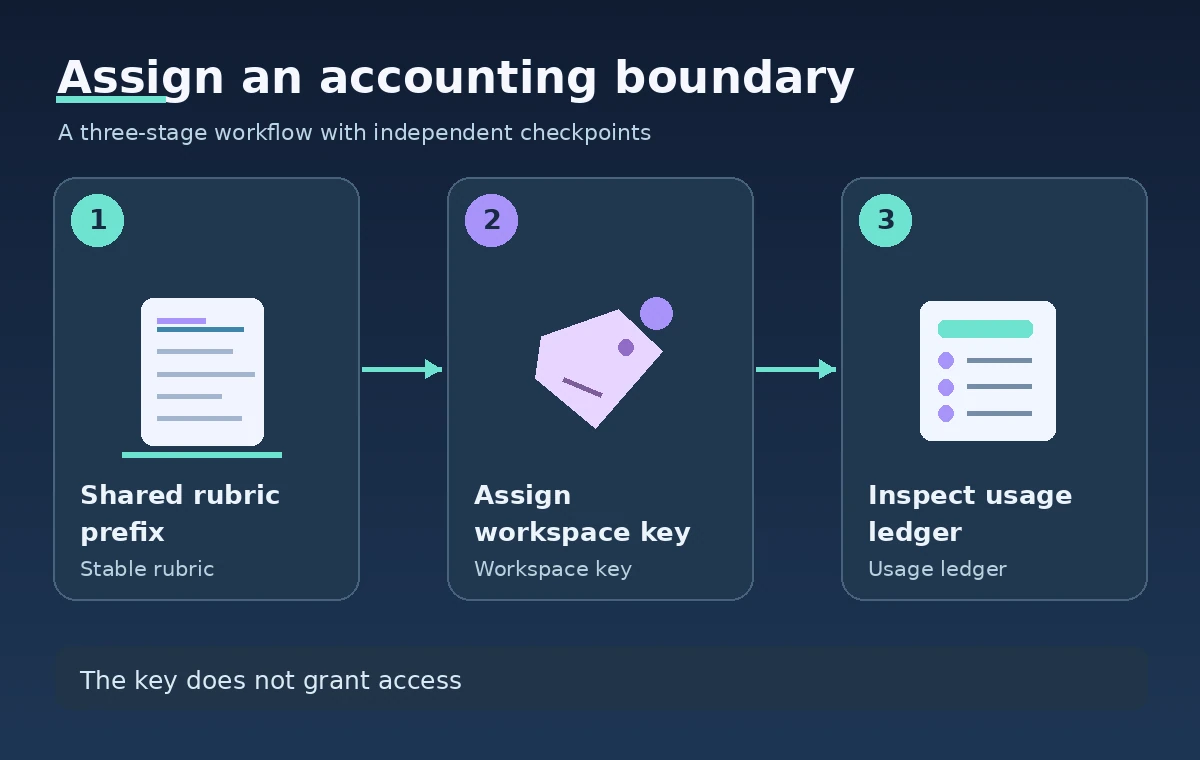
Choose identifiers without disclosing grant data
Assign an opaque, stable workspace code such as an internal nonsecret namespace plus a random identifier. Do not place donor names, email addresses, applicant descriptions, or protected collection identifiers into the key. A key should be easy for an internal cost ledger to map to its authorized workspace but meaningless to someone who sees a diagnostic log. Rotate or replace it when accounting boundaries change, and ensure the ledger documents when a new identifier took effect. Avoid creating a different key on every request: that destroys the stable grouping the parameter is meant to provide and makes longitudinal reports needlessly difficult.
Preserve the shared prompt prefix deliberately
Prompt caching works with an unchanged prefix of rendered context, not with semantic similarity between instructions. Place approved common rubric text and stable tool definitions before changing reviewer questions, timestamps, or applicant details. On supported newer models, consider explicit breakpoints after stable content if a dynamic suffix would otherwise prevent useful reuse. The same prompt_cache_key cannot rescue a cache miss caused by a changed earlier instruction or different tool schema. Record prompt version identifiers and tool configuration separately so a reported cache difference can be explained instead of being attributed automatically to the key.
Understand old-model and newer-model guidance separately
Documentation updated for newer OpenAI models distinguishes the uses of the key. On older models, cache routing may improve when related traffic shares a stable value; on GPT-5.6 and later, optional cache-accounting separation is the primary stated reason. A migration plan should not simply keep the old value and assume the prior performance effect still applies. Check the model in the request, supported cache-breakpoint behavior, and any retention setting. Preserve approved prefix structure while changing the model, and compare results using request-level usage data rather than a single dashboard screenshot.
Read actual token fields, not a hypothetical savings number
For a grant review cost report, collect each response ID, model, workspace ledger ID, total input tokens, cached input tokens, and cache-write tokens when the selected model exposes them. The prompt caching guide explains that cache-write charges are part of input-token accounting rather than an extra independent input volume to add on top. A reviewer should calculate cost by applicable billing class and current pricing, not multiply all input tokens by the uncached rate. A key is not evidence of a hit: a zero cached-token count must remain zero even when the same rubric appears repeatedly.
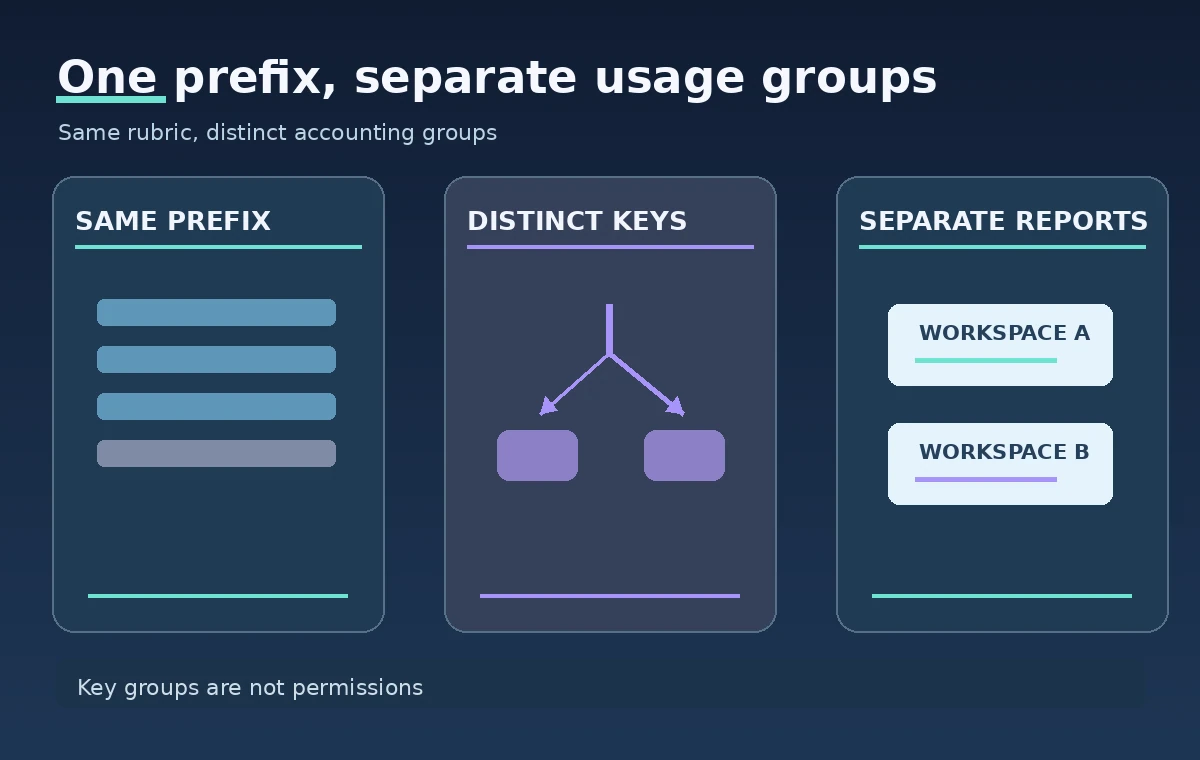
Do not treat matching keys as a security boundary
Two grant workspaces can have distinct keys yet still leak information if the application mixes attachments, carries unauthorized conversation history, or permits cross-workspace file retrieval. Conversely, cache separation by key does not replace tenant authorization, region configuration, or source-level access filtering. OpenAI documents caching within organizational and processing-region boundaries, but customer permissions remain the application’s responsibility. Keep the workspace identity derived from an authenticated server-side principal. Never let a browser pass an arbitrary workspace key and thereby determine which private files the server retrieves.
A practical, bounded validation plan
In staging, create two synthetic grant workspaces with equivalent nonprivate rubric text and different stable keys. Send several controlled requests with a fixed model and document the exact prompt prefix and request parameters. Compare usage fields and any supported diagnostics; do not infer that one key is better from a single call. Repeat after deliberately modifying the tool list or earlier instructions to demonstrate how prefix changes matter. This is a recommended test design, not a test performed for this article. Document whether the response status completed before counting the request in an accounting comparison.
Where administrators should look for exceptions
Investigate unusually low cache reuse by reviewing model changes, rendered prefix revisions, tool ordering, breakpoint placement, request volume, and retention lifetime. Investigate unexpectedly blended reports by tracing application workspace IDs to the keys actually sent, not by guessing from prompt content. Log identifiers in a controlled audit store with restricted access and a retention policy. If several services call the same API, they need a consistent mapping policy or the same workspace may fragment into multiple accounting groups. This operational audit is distinct from evaluating the correctness of the grant recommendations.
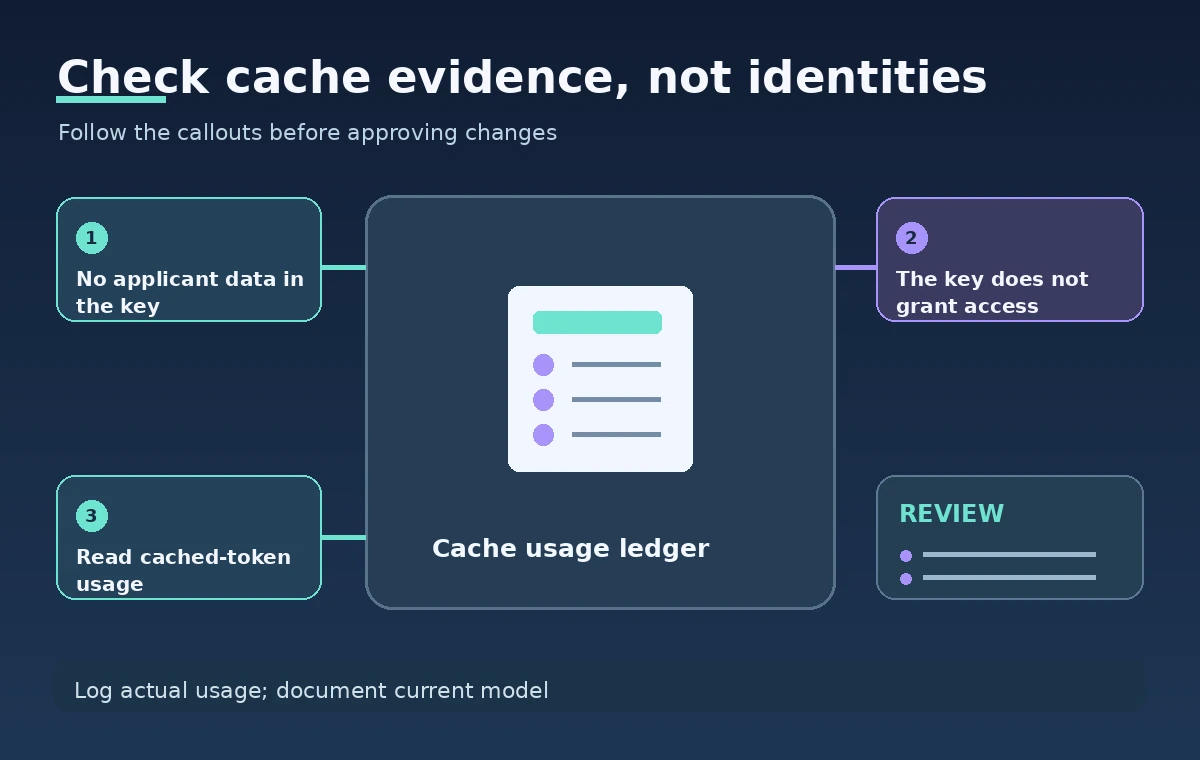
Publish a transparent accounting explanation
A concise internal report can state that two workspaces use separate stable cache-accounting keys, show token usage by billing category, and describe which source content was authorized for each review. It should also state what was not established: a cache key does not certify confidentiality, reduce costs by a guaranteed percentage, or verify any AI-generated claim. Keep financial rate assumptions dated and link to the official documentation. A good release decision requires both a source-quality review and a permissions review; the cache ledger merely helps the budget owner understand how requests were processed.
How We Research
This November 11, 2026 article is a documentation-based instructional analysis, not a hands-on test or production benchmark. We compared OpenAI, Prompt caching guide and OpenAI, Responses create API reference, identified the precise parameter or behavior that the documentation supports, and organized the guidance around an illustrative museum workflow. We did not run a live service request, inspect real WordPress content, measure accuracy, or verify delivery against a working customer account. Each pictured scenario is an original conceptual illustration; current settings, permissions, supported API versions, and organization-specific governance must be confirmed before use. The release checks deliberately distinguish technical output from authorization, evidence quality, and actual user outcomes.
Frequently Asked Questions
No. The rendered prefix, model behavior, retention, routing, and an eligible existing entry all affect reuse.
No. OpenAI describes it as optional for separate group accounting on these models; earlier models used it for routing optimization.
No. Authentication, retrieval filters, and document authorization must be enforced independently.
No. Use an opaque stable internal workspace identifier that does not expose personal data.
Use model-specific response usage fields, current billing rates, and a reproducible request ledger rather than assumptions about caching.