
Divide routine description from interpretive judgment
A museum may need to normalize object captions, draft short descriptions, and review policy-sensitive interpretation. These tasks should not all receive the same processing budget. A simple format cleanup can often be assessed with a deterministic rule, while a complicated attribution question may require reviewing several documents and explaining conflicting dates. OpenAI documents reasoning.effort as a request setting that guides how much reasoning a compatible model applies. It is a tuning parameter, not an evidence source or a guarantee of correctness. Design the workflow around the task’s consequences first: a model may help draft an exhibition label, but no setting can independently authenticate an artifact or approve a rights claim.
Verify supported effort values for the exact model
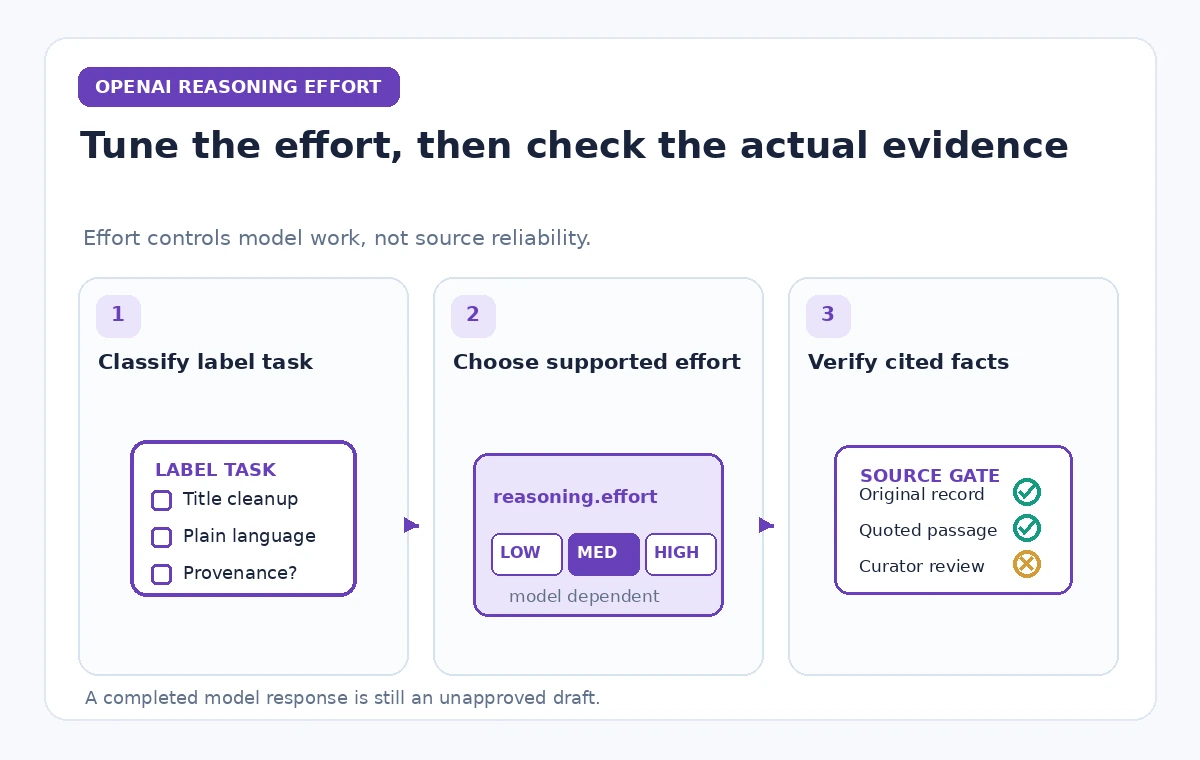
The Responses API accepts reasoning configuration for compatible reasoning models, but supported effort values depend on the model. Official documentation lists options that can include none, minimal, low, medium, high, xhigh, and max. Do not assume that every endpoint or selected model accepts every option: an unsupported setting can return a request error. Record the exact model ID, API version, and requested effort for each test case. The guide also distinguishes reasoning mode from reasoning effort for certain models, so changing mode is a separate decision. When upgrading a model, check the support table again instead of carrying an old configuration forward without verification.
Reserve lower effort for well-bounded tasks
A hypothetical low-effort workflow might extract a title, reorder a list of approved metadata fields, or rewrite a label for plain-language accessibility without changing factual meaning. Even here, specify the expected format, allowed source text, and what to do when a field is missing. Lower effort can reduce token use and response time on supported models, but that is an operational tendency rather than a test result from this article. Compare the output to a fixed source record using a reviewer-approved rubric. A missing date should remain missing; the application should not accept a plausible year supplied from general model knowledge just because the text sounds polished.
Route complex provenance questions to deeper review
A request to reconcile conflicting acquisition dates, uncertain artist attributions, or multiple translation versions requires more work than a formatting correction. A higher reasoning effort can be one configuration to evaluate for such tasks, subject to model support and operational cost. It does not turn the model into a conservator or source archivist. Provide the documents the reviewer is permitted to use and require the result to distinguish confirmed facts from competing interpretations. If the evidence remains contradictory, a successful response should explicitly say so and leave the disputed claim pending. Staff should inspect the underlying catalog entries and rights records before any public publication.
Create task-specific output and review contracts
For every task class, write down the exact fields the application expects and which changes are forbidden. A normalization job might return a proposed display title and a list of untouched source IDs; a provenance analysis might return cited passages, competing hypotheses, and unresolved exceptions. Validate the structure outside the model. Reasoning effort does not enforce JSON shape, prevent invented citations, or guarantee policy compliance. If external sources are used, retain their document identifiers and check them independently. Avoid exposing confidential donor notes to the model merely because a larger reasoning budget seems useful. The input scope should remain minimal for the job at hand.
Compare multiple efforts without inventing a benchmark
Build a small evaluation set containing routine label cleanup, bilingual title correction, contested dates, conflicting donor notes, and an intentionally unanswerable attribution question. Run the same authorized inputs with supported effort settings, recording real token usage, elapsed application time, output validity, and human-rated factual accuracy. This article does not report measurements or claim any percentage improvement. Count unresolved or unsupported claims as review failures even when the prose is fluent. If a higher setting produces a longer answer that repeats the same uncertainty, that is not automatically better. The selected configuration should follow representative observed results and the institution’s quality needs.
Do not confuse reasoning tokens with source citations
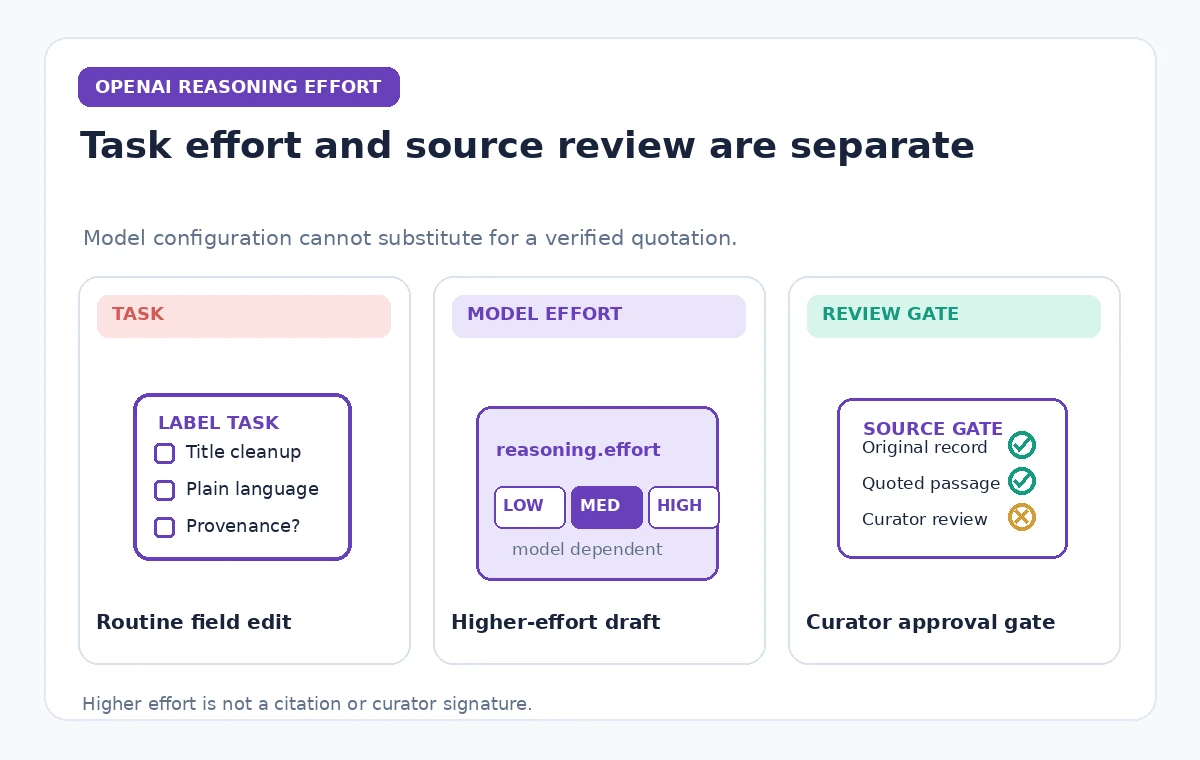
The API may report token usage for reasoning activity, but those tokens are not a visible chain of verified facts. A reasoning summary, when supported, is also not an original archive document. Keep evidence links in a separate traceable record: accession identifiers, approved documents, exact relevant passages, and dates of review. The editor should be able to identify which output claims are grounded and which remain assumptions. A diagram should show three different stages—task selection, configured model effort, and an evidence gate—not imply that additional token spending itself certifies authenticity. Where a claim lacks support, the correct state is pending rather than approved.
Protect visitor and donor information in test fixtures
Do not use raw donor correspondence, unpublished legal agreements, or identifying visitor inquiries in a convenience benchmark without authorization. Create synthetic or rights-cleared cases with realistic edge conditions and keep their provenance in the evaluation register. If a workflow must process protected text, apply approved data-handling policies and separate raw input access from aggregate performance dashboards. Report actual model configuration and outcome categories, not the private source text. Rotating an effort parameter will not change the legal basis for using information. Consent, retention, and editorial publication approval remain independent from an API request’s execution settings.
Make a manual approval gate explicit
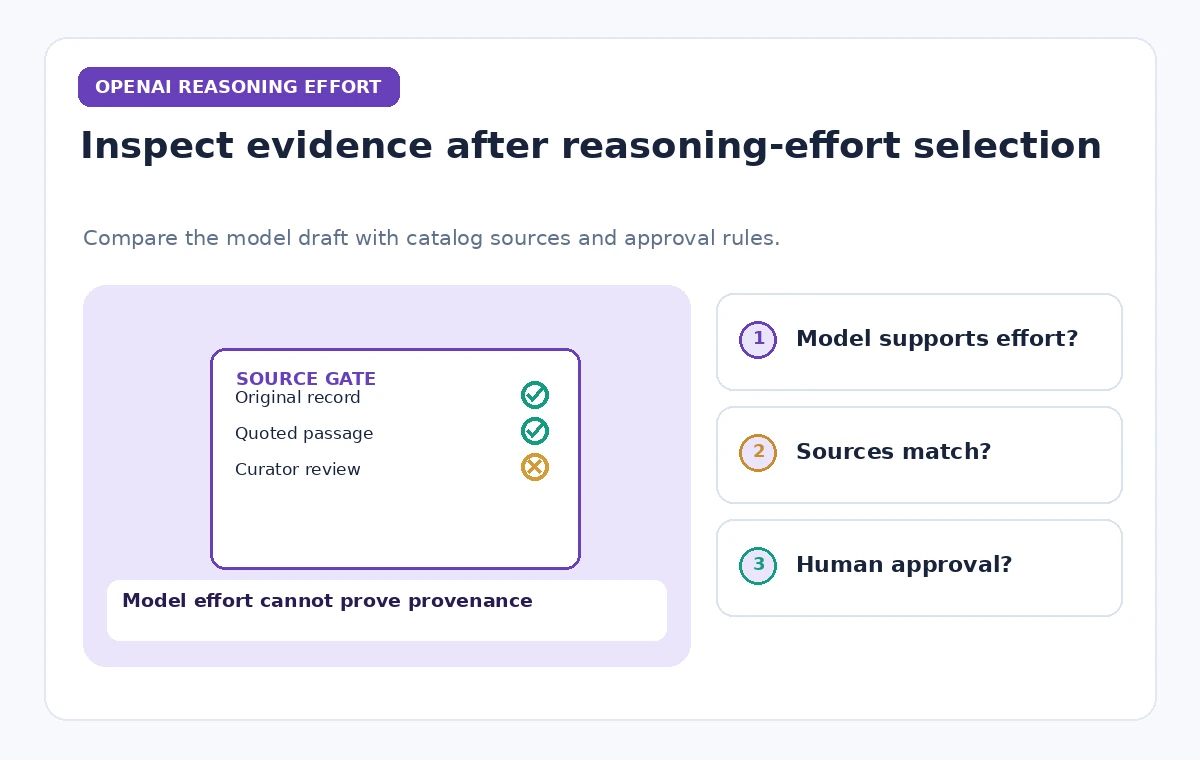
A useful editor interface has independent indicators for ‘model draft produced,’ ‘source checked,’ and ‘publication approved.’ The first can turn green when the API completes; the other two require real review events. If the model declines, truncates its response, or returns a claim without the supporting source, keep the artifact out of the public publishing queue. Allow the curator to mark disputed passages for later research and to compare the proposed caption to the original institutional record. An elevated reasoning effort should never bypass the reviewer. If the model output is particularly persuasive, that is a reason to verify its sources carefully, not to reduce human scrutiny.
Revisit configurations after models or policies change
When a model release changes available efforts, token reporting, or default behavior, rerun the institution’s representative evaluation set. Compare like-for-like inputs and capture the actual configuration instead of relying on a remembered default. Monitor real failure modes, such as unsupported parameter errors, rising review workload, and unsupported citations, without manufacturing latency or cost numbers. Record the chosen task routing and the evidence that justified it. Keep a stable rollback setting until the next configuration is approved by both engineering and editorial owners. The operational goal is a dependable review process, not maximum model effort on every request.
How We Research
We reviewed the named official developer references OpenAI: Reasoning models guide, OpenAI: API deployment checklist. We compared their documented request and delivery behavior, accepted configuration patterns, and explicit limitations with the proposed hypothetical museum workflow. This article is a source-based implementation guide: we did not execute live customer API calls, inspect private cloud accounts, run production tests, or measure latency, cost, or accuracy. Readers should verify current limits and deployment settings with the original documentation and run their own controlled staging tests before changing public systems.
Frequently Asked Questions
No. It changes model reasoning behavior on supported models; factual claims still require original collection evidence and human review.
No. Supported effort levels and defaults are model dependent. Consult the current model-specific guide before setting the parameter.
It can be a candidate for bounded tasks, but test output validity and accuracy on representative examples before adopting it.
No. Token usage is an operational metric, not a document citation or record of verified factual evidence.
Show unresolved claims clearly and require a curator to inspect the originals; do not auto-approve based on a longer model answer.