
AI tools can shorten the time between a research question and a useful brief, but market research is not one task. Public-source landscape scanning, customer interviews, competitor pricing checks, internal-document synthesis and scientific evidence appraisal use different kinds of information. A good toolkit supports each step without pretending that an attractive AI-generated market size is a verified fact.
This is a buyer’s guide to workflow fit rather than a universal accuracy ranking. It deliberately avoids the academic-literature-review focus of LabFin’s existing specialist comparison. The recommended tools occupy complementary positions: Perplexity for sourced web reconnaissance, ChatGPT for structuring analysis, Gemini Notebook for supplied documents, You.com’s developer APIs for structured retrieval and Consensus when a business claim depends on scientific studies.
First decide what kind of market evidence you need
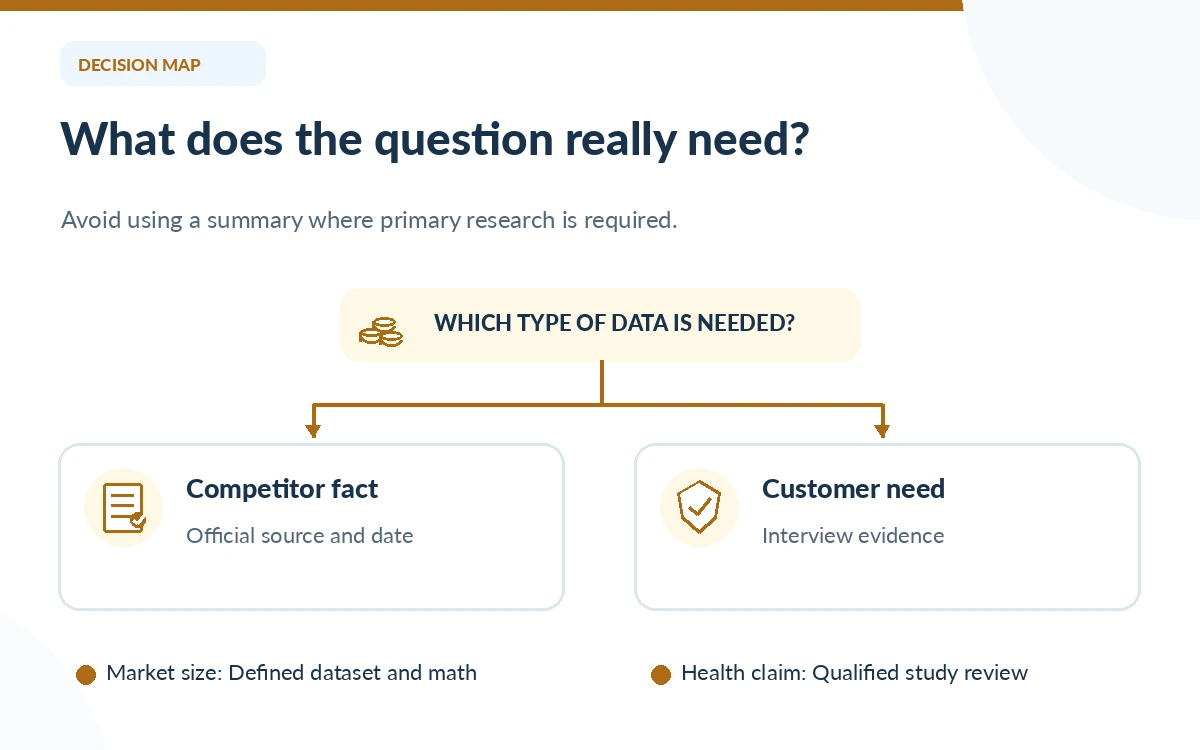
Divide the project into five evidence classes: vendor claims, independently reported public facts, customer voice, internal documents and published research. A tool that summarizes press releases can surface competitors but cannot establish buying intent. An assistant that reads interviews can highlight themes but cannot calculate an unbiased population estimate from a small convenience sample.
Write the intended deliverable before shopping for software. Is it a competitor matrix, a customer-jobs map, a source-backed industry brief or a research repository for a product team? Record the audience, decisions, geographic market, date horizon, acceptable sources and which conclusions require primary research. These boundaries determine whether search, document processing or qualitative review deserves priority.
Perplexity for finding and checking public market signals
Use Perplexity to collect an initial map of company announcements, product positioning, industry vocabulary and links to public reporting. Its documented Pro Search process supports multi-source exploration with visible citation links. Ask for contradictory sources and the date of each announcement; then open primary investor documents, original product pages and regulator filings where relevant.
Avoid asking the tool to invent a complete market size from loosely related figures. If it surfaces “market is worth $X,” trace the forecast’s definition, year, region and publisher methodology. A licensed analyst report may not permit reproduction of its full numbers. Use Perplexity as a lead generator for evidence, not as a replacement for procurement of reliable data.

ChatGPT for organizing questions and comparing narratives
ChatGPT is useful for turning a research objective into hypotheses, interview questions, taxonomy proposals and alternative explanations. Its search feature can attach sources to current factual claims. Use it to structure a side-by-side comparison of vendor promises, but insist on exact URLs, dates and an “unknown” field for claims you cannot verify. Keep generated ideas visibly distinct from observed findings.
For example, ask for three possible explanations for low trial-to-paid conversion and what evidence would distinguish them. That output is a research plan, not proof of the cause. Apply an adversarial pass: what would a skeptical customer, a finance lead and an operations manager dispute? The value comes from sharper questions and clearer synthesis rather than fabricated certainty.
Gemini Notebook for your own interviews and internal documents
Gemini Notebook is designed for working with a set of provided sources. For a market-research project, that can include interview notes you are authorized to use, meeting summaries, competitive battlecards and published reports. Ask source-bounded questions and check references back to the files. Make sure access permissions and retention rules satisfy your organization before uploading sensitive customer material.
Supplied documents inherit their original weaknesses. Five sales calls with existing power users are not representative of the whole market. A repository can accelerate finding repeated objections, but coding should preserve disagreements, timestamps and interview context. Separate verbatim customer language from an assistant’s inferred theme and from the team’s product strategy recommendation.
You.com Search API for repeatable public-web collection
A developer team may prefer a programmable retrieval interface instead of copying chatbot answers into spreadsheets. You.com documents Search and related APIs that can return web discovery data for further processing. This route fits repeatable monitoring with logged queries, timestamps, source URLs and downstream extraction steps. API integration requires engineering attention and current billing checks.
Do not equate an API response with a licensed or accurate record. Observe rate limits, content rights and robots guidance, and keep a provenance chain from retrieved page to normalized field. For cost analysis, distinguish search requests from contents retrieval and any summarization or research endpoint charges. A small, reviewed prototype is safer than a large unattended collection pipeline.
Consensus for market claims that rely on scientific evidence
When market messaging hinges on scientific assertions—learning outcomes, workplace interventions, nutrition effects or medical-adjacent capabilities—Consensus can help locate relevant scholarly papers. Its official guidance describes filters by research design and other characteristics. Use those filters to identify evidence classes rather than treating a generated synthesis as permission to make broad advertising claims.
Assess whether a result applies to the product, population and dosage or exposure being marketed. Regulatory claims require professional review beyond an AI literature summary. For contested science, show study limitations and conflicting findings. If the question is primarily about customer preference or competitor revenue, a scholarly search tool should not displace actual market research.
Build a defensible decision matrix and budget
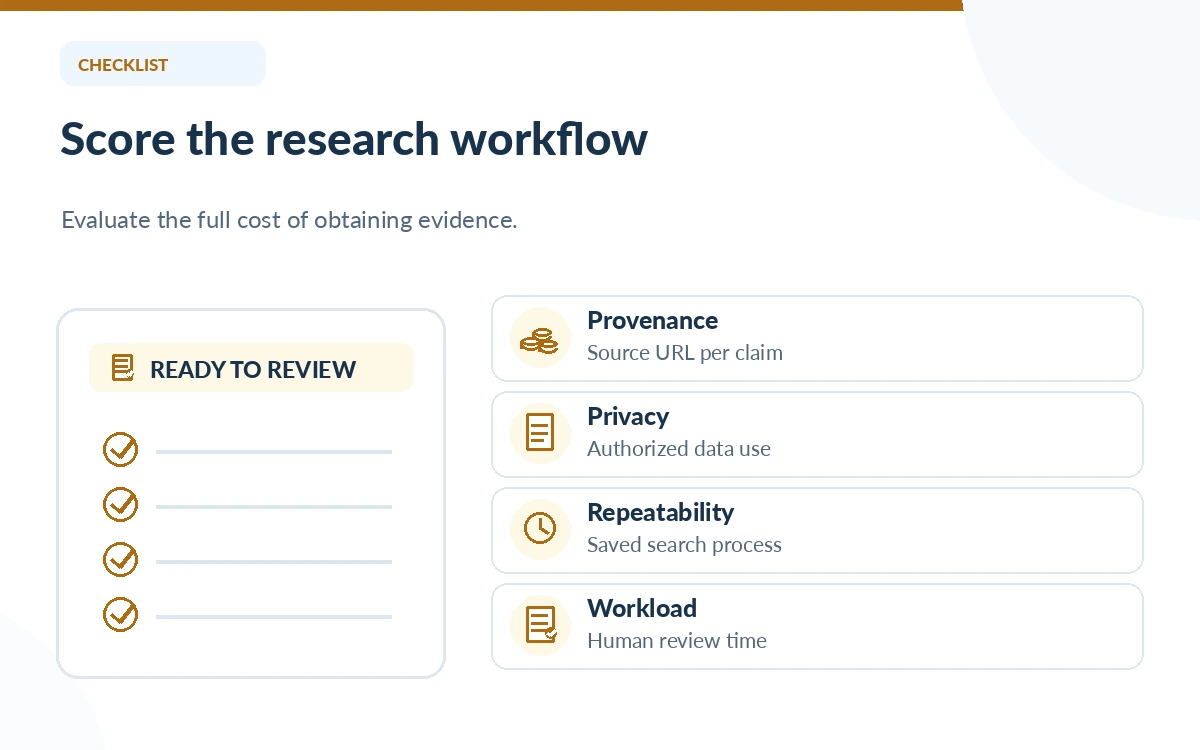
Compare candidates on evidence type, traceable sources, access controls, ease of exporting structured results, integration burden and human review time. Put “not evaluated” wherever your team has not tested a feature. Do not award numerical accuracy scores borrowed from unrelated benchmarks. A short pilot with three authentic tasks can reveal bottlenecks without pretending to provide universal product rankings.
The final stack may be two tools rather than five. For a solo consultant, a search assistant plus a document workspace may be enough. For a product team monitoring dozens of vendors, an API and shared source ledger may be justified. Document tool costs at the moment of purchase, but judge total cost by staff verification time, compliance work and error risk as well as subscription fees.
How We Research
We checked Perplexity Pro Search documentation, OpenAI Search guidance, Google’s NotebookLM/Gemini Notebook product information, You.com developer platform information and Consensus filters, checked October 26, 2026. We did not conduct independent feature trials or proprietary market-research benchmarks; the jobs-to-be-done matrix is our editorial recommendation.
Frequently Asked Questions
There is no universal winner. For public-source exploration, start with a cited web-search assistant; for internal interviews or reports, use a source-bounded document tool and verify claims against the original files.
Not from a vague prompt. Define the market, geography, period, units and primary data source. Treat generated TAM estimates as hypotheses until the underlying calculations and assumptions are checked.
Only when you have the necessary permission and the service’s privacy and retention terms meet your obligations. Remove identifiers where possible and follow your organization’s data-handling rules.
When you need repeatable queries, structured results, scheduled collection and provenance logs at scale. An API adds engineering, billing and rights-management work that a small project may not need.
They can help locate relevant studies, but applicability, evidence quality and regulatory wording still require qualified review. Scientific evidence does not automatically establish consumer demand or product-market fit.