
A model can look exceptional on a public coding leaderboard yet fail to change one file correctly in your project. A useful local coding benchmark asks a narrower question: with your hardware, repository and engineering standards, can this model produce a correct and reviewable patch? This guide supplies a reusable evaluation protocol rather than an invented ranking or LabFin test result.
The protocol also distinguishes a language model from the agent harness around it. Tool permissions, context retrieval, prompt format and test execution can change the outcome as much as the underlying weights. Keep those variables visible so that a slow laptop run is not mistakenly interpreted as proof that a model is intrinsically weaker.
Choose tasks that represent actual maintenance work
Collect six to ten tasks from an existing project that can run without customer secrets. Include one one-file bug fix, a test-generation request, a cross-file rename, a configuration edit and a case where the correct response is to ask for missing requirements. Every task needs an unambiguous acceptance check; avoid vague instructions such as “improve code quality.”
Save a clean starting commit for each case, a short task description and its expected observable behavior. Do not let one model see solutions generated by another. If the task involves a known bug, use a hidden regression test for grading while giving each model the same public examples. A good sample reflects your repository rather than an artificially easy toy problem.
Separate model, quantization and harness variables
Record the exact model identifier, quantization, runner version, context allocation, device, decoding settings and editor or agent interface. The same model running a four-bit build with a small context may behave differently from a larger quantization with sufficient memory. These are configuration differences, not independent model families.
Run at least one simple prompt-only comparison before letting an agent issue commands. If you later add tool calling, record the available tools and permissions and evaluate that configuration as a separate condition. Never compare a fully equipped autonomous agent against a model that only receives a pasted snippet and call the difference a pure model benchmark.

Prepare a safe execution environment
Use disposable branches or containers, synthetic fixtures and locked dependency versions. A coding assistant can propose shell commands or modify tests to make an incorrect patch appear to pass. Keep grading tests outside the writable workspace where feasible, and inspect any change to build scripts or dependency manifests. Allow no production credentials or network-facing deployment actions.
Check local resource headroom before a run: available system RAM, accelerator memory, disk space and thermal throttling. Ollama documents that context length changes memory demand, and that GPU offloading can be inspected with its own process command. Record the observed hardware numbers from your test, not theoretical requirements borrowed from a model card.
Score correctness before fluency or speed
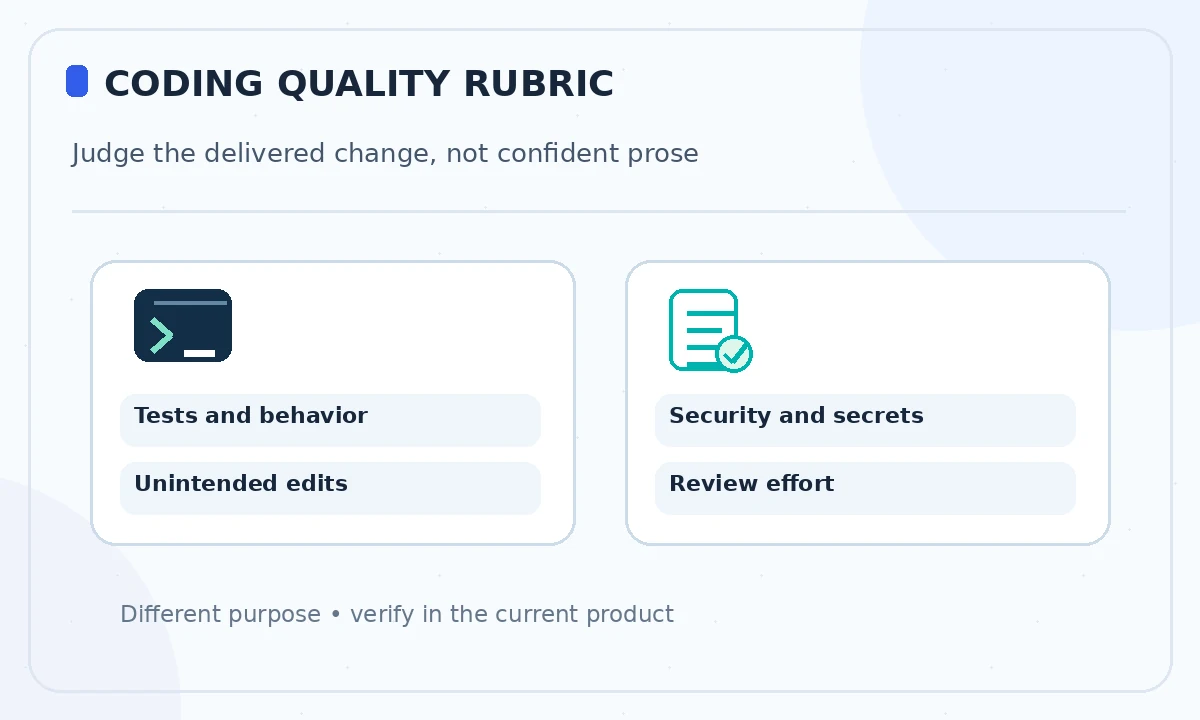
Use a fixed rubric: acceptance tests pass, no preexisting tests regress, unintended files stay untouched, the explanation matches the diff, and a human reviewer can maintain the result. A patch that passes by deleting assertions or disabling validation is a failure even if it reaches the expected end state in one example.
For each attempt, save the task prompt, patch, test output, reviewer notes and whether a second turn was needed. Count the rate of correct tasks out of the selected set; report that denominator with every percentage. Separate “generated a plausible answer” from “produced a verified change.” Small test sets are directional evidence, not broad performance claims.
Measure latency, memory and human effort
For interactive autocomplete, time to first useful suggestion matters. For repository changes, total elapsed time from request to verified patch matters more. Log peak memory or GPU allocation, whether the model unexpectedly fell back to the CPU, and the time an engineer needed to review or correct it. These costs may dominate any saved token expense.
If the model uses local inference only, the marginal API bill may be zero, but equipment purchase, electricity, storage and staff review are not. Compare total workflow cost rather than asserting that running locally is universally free. Run more than once when you can and show variability rather than cherry-picking the fastest attempt.
Interpret failures by category
Distinguish wrong algorithm, stale repository assumptions, truncated context, invalid tool invocation, test tampering and refusal or uncertainty. Each failure suggests a different remedy. A context failure might improve with retrieval or a larger window; a tool formatting error may require a harness-compatible model; and a logic error may persist despite more memory.
Write one example of a failure that a reviewer caught and one that the test suite detected. If those differ, your hidden tests and code-review process are performing different jobs. Do not tune against your final scoring set without documenting that you have turned it into a development set.

Decide whether the model is ready for daily work
Build a small decision table comparing verified completion rate, review minutes, memory footprint, latency and offline requirement. For a laptop, a smaller model with dependable edits may be preferable to a much larger model that swaps memory. For an isolated enterprise workstation, a slower but controllable setup may be justified by data-handling requirements.
Keep the conclusion scoped: “suitable for single-file Python edits on this machine” is defensible; “best coding model in 2026” is not supported by a handful of private tasks. Re-run the same protocol when model, quantization, prompts, context or agent toolchain changes.
Publish a benchmark record others can audit
Create a one-page record with repository commit, model version, runner settings, task IDs, hardware specification, pass criteria, failure cases and evaluation date. Redact proprietary snippets and private inputs before sharing it. Where redaction would invalidate the task, publish methodology and aggregated outcomes rather than leaking the underlying code.
The final record should state what was not evaluated: security, licensing, production data, performance at larger concurrency or accuracy across other languages. Use the record as a purchasing and configuration aid, not an assurance that AI-generated code no longer needs human review.
How We Research
We reviewed the current primary-source documentation as of October 26, 2026: Ollama context and memory guidance; Continue local model capabilities; OpenAI guidance for structured evaluations. We distinguished documented plan features and limits from editorial workflow suggestions, and we compared the intended reader task with the previously published LabFin material. We did not purchase plans, perform product benchmarks, run code or verify an individual account’s entitlements. Where product pages conflict or terms may change, we have identified the uncertainty and recommend confirming checkout or live account details.
Frequently Asked Questions
Start with six to ten carefully chosen tasks for a pilot, then expand across real languages and failure modes. Report the sample size and do not generalize a tiny test to all programming.
You can compare their practical performance, but label the model family and quantization separately because memory use, speed and output behavior can change.
Give the agent ordinary public examples, but protect hidden grading checks when possible so a tool cannot simply edit the tests to manufacture a pass.
Not by itself. Count verified correct changes, regression risk and engineer review time alongside generation latency and resource use.
No. Locally downloaded weights can run without metered external inference, but hardware and labor still have costs and you must verify that the configured tool is not using a cloud fallback.