
One stuck image job, many tempting retry buttons
Consider a museum migration that queues image derivatives for an online collection. A single upload task has been failing because the image processor cannot read a missing source file. An operator pauses the queue while repairing storage and then sees an option to force the task to run. This hypothetical incident illustrates an important difference between automatic queue delivery and a manual diagnostic action. A forced task is not a harmless status check: it sends work to the target again. Before clicking or invoking an API method, identify which object and downstream operations that task can affect. A duplicate derivative, duplicate notification, or overwritten catalog pointer may be more damaging than a temporary delay.
What the RunTask method promises—and what it bypasses
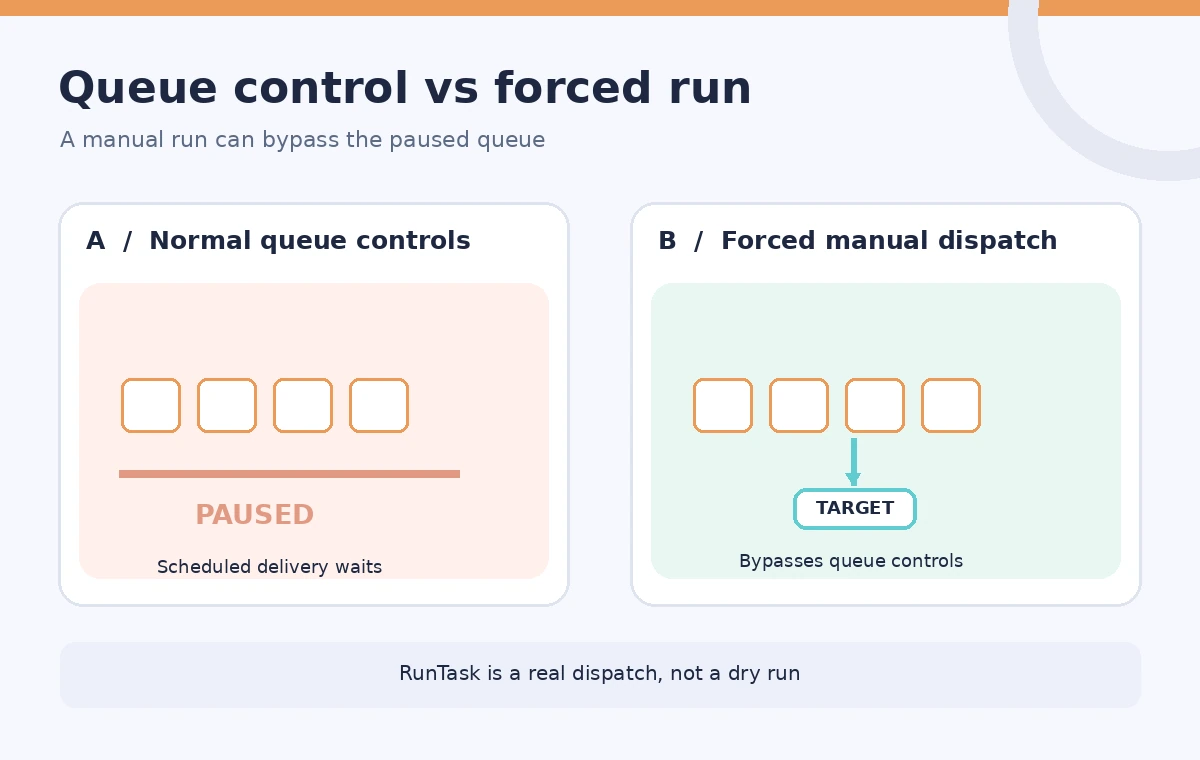
The Cloud Tasks v2 REST method named projects.locations.queues.tasks.run forces one task to run now. Google explicitly documents that it can dispatch a task even when the task is already running, the queue has reached its rate limits, or the queue is paused. Those exceptions make RunTask valuable for manual debugging and potentially dangerous as a general recovery script. A paused queue does not guarantee that RunTask will leave the target untouched. Nor does a busy queue impose its usual rate ceiling on this manual action. Treat authorization to invoke it as an operational privilege and include it in incident procedures rather than in an ordinary user-facing button.
Inventory the precise task before making a call
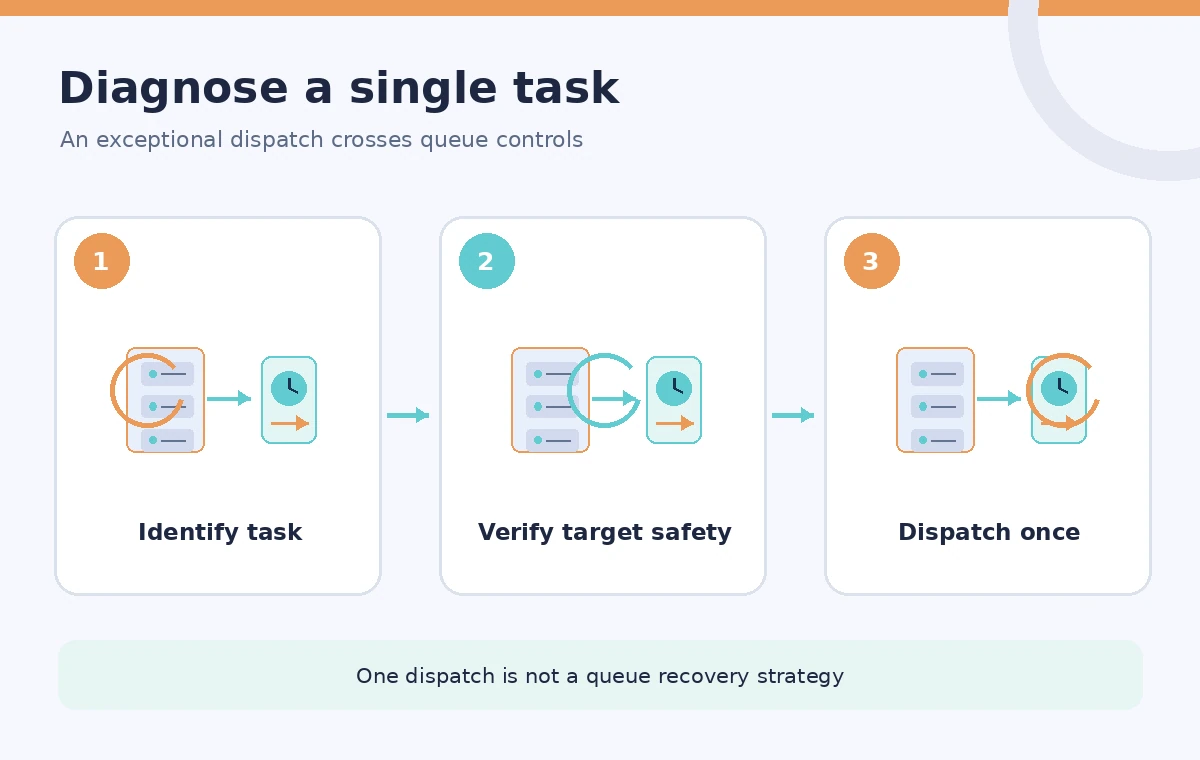
Capture the full task resource name, the queue and location, the intended HTTP target, and the archive object identifier from the job record. Inspect the target service’s health and current deployment before forcing delivery. If the original source object has been replaced, confirm that the queued payload still refers to the correct immutable version or intended current object. The target may already have processed a previous attempt even when the queue shows a failure. Compare your application’s processing ledger, not just the task’s apparent state. A diagram can show task identification, target inspection, and manual dispatch, but it cannot certify that a live target is safe to call.
Use manual dispatch for one controlled experiment
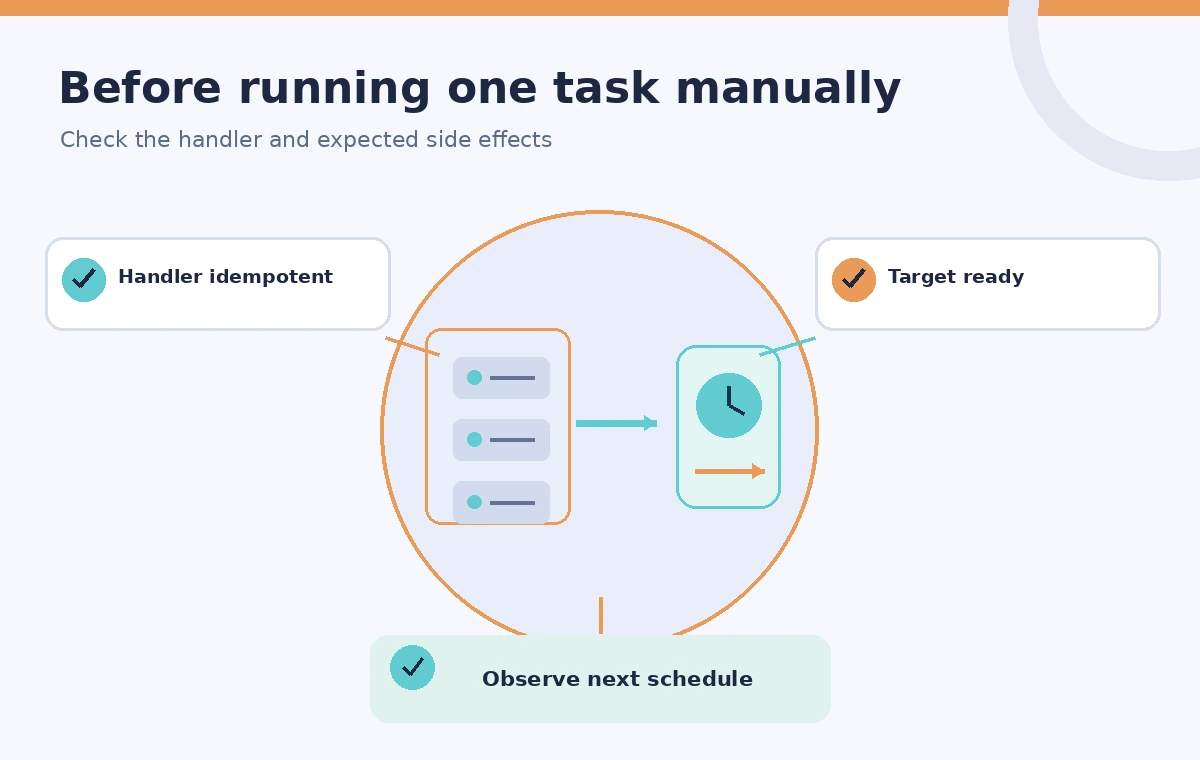
When the handler is repaired and its side effects are understood, select a single noncritical task for diagnosis. The REST method is POST to the task resource with a :run suffix. Use the official client or an authenticated request with the correct Cloud project, location, queue, and task identifier; never place credentials in a blog example or browser address bar. Observe the handler response, service logs, and application ledger. Avoid sending multiple RunTask requests to the same task to see whether it eventually works. Since Google says RunTask can dispatch a task already running, overlapping diagnostic attempts can occur unless the worker prevents them.
Interpret successful and failed delivery correctly
Google documents that a successful response from the task target causes the task to be deleted. If delivery fails, Cloud Tasks resets scheduleTime to the RunTask call time plus the retry delay determined by the queue RetryConfig. That means a failed diagnostic run can change the next scheduled attempt. A NOT_FOUND response may mean the task has already succeeded or permanently failed, not that a new upload should automatically be created. Correlate the queue outcome with the target’s durable processing state, then decide whether a new task is actually warranted. Do not interpret an HTTP request accepted by RunTask as a guarantee the archive transformation completed.
Distinguish paused, throttled, and forced traffic
Normal queue controls exist to protect worker capacity. A paused queue blocks ordinary dispatch, while its configured rate limits control ordinary throughput. A manual RunTask call deliberately crosses those boundaries, so performing it on dozens of museum jobs can defeat the very safeguards used during an incident. The comparison illustration separates normal scheduled delivery from a forced diagnostic dispatch. If the target is overloaded, fix capacity or downstream dependency problems rather than hammering each task manually. For bulk recovery, restore the planned queue behavior and monitor dispatch and error rates instead of building a loop around the manual method.
Design the HTTP worker for redelivery
Even careful operators need idempotent handlers. Use a stable media job identifier, store a processing state, and make derivative output paths deterministic. If the destination image already exists and its checksum matches the approved source version, the worker can record that fact rather than blindly rewriting it. If an external notification was already sent, the ledger should prevent a second email. Protect the update with a transactional or compare-and-set mechanism appropriate to the application, because two requests may race. Store the source version and transformation recipe used. These are application practices, not features that the RunTask endpoint automatically supplies.
Separate observability from side effects
An operator who only wants to see why a task failed should first inspect logs, metrics, task metadata, and worker error reports. Calling RunTask performs real work; it is not equivalent to a dry run, preview, or validation endpoint. A safer diagnostic process includes a staging worker, synthetic object, or nonmutating health probe when practical. In production, label the manual action as a dispatch and require an incident reason. Restrict who can invoke it and record the task name and call time. If the target includes private accession files, limit diagnostic logs to metadata that staff are authorized to view.
When the incident ends, restore predictable dispatch
Once a representative task succeeds, examine the queue state, retry settings, target service health, and pending work before resuming normal throughput. Monitor failures and duplicated side effects over a reasonable observation period, not just the first clean response. Preserve the operator notes about which task was forced and why; this supports audit and future playbooks. If the task disappeared, verify the corresponding catalog image and metadata version in storage. The desired result is a reliable return to queue-managed delivery. Manual RunTask calls should remain an exceptional diagnostic tool, never a replacement for a healthy worker or a retry policy.
How We Research
Our primary sources were Google Cloud Tasks RunTask REST method; Cloud Tasks queue retry configuration. We checked the precise Cloud Tasks RunTask dispatch exceptions and the documented success, failure, and NOT_FOUND behaviors, then compared those with queue retry guidance. We did not invoke a production endpoint or retry an existing museum job; the task and its downstream worker are illustrative. Readers should verify the cited product documentation, feature availability, and their own account configuration before deploying anything. The schematics explain the decision process rather than reproduce vendor screens or claim measured outcomes.
Frequently Asked Questions
Yes. Google documents that it can force dispatch even when a queue is paused.
The method can bypass an already reached queue rate limit; do not use it as a mass-retry loop.
Cloud Tasks removes the successfully executed task from the queue.
Cloud Tasks resets the task scheduleTime using the call time and retry delay from RetryConfig.
No. It sends the task to the target. Review the worker’s idempotency and expected side effects first.