
A header is routing context, not permission
An archive team sends image-derivative jobs to a protected worker. The request includes Content-Type and an internal job reference, but a handler that trusts any header saying approved could accept a request from the wrong caller. Headers describe a request; they do not, by themselves, establish who sent it.
Imagine a fictional archive scanning station submitting thumbnail work for approved objects. The worker must identify the payload format, authenticate the caller and check that the requested source object is eligible for transformation. Separating those tests prevents a plausible queue header from becoming an accidental authorization bypass.
Understand HttpRequest.headers on an HTTP task
Cloud Tasks exposes HttpRequest.headers as a map of HTTP header names and values for HTTP target tasks. You can provide Content-Type explicitly when creating the task. The HTTP request body has its own encoding rules; declaring application/json cannot repair a malformed or unexpected payload.
The REST reference notes that Cloud Tasks computes or replaces several headers. It sets Host from the URL, computes Content-Length and controls User-Agent; X-Google-* and X-AppEngine-* are not ordinary caller-controlled fields. Design your handler around documented behavior instead of trying to force reserved headers into task creation.
Choose Content-Type to match the actual bytes
If a job body contains JSON describing an authorized source key and requested derivative size, set Content-Type to application/json and validate the parsed structure. A binary payload should use an appropriate media type and a distinct schema. Do not accept a JSON-looking string because an arbitrary client supplied the label.
The Cloud Tasks API represents a task body as base64-encoded bytes, while the dispatched HTTP handler receives the decoded bytes. Base64 is a transport representation, not confidentiality. Keep private image contents out of request bodies where a short, access-controlled object reference and approved worker lookup are sufficient.
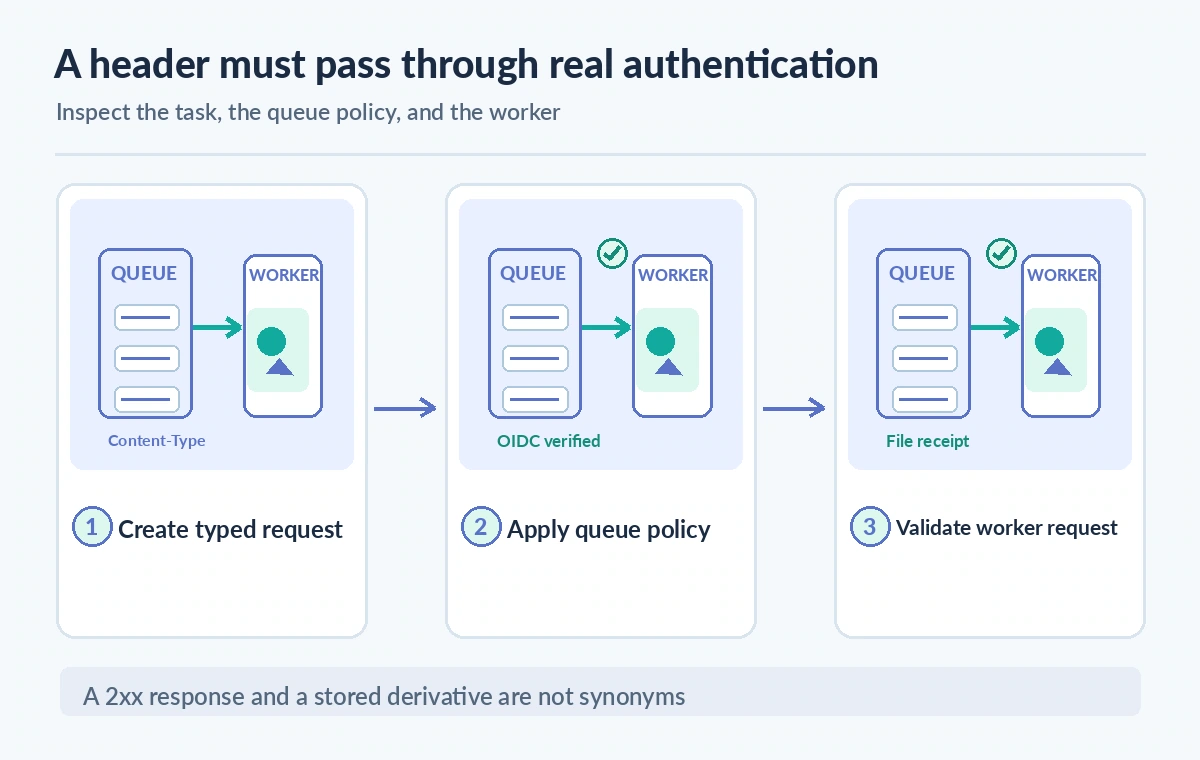
Account for queue-level header and auth overrides
Google documents HTTP target overrides on queues, including headerOverrides and an optional queue-level authorization configuration. A queue override can change the effective request sent to the worker; the task-level headers alone are not always the full dispatch policy.
Review the queue definition alongside the task definition. If OIDC or OAuth authentication is configured at queue level, understand which Authorization header actually arrives. Record the queue revision in an incident review, but never log raw bearer tokens or copy secrets into the article or an ordinary operations dashboard.
Authenticate the caller before evaluating task metadata
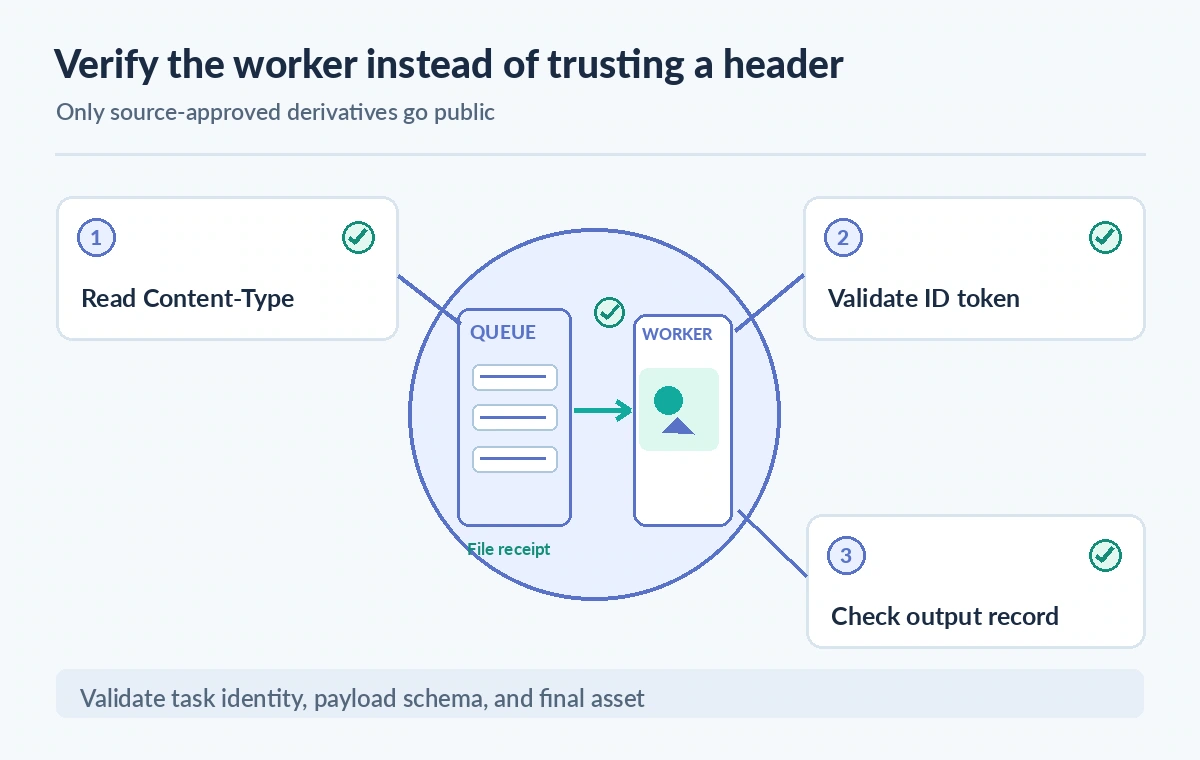
A Cloud Tasks handler should verify the appropriate service identity and token audience rather than relying on X-CloudTasks-QueueName or a human-readable job label. Google explicitly describes dispatch headers as information, not an identity source. Match the authentication method to the target service and its published guidance.
For a Cloud Run worker, prefer a service account with least-privilege invocation rights and the documented OIDC path. A header like X-CloudTasks-TaskName can help correlate attempts after authentication succeeds. It cannot prove the request is genuine when viewed by itself on a public endpoint.
Separate dispatch acknowledgement from asset completion
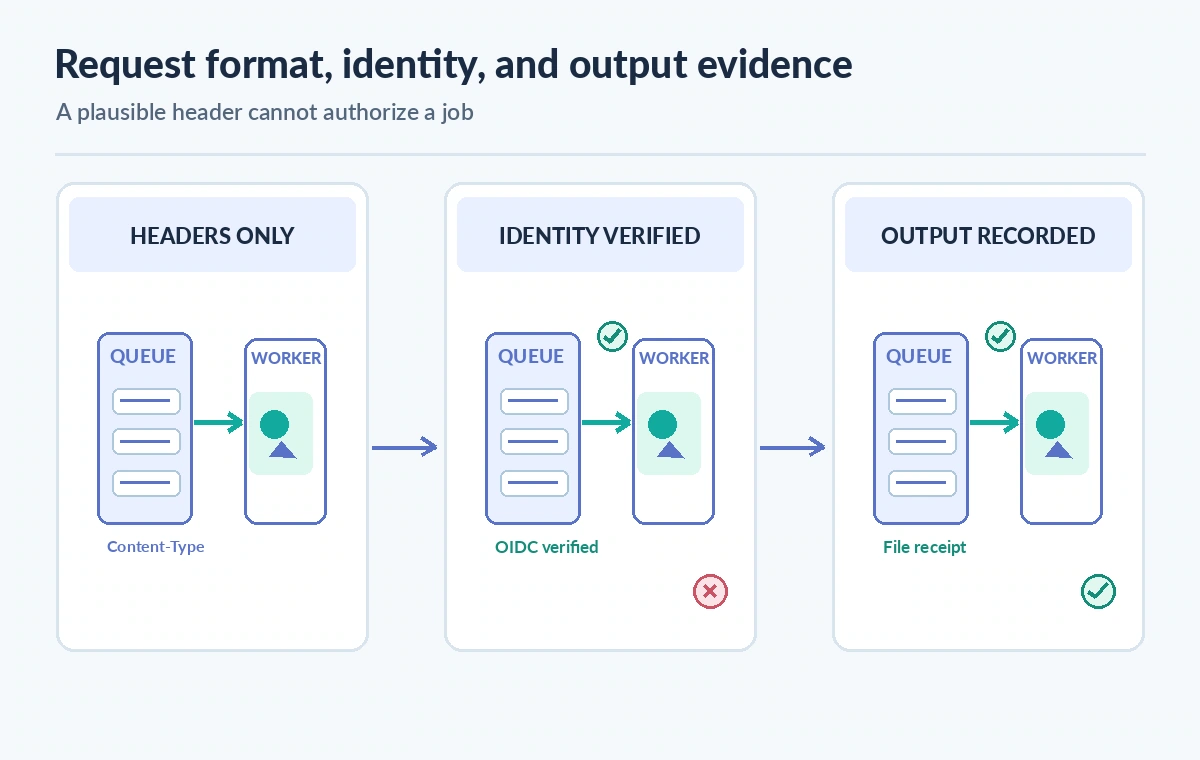
A 2xx handler response acknowledges a task and Cloud Tasks can remove it from the queue. That alone is not a durable declaration that a derivative file was written, scanned and approved for public use. A worker that responds early needs a separate mechanism to record completion or failure of the actual transformation.
The diagram compares a request accepted only by header shape, an authenticated request, and a verified derivative receipt. Each stage answers a different question. A renderer crash after authentication should leave an exception in application storage, not an invented green status based solely on queue metadata.
Design retries around stable job identities
Task delivery may be retried after a non-2xx response or other failure. Use a stable job identifier tied to the source checksum, transformation recipe and intended output key to make duplicate attempts safe. The task name is helpful for diagnostics but should not be the only key preventing duplicate uploads.
Do not issue a new public thumbnail for every retry. Confirm whether the exact derivative already exists and whether its source revision matches. A prior successful write followed by a response timeout is precisely the case that can create duplicates if the worker relies only on the current request headers.
Limit sensitive data in user-defined headers
HTTP headers may appear in reverse-proxy telemetry, diagnostic logs and error traces. Put only low-sensitivity correlation values there, not signed source URLs, donor names, raw document excerpts or privileged authorization artifacts. Keep access decisions in approved identity and permission systems.
Use an internal opaque reference in the task payload and resolve its permissions within the worker. If compliance requires tracing an asset, associate that reference with an access-controlled audit table rather than publishing storage names in logs. Confirm retention rules for task metadata and error monitoring before a production rollout.
Validate a controlled matrix of requests
Create synthetic tests for JSON body with matching media type, unsupported Content-Type, missing OIDC token, wrong audience, changed queue override and duplicate delivery. Verify that each case returns a deliberate status and that no failed request writes a public derivative.
A useful acceptance matrix also distinguishes a successful transport response from a successful file checksum and content review. The illustrations show these conceptual states, not screenshots of a real Cloud Tasks console or results from a live staging queue. Test actual settings only in an authorized environment.
Release the thumbnail only after worker evidence
An archive derivative should become visible only when the worker authenticates the request, validates the source, completes the transform, records output provenance and passes any privacy or rights checks. A Content-Type header is a parser hint, not that entire process.
This guide relies on Google documentation and a hypothetical museum workflow. We have not configured a Cloud Tasks queue, validated identity tokens, executed jobs or measured retry rates. Check current task and queue resources, target-service rules and IAM policy with an operator before deployment.
How We Research
Our November 11, 2026 desk review consulted the following named primary vendor documentation: Google Cloud Tasks REST task resource; Google Cloud Tasks queue resource and overrides; Create HTTP target tasks. We compared documented fields and failure semantics with a fictional museum workflow, distinguishing request-level facts from institutional approval decisions. The illustrations are original instructional graphics, not screenshots or observed service outputs. We did not execute API calls, access real museum records, run security or accuracy benchmarks, measure performance, or claim an actual success rate. Recheck version-specific service behavior, accounts, privacy, rights and independent source records before deploying a real workflow.
Frequently Asked Questions
Yes. Set a suitable media type for the actual dispatched body and validate the decoded content in the worker.
No. The HTTP target documentation says Cloud Tasks computes or replaces these headers during dispatch.
No. They provide task diagnostics; authenticate the request with the supported identity mechanism.
Yes. Queue-level HTTP target overrides may change effective headers and authentication settings.
No. It acknowledges delivery. The application must separately verify derivative creation, provenance and release approval.