
A task arriving at a URL is not proof of identity
A museum schedules volunteer access reminders using Google Cloud Tasks. The worker endpoint receives HTTPS requests containing an email address and an event ID, and the team initially assumes that a difficult-to-guess URL is enough protection. Anyone who obtains the endpoint could then attempt to send a forged reminder request. For a private HTTP handler, use authenticated task delivery and evaluate the caller rather than relying on the URL, a static header copied between environments, or the mere fact that a request reached the server. Google’s Cloud Tasks documentation supports attaching an OIDC ID token generated for a service account to an HTTP task. Identity must still be checked at the receiving service; it does not establish whether a particular reminder should be sent.
Choose the correct token for the target
Cloud Tasks supports an OIDC ID token or an OAuth access token for authenticated HTTP tasks. Google recommends ID tokens for handlers running on services such as Cloud Run and Cloud Run functions, while Google APIs hosted at googleapis.com generally expect an access token instead. These token types answer different questions and should not be swapped casually. A public Cloud Run URL with an ID token configured is not necessarily restricted unless the receiving service enforces authenticated invocation. Before creating tasks, document the exact target hostname, whether its platform checks the token, and the service account authorized to invoke it. Do not put an API key or bearer token in an article, an example screenshot, or a publicly accessible workflow log.
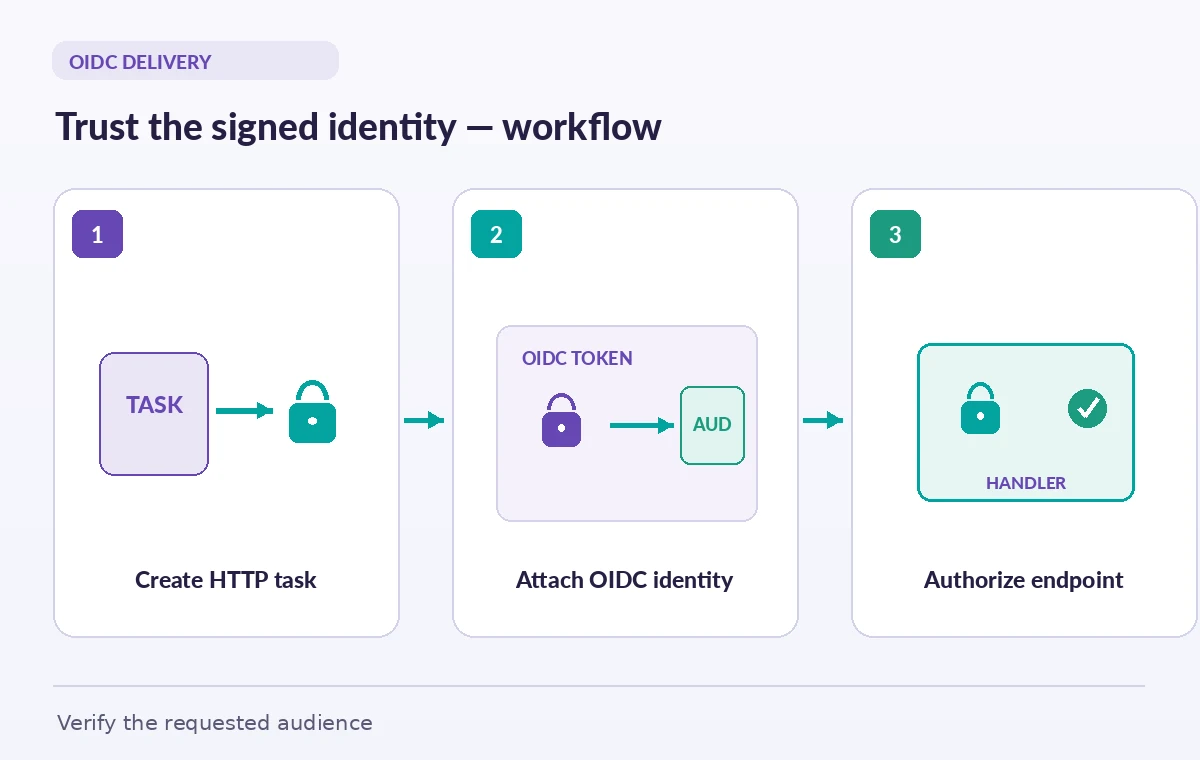
Set serviceAccountEmail and audience intentionally
In an HTTP task, OidcToken can include serviceAccountEmail and an audience. The service account must be in the same project as the Cloud Tasks queue according to Google’s guidance. The audience identifies which receiver the ID token is meant for; if the application uses a path or query string to route tasks, do not assume the complete request URL is the audience the platform expects. Match the receiver’s configured accepted audience and test that a token intended for another service is rejected. Keep the choice documented per environment so a staging task cannot accidentally authenticate to the production webhook. The process diagram depicts an identity-bearing request, not a raw credential or a captured production JWT.
Grant narrowly scoped permission to enqueue and invoke
The producer that creates a task requires permission to act as the selected service account, which Google documents as iam.serviceAccounts.actAs for this pattern. That is separate from the account’s right to invoke the target. Use distinct identities for task creation and task execution when doing so makes permissions easier to review. A museum preview worker should not inherit the ability to call every production administrative endpoint. Inventory roles, disable unused accounts, and keep identity configuration out of general article content. If a task cannot be created, investigate enqueue and act-as permissions. If it is accepted by Cloud Tasks but denied by the receiver, inspect invocation authorization and token audience rather than automatically broadening every role.
Understand queue-level authentication overrides
Cloud Tasks can also configure HTTP-target authentication at the queue level. Its documentation states that queue-level httpTarget overrides the authentication specified on individual tasks. This can be useful for enforcing uniform policy across a batch of deliveries, but it can surprise teams that assume each task’s oidcToken is authoritative. Before rollout, inspect the queue configuration as well as the task payload. Choose one documented source of truth and avoid mixing individual tasks targeted at different trust boundaries into a queue that overrides their identity. When the same worker has different sensitivity levels, separate queues or explicit authorization rules can be safer than relying on a visual grouping in the dashboard.

Verify claims and application permission separately
A gateway or platform can validate the signature, audience, and issuer of an ID token, but the handler still needs to decide whether the caller may perform the requested operation. At minimum, map the verified service-account identity to a narrowly defined operation such as ‘enqueue membership reminder,’ then validate the event ID and the intended recipient against approved museum data. Do not let a valid token authorize arbitrary URLs, employee records, or mail templates. Log a short event identifier and decision code rather than the bearer token itself. A rejected request is a useful security event: preserve enough metadata to diagnose mismatched audience or unauthorized service-account usage without exposing personal data.
Keep retries from turning into duplicate messages
Successful authentication does not provide exactly-once processing. Cloud Tasks can retry deliveries when the handler does not acknowledge completion, and the underlying business action may have happened just before a timeout. Store a stable reminder operation ID and make the database or message ledger reject repeated sends. The identity check should occur before any irreversible side effect, while the idempotency check should occur before the email or ticket update. If the handler returns a failure after committing the update, a subsequent authorized task should find the existing operation record and complete safely. That distinction is important: an authenticated request may still be a duplicate, and an unauthorized request should not reach duplicate detection on private records.
Troubleshoot a denied webhook without weakening security
Start with the task’s target URL and the queue-level override, then confirm the service account, accepted audience, and required invoker permission. Inspect the receiver’s denial reason if available, and compare a synthetic authorized task with a synthetic task from an intentionally untrusted identity. Do not solve an audience mismatch by permitting every issuer or making a previously private service public. Distinguish transport failures, authentication failures, and application validation failures in the operations dashboard; they require different responses. For time-critical reminders, plan a manual fallback when repeated failures exhaust the retry budget. This is an operational release gate, not an excuse to bypass identity verification.
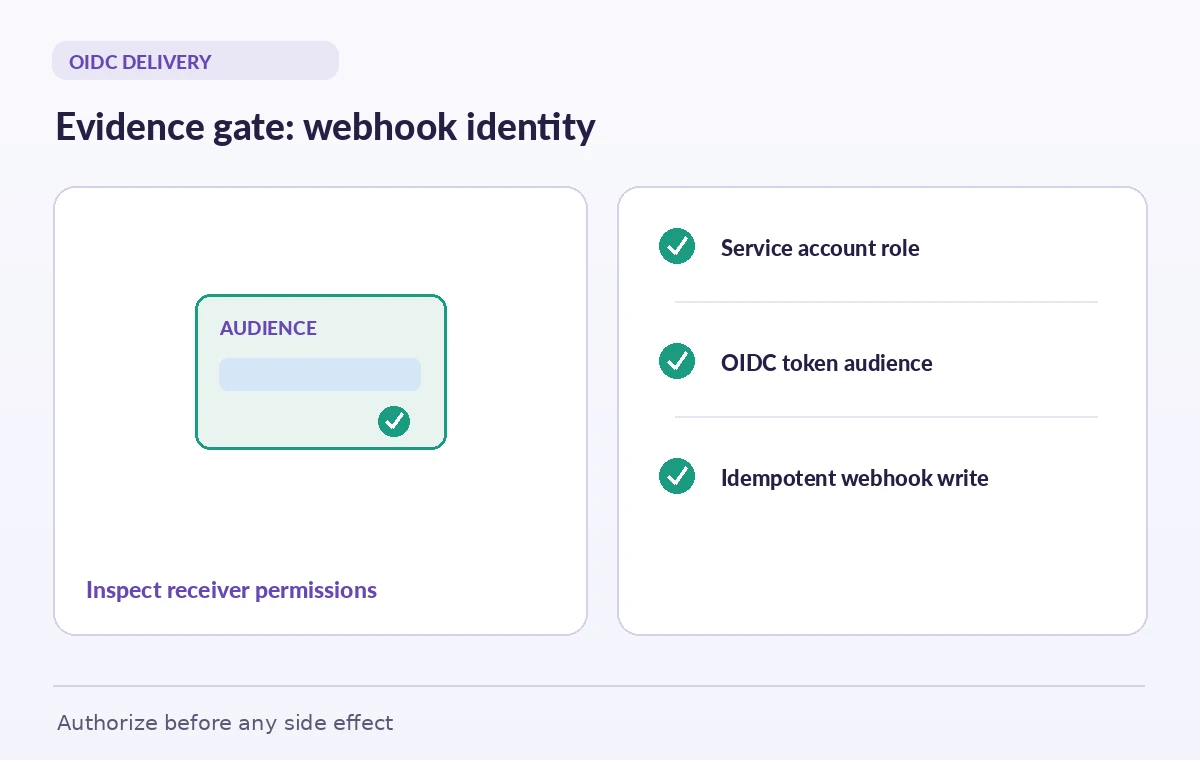
A safe rollout sequence for a volunteer webhook
Define the intended webhook operation and its minimum required fields. Choose the platform’s supported token type, configure the service account and audience, and review both the queue and the target’s permission settings. In staging, send one well-formed synthetic task, one with a mismatched audience, and one with a repeated event ID. Verify that the first is processed, the second rejected, and the third treated idempotently, then record the configuration change and sign-off. Only afterward migrate a small batch of real reminders with monitoring. The goal is a clear chain from scheduler identity to authorized business action, not a claim that HTTPS or an OIDC header alone makes every request safe.
How We Research
We consulted the original provider documentation: Google Cloud Tasks HTTP target authentication; Google Cloud Tasks create tasks guide; Google Cloud Run service-to-service authentication. We checked the official task creation reference and authentication guidance for token type, audience, service-account project requirements, and override precedence. The illustrated token and events are synthetic. We did not call an actual Cloud Run service or examine private IAM settings. We checked the terms and limits against the cited references but did not manufacture benchmarks, source access, or simulated production outcomes. Recheck provider settings and local organizational policy before a live rollout.
Frequently Asked Questions
Google generally recommends an OIDC ID token for Cloud Run and similar handlers, while Google APIs usually expect OAuth access tokens.
It binds the identity token to the receiver that should accept it. Check the audience expected by your target before dispatching.
The Cloud Tasks authenticated HTTP-task guide requires the service account to be in the same project as the queue.
Yes. The documented HTTP target configuration at queue level overrides task-level authentication choices.
No. Authentication verifies the caller; idempotency of sending or updating is an independent application responsibility.