
A queued job can leak more than an image ID
A museum digitization service creates Cloud Tasks jobs to process approved exhibit thumbnails. One developer wants to put the entire curatorial note, donor name, temporary cloud URL, and publication status into each task body to avoid a database lookup. That design increases the number of places where sensitive notes may appear during logging, retries, or debugging.
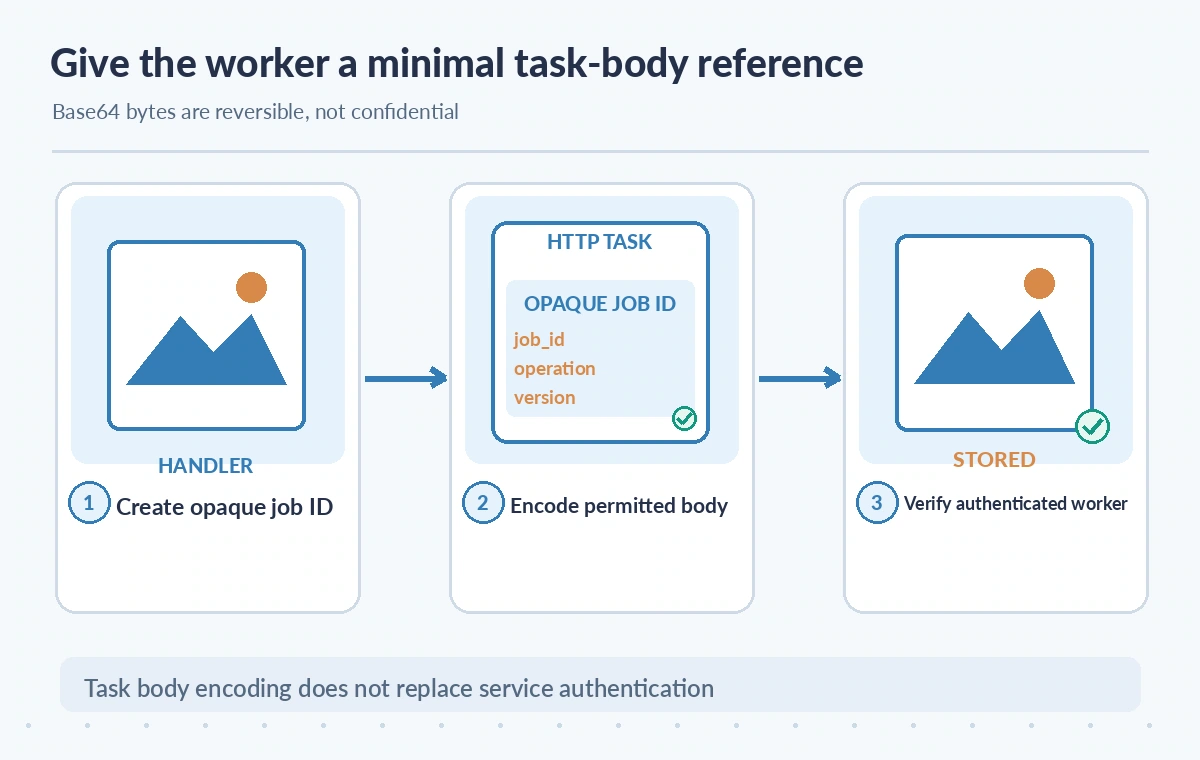
Instead, an HTTP task can carry a narrow opaque job identifier and a non-sensitive operation name. The worker retrieves controlled details from an authorized system after authenticating the request. Cloud Tasks offers a transport mechanism and delivery controls; it does not decide whether a particular museum note is suitable for inclusion in its payload.
Understand the REST body encoding precisely
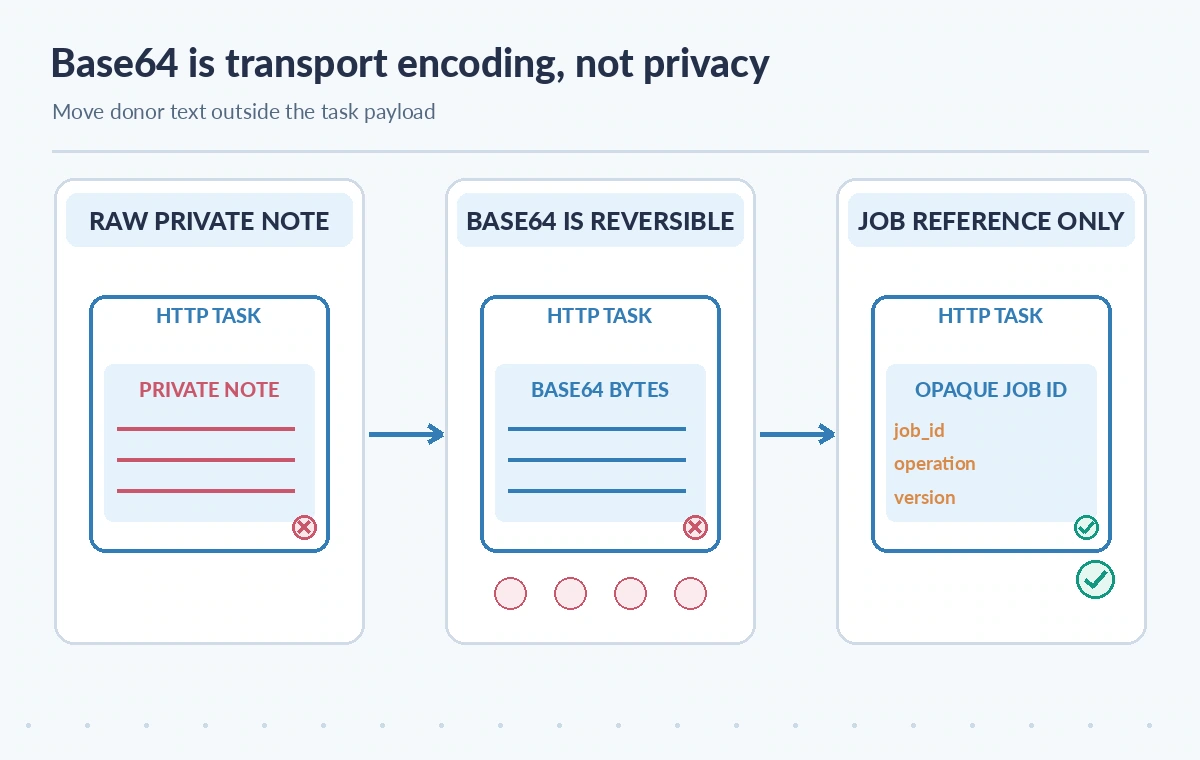
The Cloud Tasks REST task resource describes HttpRequest.body as a string of bytes represented in Base64 when sent through JSON. This is a serialization rule, not encryption. Anyone permitted to read the encoded value can decode the original bytes; it provides no confidentiality by itself. SDKs can abstract the representation, so verify the library contract before double-encoding.
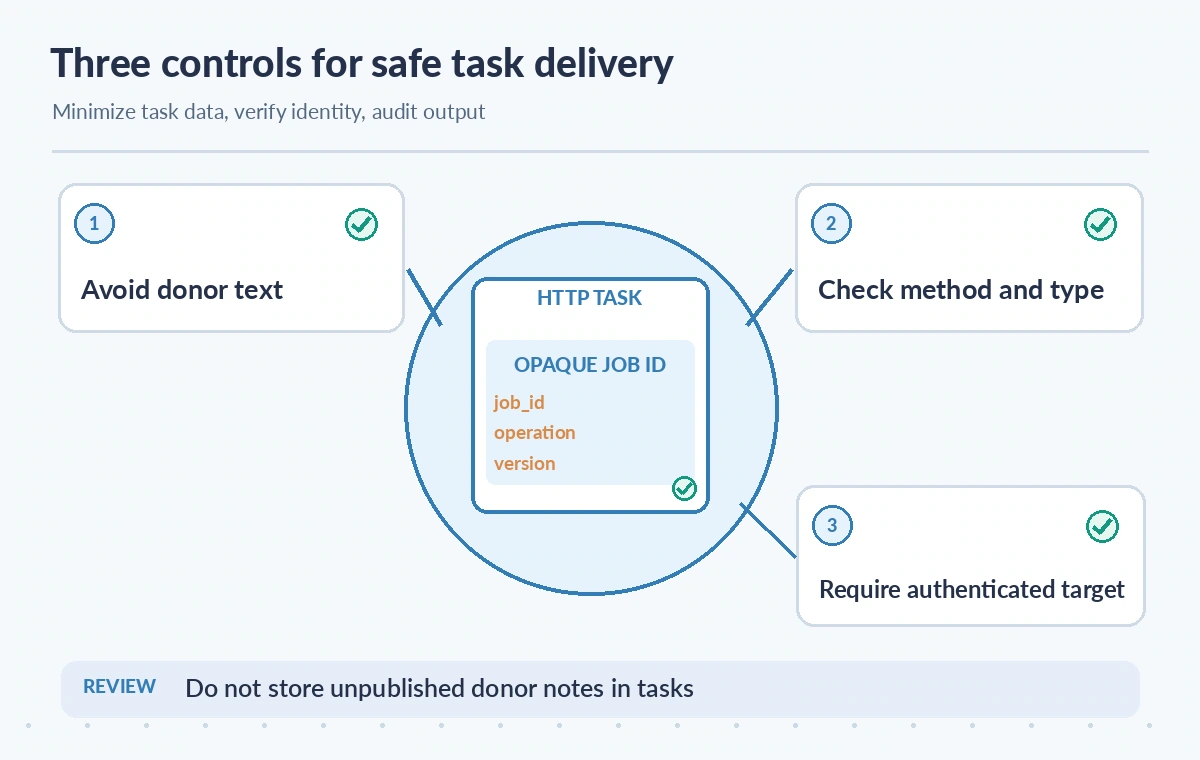
The HTTP request body field has method restrictions. The HttpRequest documentation permits body data for POST, PUT, or PATCH, and the service computes Content-Length. Do not assume a GET request can carry an arbitrary payload through the same field. Validate the configured method and the target’s expected media type before enqueueing.
Define a minimum information contract
An illustrative payload can include an opaque internal job ID, a versioned operation code, and a request schema revision. The job ID should resolve to an approved source object, expected derivative, and transformation recipe inside a protected database. Leave donor contact details, embargoed notes, signed URLs, and raw image bytes outside the task when the handler can retrieve them safely.
A minimal body reduces accidental disclosure and makes retries easier to reason about. It does not automatically make the request secure: the HTTP target, queue permissions, and downstream database still require access controls. Store a stable idempotency key server-side so repeat deliveries for the same job do not produce duplicate public objects.
Set Content-Type for the actual payload
Cloud Tasks documents that HTTP tasks with a body default to application/octet-stream if a Content-Type is not specified, and that the header may be set when the task is created. If the worker expects JSON, explicitly choose application/json and validate the decoded shape. Reject unexpected fields and unknown operation codes at the receiver.
Do not confuse encoding with syntax validation. A Base64 string can decode successfully into malformed JSON, and valid JSON can still contain unauthorized file references. Use schema validation and an allowlisted operation contract, and return an appropriate handler response only when the job has reached the agreed durable state.
Separate authorization from request metadata
For compatible HTTP targets, Cloud Tasks supports authenticated requests using an OIDC token or OAuth token configured with an appropriate service account. The backend must validate the token, its issuer or audience as applicable, and the identity allowed to invoke the handler. Queue names and other delivery headers are useful diagnostics but should not be treated as authentication.
Do not place API keys in task bodies as a convenient workaround for target authentication. A key copied into diagnostics or task data can be reused by unauthorized readers. Rotate credentials according to the institution’s policy and use service identities with the least permissions needed to fetch one authorized job record.
Compare three payload-handling states
The first conceptual state places an entire unpublished note in the request. The second merely Base64-encodes that note, leaving it reversible and still sensitive. The third sends an opaque job reference to a worker that independently checks authorization before retrieving details. The diagram teaches data minimization rather than depicting a tested Google Cloud deployment.
A responsible review should flag the first two states even if their HTTP requests succeed. Encoding alone changes representation, not disclosure risk. A reference-only design also needs controls for guessable identifiers, stale job versions, and worker privileges; do not call it secure until those boundaries are tested in the organization’s environment.
Build an idempotent processing record
Create a durable job receipt before putting a task in the queue. Bind the receipt to a source version, approved transformation type, expected output path, and rights-review state. A repeated delivery should check the receipt and decline to overwrite an already verified derivative. Where object storage supports preconditions, use them rather than relying solely on a remembered in-memory flag.
Record the actual derivative checksum and completion timestamp after the worker commits its output. A 200-class HTTP response is not evidence of a correct image unless the handler’s success contract requires durable completion. Maintain a reconciliation process for failed tasks and expired retries so inaccessible outputs are not silently marked as done.
Review logging and task inspection permissions
Task payloads can surface to operators with broad inspection permissions or in poorly designed application logs. Decide which administrators may see full task content and avoid logging raw request bodies in public monitoring. Write sanitized operational fields such as job ID, error class, and retry attempt instead of a private curatorial note.
If debugging requires payload inspection, apply an approved access process with a short retention period. Redact donor names and temporary credentials before sharing incident excerpts. Auditors should see that the source file was processed under an authorized policy, not a copy of its private narrative embedded in a queue record.
Run a controlled staging validation
Use a synthetic record with a fake accession ID, one valid operation, one malformed Base64 input, and one request containing a prohibited field. Test HTTP method restrictions, JSON decoding, OIDC audience checks if used, and duplicate delivery behavior. Confirm that the handler rejects unauthorized or invalid jobs without returning private database content.
Document observed outcomes only after running the actual test. This article itself performs no task creation, API call, security assessment, or penetration test. A diagram containing arrows and locks illustrates intended control flow, not evidence that a deployed service has these controls.
Approve the pipeline independently of queue success
Before releasing thumbnails, reconcile expected and stored object versions, check image quality, confirm source rights, and require a named editor’s publication decision. A properly encoded task body establishes neither the legality of the image nor the accuracy of its caption. Keep the publication step outside the worker until the content review is complete.
Review current Cloud Tasks API limitations, HTTP method support, service account setup, billing, and organization logging policies before production changes. A safer payload convention improves data minimization, but accountability still depends on the whole intake-to-publication chain.
How We Research
We examined primary vendor documentation on November 11, 2026: Cloud Tasks task REST resource; Cloud Tasks create HTTP target task; Cloud Tasks authenticate HTTP targets. The feature boundaries described above come from these references; the museum and archive scenarios are deliberately hypothetical. We compared the documented fields against likely failure modes, including source omission, access restrictions, and incomplete downstream work. Each illustration depicts an explanatory example rather than a real product screen, observed experiment, performance metric, or customer data. We did not issue live requests to the services, inspect private content, test prices, or certify security. Verify current API behavior, organization permissions, storage terms, billing, and source rights before making production changes.
Frequently Asked Questions
No. Base64 is reversible byte serialization for the REST representation, not a confidentiality mechanism.
The HttpRequest resource documents POST, PUT, and PATCH for request-body payloads.
Explicitly set application/json and validate the decoded schema; the documented default with a body is application/octet-stream.
Prefer an opaque job ID and minimal operation fields; fetch protected notes in an authorized worker.
No. Verify durable output, source rights, and human publication approval separately.