
A correct queue can still call the wrong route
A museum uses App Engine to generate approved thumbnail previews after catalog updates. The queue is healthy and tasks are being dispatched, but the new handler is mounted under an updated path. A task that reaches the wrong endpoint may fail, trigger repeated work, or receive an unrelated response. Queue health is not a substitute for destination verification.
For App Engine targets, AppEngineHttpRequest.relativeUri identifies the path component of the request to the service. It is not a full externally hosted URL. The REST reference explains that the delivered URL is constructed as host plus relativeUri, using App Engine routing. Separate host selection, handler path, and application authorization.
Apply the documented URI format limits
The relative URI must begin with a slash, be a valid HTTP relative URI, and cannot contain spaces. Google documents a maximum length of 2083 characters; an empty value uses the root path slash. The field can include a path and query string, but this does not make query parameters a safe place to put secrets.
Write a handler specification before constructing a task: method, canonical path, expected payload format, authentication policy, and idempotency key. Reject inputs that try to sneak in an absolute external URL, unapproved path segments, or personal information in query parameters. When encoding is needed, use the correct URI encoding rules rather than concatenating raw titles.
Understand task and queue routing precedence
The App Engine routing choice can be made at task level, but a queue-level appEngineRoutingOverride takes precedence for App Engine tasks. A relativeUri can be perfectly formed while the queue points to a different service, version, or instance than the creator expected. Inspect queue configuration when diagnosing an apparently unreachable handler.
Do not confuse App Engine requests with ordinary HTTP-target tasks. The queue routing override for App Engine tasks does not change generic HTTP targets. Keep separate inventories for their destination types, credentials, service boundaries, and expected response behavior, especially during a migration between legacy App Engine workers and newer HTTP handlers.

Avoid hidden assumptions about redirects
Google documents that App Engine task dispatches do not follow redirects. If the destination returns a redirect to a new handler, do not count the redirect as completed processing or assume the downstream operation happened. Change the task path or application handler configuration through a controlled release instead of relying on browser-style redirect behavior.
The same reference treats a 2xx handler response as a successful attempt, while non-2xx responses or timeouts are failures subject to retry configuration. A 2xx response still needs a completed work receipt in the application ledger. An endpoint can acknowledge a request before later image processing fails, and that difference must be visible to operators.
Design a minimal, verifiable callback payload
For a hypothetical museum system, the payload might contain a catalog-record ID, requested derivative type, source revision, and opaque job ID. It should not contain the donor’s address, a public download link to restricted scans, or full exhibit copy. The handler should retrieve authorized source data after authenticating the request.
Define a uniqueness constraint for each intended derivative and source revision. A second delivery of the same task should find the existing job or safely resume it, rather than creating another public image. Keep route names descriptive but free of personal data. The diagram uses symbolic URI paths, not actual infrastructure endpoints.
Compare invalid, valid, and completed states
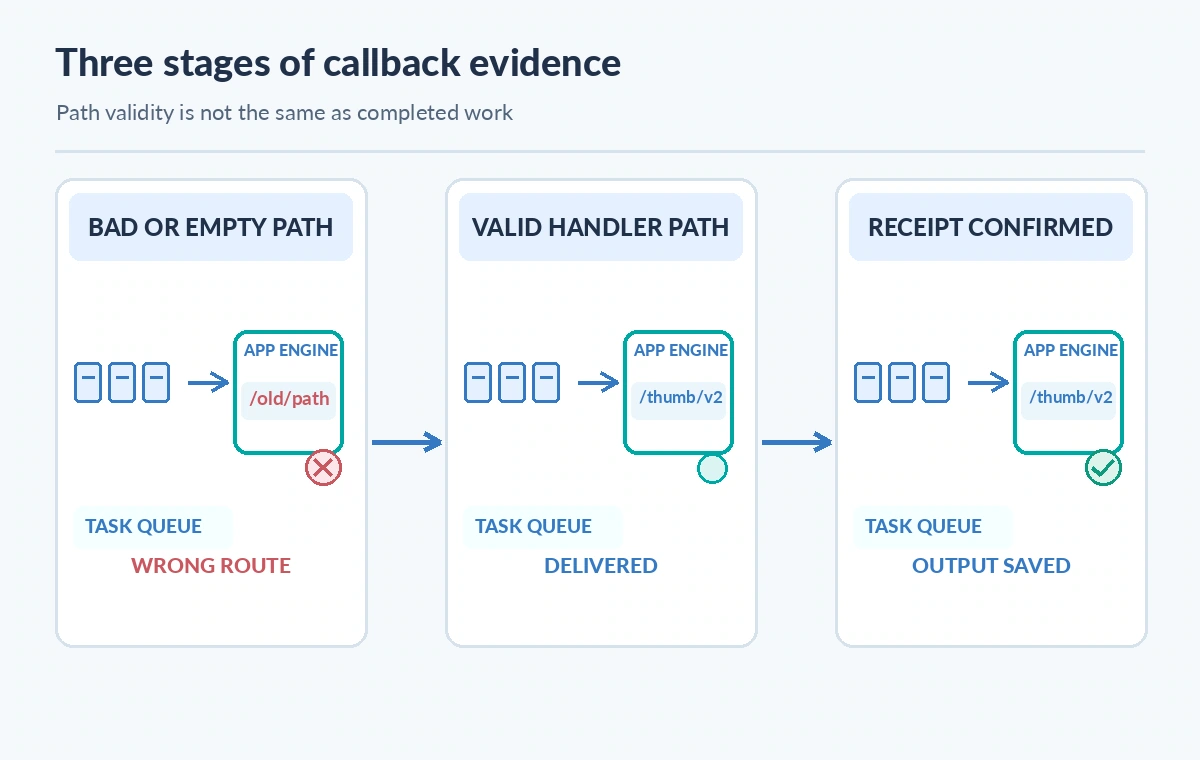
Our visual comparison distinguishes a missing or unintended path, a correctly constructed relative URI, and a handler-confirmed output. These are illustrative states, not traces from an active Cloud Tasks queue. A valid path is necessary but insufficient: method, routing override, permissions, and downstream effects still need review.
Avoid using a single success badge for both delivery and business completion. A handler can return an accepted status while its background work is pending. Store separate fields for received, processing, completed, and failed, with timestamps and safe error summaries. A queue dashboard should never invent processing outcomes from transport-level success.
Test routing in a controlled environment
Create a small fictional catalog fixture in an authorized test project. Use a handler that records a synthetic job ID and returns a known status code. Exercise the intended path, the root-path default, a deliberately missing route, and a task created while a queue override is enabled. Document observed behavior without dispatching public notifications.
For each test, record the task name, queue name, expected service, relative URI, attempt response, and application receipt. Do not replay a timed-out task blindly: check whether the handler already applied the side effect. A controlled diagnostic is different from a performance benchmark and provides no evidence about unrelated projects.
Handle auth and production logging carefully
App Engine tasks are delivered within a project-specific routing environment and have distinct handler requirements. Google’s reference explains constraints on App Engine handler login settings, including that tasks do not run as a normal user. Verify runtime authorization and service permissions for the deployed application rather than assuming a relative path grants trusted access.
Sanitize log fields before exporting them to centralized monitoring. URI queries can leak tokens, record IDs, or sensitive patron data. Treat Cloud Tasks delivery headers as diagnostic values, not independent cryptographic proof of the caller. Authenticate through supported controls, and keep a short-retention ledger of the identifiers required for troubleshooting.
Make rollback safe for pending tasks
When renaming a handler, leave a compatible route only if it can process old queued jobs safely, or pause the queue during a carefully planned migration. Inventory pending task formats and queue overrides. If a handler is deleted too early, retries can persist and obscure which records never received a derivative.
Test the rollback path with a representative pending task, using no real donor data. Record the old and new target routes, deployment version, planned cutover, and reconciliation owner. Do not call a migration complete until every queued job is either confirmed, explicitly failed for review, or canceled with documented authorization.
Release the thumbnail only after source verification
Before a generated preview becomes public, reconcile the task job ID with the source image version, storage checksum, rights approval, and accessibility text. Passing the transport path checks cannot establish that the content is safe, legible, or accurate. Release approval belongs to the editorial and collection workflow.
This article is based on published Cloud Tasks and App Engine reference behavior, with a fictional museum use case. We did not create a live queue, inspect a service, verify any user account, or measure dispatch success. Review current permissions, handler configuration, and regional support before implementing.

How We Research
We consulted these primary vendor documents on November 11, 2026: Google Cloud Tasks Task REST schema; Google Cloud Tasks Queue REST schema; Google Cloud Tasks task creation overview. We checked the named request fields, response definitions, and known limitations, and compared them with a hypothetical collection-management failure mode. The images are original conceptual diagrams rather than product screenshots or measured before-and-after results. No live API calls, customer content audits, source-image recognition tests, performance benchmarks, permission tests, or price measurements were performed. The example museum, identifiers, and outcomes are fictional. Production decisions require fresh version-specific documentation, authorized access, rights review, and human acceptance testing.
Frequently Asked Questions
No. It is a relative URI for an App Engine task handler and must begin with a slash when provided.
The documented default destination path is the root path, slash.
No. Google documents that App Engine task dispatches do not follow redirects.
Yes. For App Engine tasks, appEngineRoutingOverride at queue level takes precedence over task-level routing.
No. It confirms the task attempt was acknowledged; verify completion against an application-level record and the stored object.