
A children’s museum has an original fictional owl guide voice created by its creative team. The new exhibit needs a calmer narration style for quiet galleries, but the staff must avoid imitating a recognizable public figure or changing names and room numbers. ElevenLabs Voice Remix can generate variants of eligible voice profiles through descriptive prompts. This example focuses on source rights, voice continuity, and human listening checks; it does not claim that a particular preview was generated or approved.
Document who owns the voice and why it may be reused
Before opening a remix panel, identify the source voice. ElevenLabs says remixing is available for voices you own, eligible Voice Design profiles, or Voice Library voices with an infinite notice period. Ownership and permission are not the same as simply having access to an audio file. Keep written authorization and any usage restrictions with the project notes.
Use a fictional character design brief rather than a real actor’s name or a request to “sound exactly like” a particular celebrity. Describe the desired speaking manner, age-neutral tone, and context in terms of the character’s role. If the original voice was contributed by a performer, confirm that changing its attributes is covered by the agreement.
Separate style adjustments from identity changes
Voice Remix supports natural-language changes to accent, speaking style, pacing, and other attributes. Decide what must remain stable: the owl guide’s friendly character, the pronunciation of room numbers, and a recognizable timbre. A request for slightly slower, softer delivery is different from asking for a completely different person. Document that distinction before trying several prompts.
Ask the team what voice consistency means across the whole exhibit. A reassuring guide in one room should not become an unrelated personality in the next. Voice identity also affects accessibility: dramatic changes in pacing or accent may make a familiar recorded instruction harder to follow.
Choose the source and preview with controlled prompts
ElevenLabs describes preview generation followed by creating a voice from the chosen preview. Select an eligible source voice, then supply a bounded prompt such as “gentle museum guide, relaxed pacing, clear consonants, preserve warm character.” Avoid referencing a real person’s likeness. Use a short test script that includes the museum’s difficult names and location references.
Preview the output at normal listening volume and compare it with the approved original voice. The source voice is not overwritten by a remix according to the product documentation, so retain both profiles for review. If a generated voice is too different, revise the description rather than trying to conceal an identity shift with post-processing.
Control prompt strength and compare identity drift
ElevenLabs documents prompt strength settings from subtle transformations toward very strong adherence, which may substantially change the original voice. Begin conservatively where maintaining a character identity matters. A stronger setting can sound more dramatic but may sacrifice the consistency that visitors expect. Make the creative decision by listening, not by assuming that high strength is better.
The comparison illustration contrasts a generic imitation-like result with a reviewed fictional narrator, emphasizing identity and wording rather than pretending to show acoustic measurements. It is not an actual waveform captured from ElevenLabs. Keep the source and candidate clips side by side for an authorized reviewer.

Review pronunciation and meaning on exhibit-critical terms
Include exhibit names, accessible-route references, dates, and room numbers in the review script. A voice can sound natural while mispronouncing a family name or altering the stress on an important instruction. Listen across quiet speakers and standard headphones. Human review should assess not just pleasantness but whether the guide can be understood by first-time visitors.
If a remixed voice introduces a speech-style problem, adjust the prompt or narration script while preserving the approved content. Do not “fix” a flawed line by changing its meaning. Written signage must remain the authority for emergency and navigation instructions.
Account for preview charges and supported voices
The official documentation ties remix pricing to the length of the test script and explains eligibility limits. Confirm the current charge before running many long previews, and do not assume every voice in a public library can be remixed. The guide distinguishes owned clones and qualifying Voice Library voices from those whose notice periods do not permit this use.
Keep a simple ledger of each candidate prompt, review result, and accepted voice ID. This supports repeatability and prevents a different editor from selecting a rejected variant by mistake. Avoid publishing a preview simply because it appears in a generated list.
Prepare a truthful visitor-facing description
If the museum uses a synthetic voice, describe it as a fictional narrated character where that context matters. Do not imply a real curator, historical figure, or local volunteer recorded it if that is not true. Keep the human-approved script and the voice permissions in the project’s editorial file. The listener should not need to infer consent from the professional sound quality.
Check that the exported audio has no unintended vocal effects or uneven loudness across adjacent exhibit stops. A new voice variant can change how pauses and emphases work even when words remain identical. Compare several connected segments, not only a single polished sentence.
Check rights, identity, and script before release
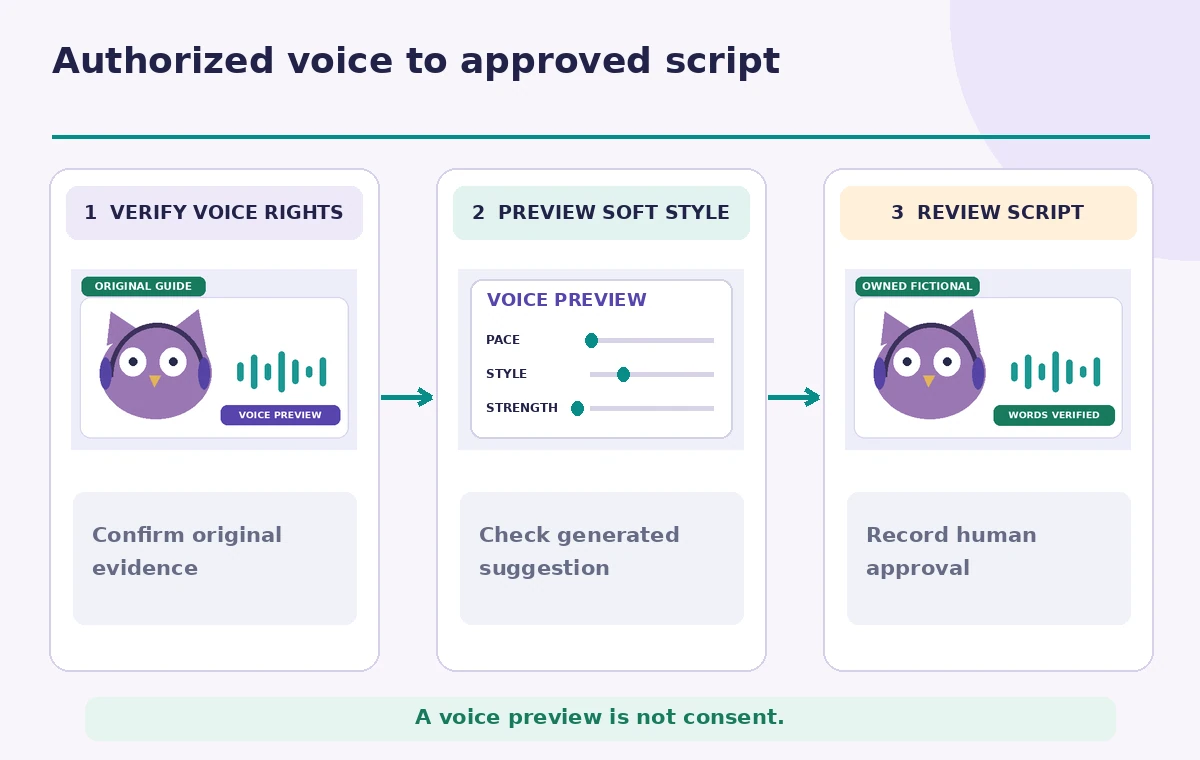
The final figure marks three separate approval points: source permission, recognizable fictional identity, and the exact approved wording. Each can fail independently. Have a creative lead approve style and a content owner approve pronunciation and safety text. Do not substitute a model-generated preview for either person’s sign-off.
Archive the source voice profile details and accepted settings without distributing private credentials or unauthorized voice samples. If an output resembles a specific person unexpectedly, do not release it. Regenerate using a less suggestive description or move to an openly artificial voice.

How We Research
Our editorial method for this guide was to read current named vendor documentation: ElevenLabs, Voice remixing capability guide; ElevenLabs, Voice Remixing quickstart. We mapped the documented controls, scope, access requirements, and known limitations to a narrowly defined hypothetical work scenario, then identified what a human reviewer must independently compare with the authoritative source. The illustrations are original explanatory drawings, not live screenshots, measurements, tested audio outputs, or customer case studies. We did not run a connected service account, purchase credits, verify a real organization’s permissions, or obtain real participants’ consent. Plan entitlements, interface labels, and costs can change. Review the vendor documentation and the source records before applying any action to real data.
Frequently Asked Questions
No. ElevenLabs limits eligible Voice Library voices to those with an infinite notice period and lists other permitted source types.
No. The documentation describes a new variant while retaining the original.
Not necessarily. Stronger settings can substantially change the identity, so compare carefully.
This workflow avoids identity imitation and requires appropriate rights for any source voice.
Source permission, identity consistency, and exact pronunciation and wording of approved narration.