
Copy.ai pricing is easy to misunderstand if you read “unlimited words” and assume that means unlimited automations. Its Chat product and workflow-driven go-to-market platform are separate buying decisions. Chat seats support routine conversational drafting; workflow credits and higher-end integrations are more relevant when a team wants to run repeatable processes with structured inputs and outputs.
This guide uses US dollar rates displayed on the official pricing page checked October 26, 2026. Rates and inclusions may change, so treat the arithmetic here as a transparent scenario, not a quote or an invoice. We do not treat access to a language model, a workflow credit or an employee seat as identical units.
Understand the difference between Chat and workflow capacity
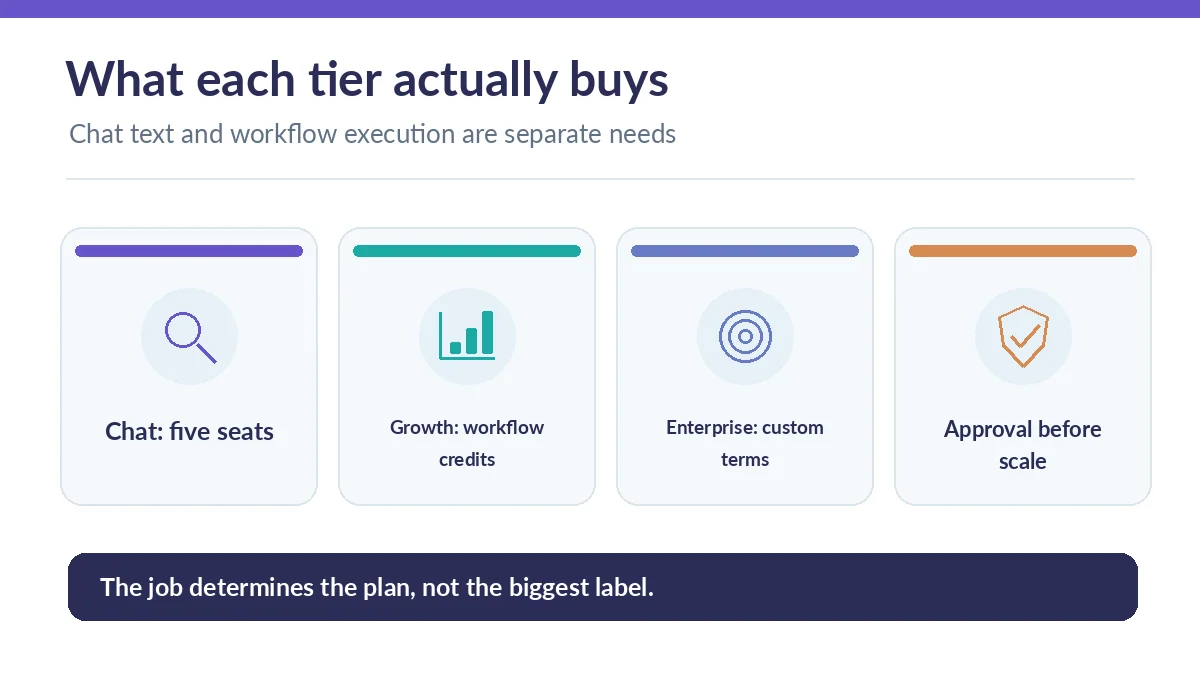
The Chat tier is designed for small teams using AI conversation and projects. The published plan includes five seats and unlimited words in Chat, with access to models from several providers. Unlimited chat words describe that chat usage category; they do not grant unlimited workflow runs or API access. Check what your team will actually automate before comparing plans.
Growth is described as a larger operational tier with 75 seats and 20,000 workflow credits per month on the pricing page reviewed. Enterprise adds sales-led arrangements, including advanced integrations, API access and customizable workflows. Those capabilities may have operational constraints; obtain written plan terms for anything essential to your purchasing decision.
Read the published US prices with the billing period attached
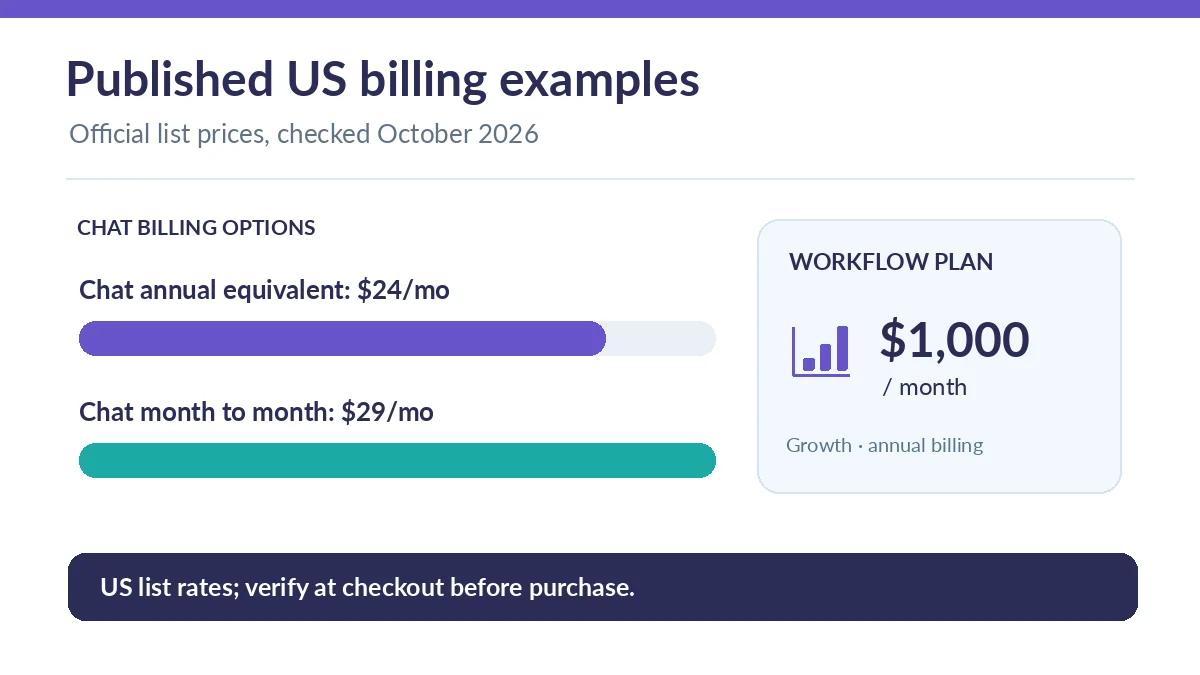
The public pricing page shows the Chat tier at $29 per month on monthly billing or an effective $24 per month when the annual $288 charge is selected. The distinction matters: paying $288 upfront is not the same cash-flow decision as a monthly charge that can potentially be stopped between periods. Taxes and final checkout rules are not included in those headline amounts.
Growth is displayed at $1,000 per month billed $12,000 annually. That is a different class of purchase from a $24 chat subscription. Enterprise requires consultation rather than a public universal price. The official checkout should be the final authority for region, promotions, team size and applicable taxes.
Calculate seat costs without false per-person assumptions
If a five-person team uses only the Chat tier, divide the annual $288 bill by five to understand the budget impact under full utilization: $57.60 per seat per year, before taxes. If only two people use the workspace, the same subscription costs $144 per active user per year. These are arithmetic examples, not independently quoted per-seat prices.
For a larger organization, a seemingly favorable “included seats” figure can mask onboarding and workflow administration. Ask who requires an interactive account and who only receives the output. Do not automatically upgrade because staff headcount grew; a few controlled process owners may serve a larger group through reviewed deliverables, subject to your access and license terms.
Budget the actual workflow workload
Define a workflow as a repeatable sequence, not just a single generated sentence. An example process might research a company, extract relevant facts, draft a customized note, and route the proposed note for human approval. Copy.ai documents test runs and their estimated credit use; this is a better planning input than guessing a flat cost per completed campaign.
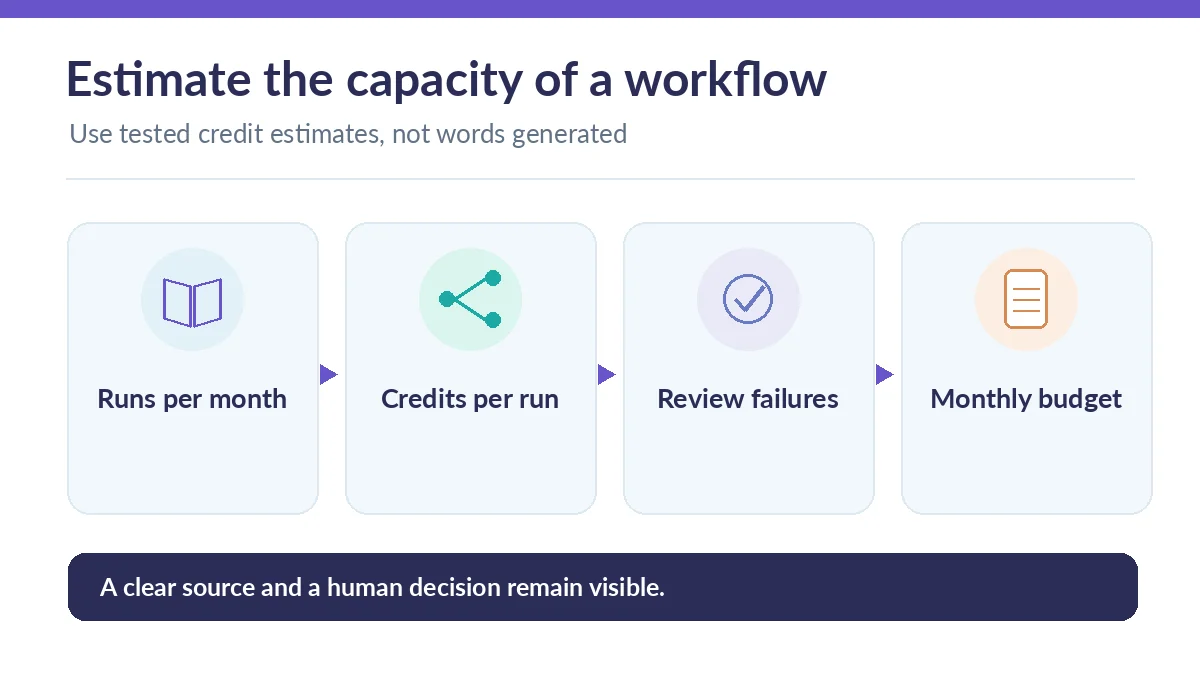
A practical worksheet uses four columns: runs per month, estimated credits per run, allowance, and exception rate. Multiply planned runs by tested consumption, then leave a margin for retries or more complex cases. The 20,000-credit headline is not enough to determine capacity without the credit cost of the exact steps you configure.
Estimate three purchase scenarios
Scenario A is a solo marketer writing occasional copy: use the free or lowest suitable chat option only if the current public offering and feature limits fit. Scenario B is a five-person messaging team: compare the Chat annual bill with the staff time spent editing and verifying responses. Scenario C is a revenue-operations team executing thousands of structured runs: test workflow credits and approval overhead before considering Growth.
For scenario C, an illustrative 100 runs requiring 60 credits each would need 6,000 credits. That number is a hypothetical planning calculation, not a Copy.ai rate card or benchmark. Credit consumption must come from the test output of your actual workflow. Request enterprise terms when API permissions, data contracts or custom integrations are a hard requirement.
Find costs the product page does not capture
An automation budget includes preparation of clean input data, review time, legal or security approval, integration maintenance and rework after source systems change. A low monthly headline can still produce expensive unreliable outputs if people must correct every run. Track “approved usable deliverables per month” alongside invoice cost rather than counting generated words.
You should also distinguish a demo account from a production rollout. Test with synthetic or approved non-sensitive examples first. Confirm retention, access roles, connecting third-party systems and data-processing terms through official vendor documentation and your organization’s procurement process.
Decide when an upgrade is justified
Upgrade for a demonstrated workflow that saves a material amount of verified work, not because a pricing table appears to offer more seats or models. A buyer should be able to name the owner, input system, failure condition, review queue and monthly run volume. If those answers are missing, start with manual assisted drafting and gather actual workload evidence.
An Enterprise conversation is appropriate when you need negotiated security terms, complex integration, volume allowances or designated support. Request a written statement of usage definitions and overage handling. A route that exists in an affiliate or redirect registry is not evidence of a partnership or an endorsed procurement choice.
Use a one-page approval memo before purchasing
Prepare an internal memo recording business task, alternative workflow, the number of accountable operators, expected credit consumption, contract length and a defined stop condition. Add one non-financial test, such as whether a reviewer can trace every generated claim to an approved source. A workflow that produces plausible but unsupported sales claims fails the test regardless of cost.
Review the memo after a controlled trial, noting accepted outputs, required corrections and worker time. Compare that with a human-only baseline, but describe the test as your own organization’s evidence, not an industry-wide benchmark. Revisit the official Copy.ai pricing page on the purchasing date because AI subscription offerings can shift rapidly.
How We Research
We examined the current official Copy.ai pricing page and the vendor’s workflow testing and credit-estimate documentation. Monetary examples are explicit arithmetic using posted rates and invented hypothetical workloads clearly labeled as such; no vendor quote, account-specific eligibility or actual run benchmark is implied. Pricing checked October 26, 2026, in US dollars and subject to checkout verification.
Frequently Asked Questions
No. Chat words and metered workflow credits are different product dimensions. Check the specific allowance and tested credit use of the automation you intend to run.
It is the effective monthly equivalent on an annual commitment shown with a $288 annual bill. The public monthly-billing figure is $29 per month.
That cannot be inferred without running or estimating your exact steps. The platform exposes a test-run credit estimate for planning; workflows have varying consumption.
The public Enterprise tier is sales-led and does not provide a universal numeric quote. Request a proposal covering usage, security, integrations and support.
The checked pricing page lists five seats for Chat. Confirm current seat and access rules at checkout and do not share one user identity to sidestep license conditions.