
Writesonic pricing now covers more than a stand-alone AI writer. Its official plans combine AI search visibility monitoring with article generation, site audits and varying levels of automated workflows. That matters if you arrived looking for inexpensive blog drafts: you may be comparing a broader monitoring platform rather than a simple pay-per-article product.
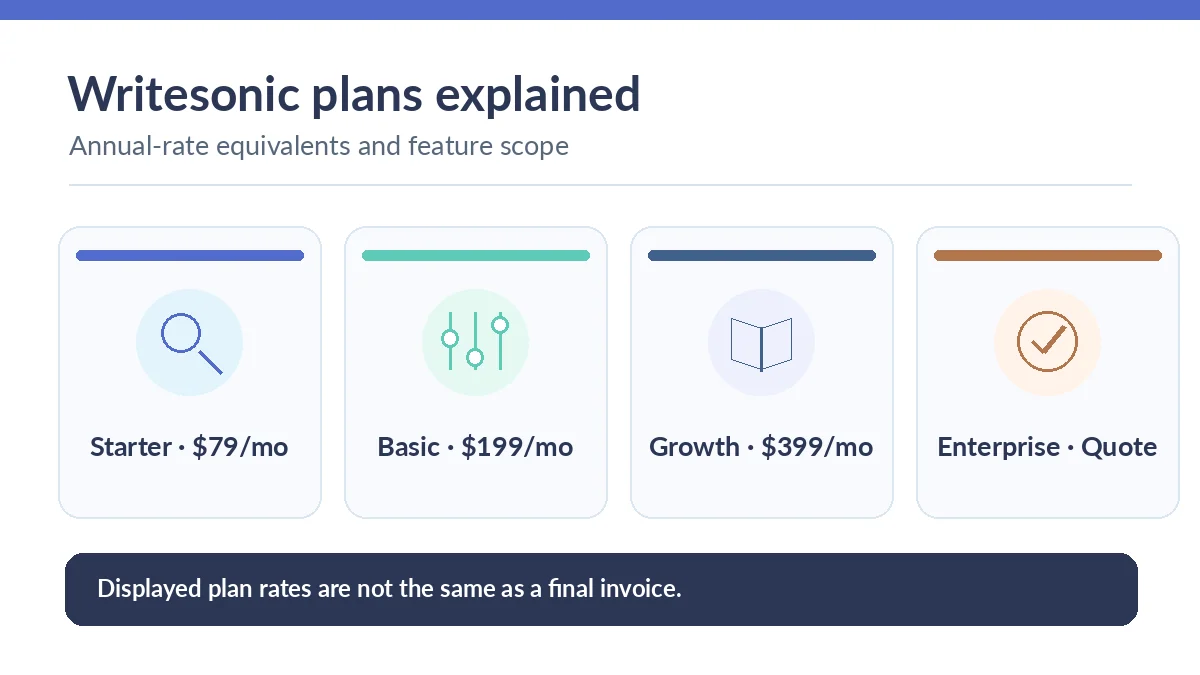
On the US pricing page checked October 26, 2026, the annual-billing monthly equivalents shown are Starter $79, Basic $199 and Growth $399. Enterprise requires a custom quote. This guide separates those list prices from billing frequency, tracked prompts, articles and users. It does not imply a successful purchase, independent tool test or a guaranteed ranking lift.
Read the pricing toggle before comparing numbers
The prominent public figures are tied to annual billing. At those displayed rates, twelve months of Starter amount to $948, Basic $2,388 and Growth $4,788 before taxes and any different checkout terms. The comparison is straightforward arithmetic: the first price is not necessarily what will be charged for one cancellable month.
Writesonic advertises a monthly-versus-annual toggle and an annual savings message. Check the live monthly rates directly when purchasing, because a screenshot of the annual view cannot establish your month-to-month invoice. Record the selected country, currency, billing cycle and renewal rule.
Starter: a small visibility and content experiment
The Starter annual-rate presentation includes tracking 50 prompts and 50 answers daily across the named AI-search surfaces, as well as 15 AI articles per month and ten site audits covering up to 100 pages each. It lists one user and one project. These numbers describe plan allowances, not evidence that your brand will appear in a particular AI answer.
Starter is best treated as a narrow pilot if you have one brand, a manageable prompt set and some editorial capacity. Before buying, define the questions you want to monitor and decide who will validate findings. A dashboard can show signals, but it does not prove that AI-driven visibility causes sales.
Basic: more tracked answers and editorial capacity
Basic is listed at $199 per month equivalent with annual billing. The current page displays 100 prompts and 300 tracked answers daily, 25 AI articles per month and twenty site audits of up to 1,200 pages each. It also lists two users and one project, making collaboration limits relevant to the buyer.
Use Basic only if the additional coverage maps to a genuine need: more product areas, a larger site or a second editor. If your bottleneck is factual approval rather than content volume, buying ten more generated articles may not change throughput. Test whether extra audits create actionable tasks for your team.
Growth: monitoring depth and larger team capacity
The public Growth annual-equivalent rate is $399 per month. The pricing comparison describes 200 tracked prompts and 600 daily answers, 50 AI articles per month, 50 site audits of up to 2,500 pages each, and three users across two projects. Features such as sentiment and a more developed action workflow appear at this level.
Do not treat higher monitored-answer counts as higher answer quality. Distinguish what the provider counts as an answer, how locations and languages are handled and which sources are available. If several brands need independent access controls or custom markets, an Enterprise conversation may be more appropriate than stretching Growth.

Enterprise: get a quote for the deployment you require
Writesonic presents Enterprise as custom. The site describes broader platform tracking, adjustable regions and prompts, additional workflow support, custom team configuration and enterprise security or support options. A quote must specify all of those details; none can be converted into a verified fixed public price from the current page.
Send sales an implementation brief containing markets, brands, analysts, monthly content needs, audit frequency, required integrations and identity controls. Ask how the vendor counts projects, agents and tracked responses. Insist on renewal terms, overage rules and export rights so a monitoring history does not become a costly lock-in.
Calculate whether the quotas match your workload
Suppose a team publishes eight fact-checked articles monthly. Starter’s advertised allowance of 15 AI articles may be sufficient on quantity alone, but review effort, project scope and audit needs could still be restrictive. Conversely, a team planning 40 generated drafts might look toward Growth’s listed 50-article allowance, but must verify how a generated article is counted.
For visibility tracking, inventory meaningful prompts rather than filling an allowance with near-duplicates. Assign each tracked phrase a reader intent and a target market. Compare coverage needs with plan limits, and log when data is unavailable or the tracked set changes. These are proposed planning examples, not measurements from a Writesonic account.
Separate search-visibility metrics from SEO outcomes
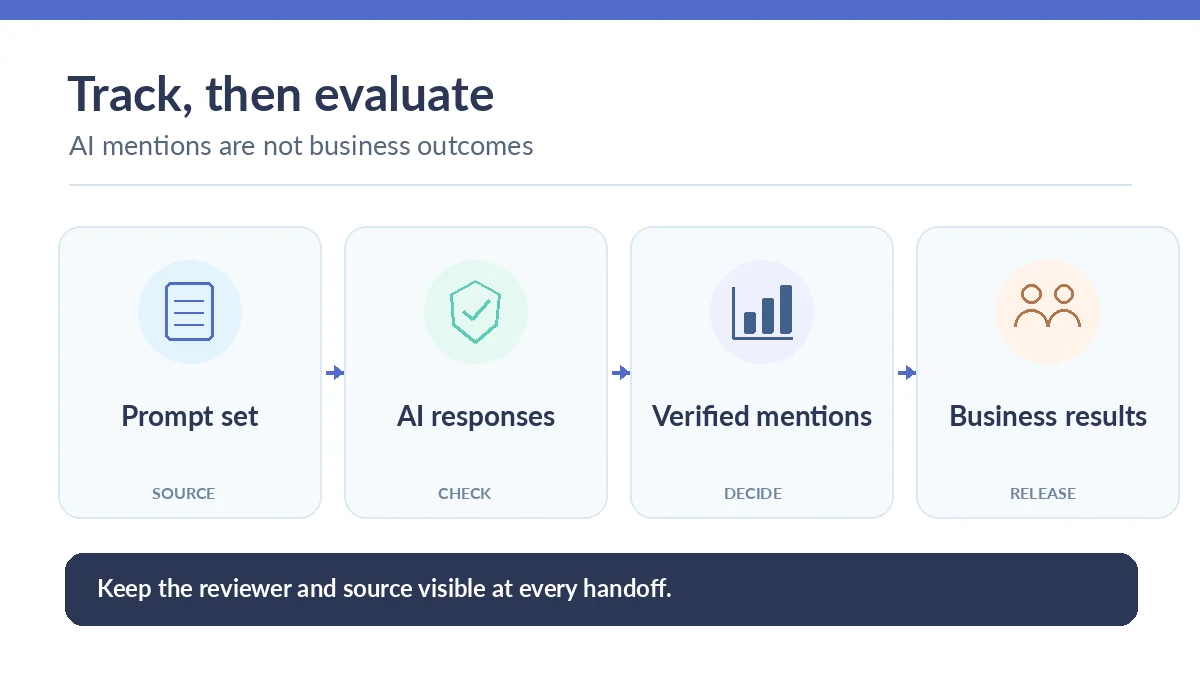
Visibility tracking may show whether particular AI surfaces mention or cite a brand under selected prompts. That is different from clicks, organic impressions, sales-qualified visits or customer conversion. A model response can change without a corresponding improvement in business outcomes. Do not purchase a plan on the assumption that a monitoring feature guarantees traffic.
Pair any AI-visibility report with your own site analytics and editorial evidence. Review which claims are supported, which cited pages actually exist and whether corrective content helps readers. Use Google Search Console or your existing analytics where appropriate, keeping methodology and attribution limitations visible.
Choose by a three-part purchase gate
First, confirm the actual deliverable: content creation, ongoing AI visibility monitoring, or both. Second, compare the published quotas against your markets, number of projects, users and approval staff. Third, calculate the contracted annual amount and the internal time required to review outputs and respond to site audit findings.
Save the dated official pricing offer before checkout and re-check limits and conditions at renewal. A cheaper specialist AI writing tool may serve a team that needs only drafts; the broader Writesonic platform may fit one that can genuinely act on monitoring and audit data.
How We Research
We examined the current official Writesonic Plans & Pricing page on October 26, 2026, including the annual-billing figures and the comparison table for prompts, tracked answers, articles, audits and users. The annual totals here are direct multiplication of displayed rates and are not payment receipts. Product tiers, counting rules, monthly checkout rates and Enterprise terms should be reconfirmed at purchase.
Frequently Asked Questions
The official pricing page checked October 26, 2026 shows $79 per month equivalent when billed annually for Starter. Confirm the monthly toggle and checkout terms before paying.
Yes, its current public plans combine AI-search visibility features with content and SEO capabilities, but each tier has different tracking and usage allowances.
The current public comparison lists 25 AI articles per month for Basic and 50 for Growth. Verify counting rules before planning a production pipeline.
No fixed public Enterprise price was confirmed from the provider pricing page. The vendor presents custom terms; request an itemized quote.
No tool can guarantee improved search ranking. Monitoring and generation may support editorial decisions, but content quality, relevance and real-world performance still require review.