
The best AI product description generator is the one that preserves what the product actually is while reducing repetitive catalog work. A fluent paragraph that invents a warranty, material, dimension or included accessory can damage trust and trigger marketplace problems. The key buying distinction is between a store-native assistant, a marketplace listing helper and a flexible standalone writing tool.
This comparison concentrates on product listings, not marketing headlines or long-form blog content. It gives small merchants a repeatable SKU test and separates verified platform capabilities from assumptions about search performance. We have not uploaded products, run marketplace experiments or measured revenue lifts; the decision criteria below are editorial and operational.
Begin with a single source of product truth
For each SKU, collect an immutable identifier, variant attributes, materials, dimensions, care instructions, inclusions, exclusions, manufacturer evidence and approved imagery. Include compliance language where relevant. A generator should not be asked to derive physical specifications from a picture or other sellers’ listings when your own product records contain the authoritative answer.
Use a structured input table with three labels: verified, uncertain and prohibited. For example, ‘stainless-steel exterior’ may be verified while ‘dishwasher-safe’ is unknown; the latter must not become a confident feature. This table makes it possible to compare tools using the same product facts and to see whether an assistant silently transforms a conditional statement into a promise.
Shopify Sidekick: strongest inside Shopify
Shopify’s current help page describes using Sidekick to suggest product descriptions from merchant-provided details. Its instructions emphasize adding actual features, editing the draft and checking accuracy before saving. This is an attractive fit for a merchant already maintaining catalog data in Shopify because the review happens near the existing product workflow.
The limitation is not writing quality alone. Product descriptions must still distinguish sizes and variants, reflect inventory and policy changes, and match merchant claims. Shopify explicitly says merchants remain responsible for accuracy. Check language support and the desktop editing path for your account, as documentation and interface labels may change over time.
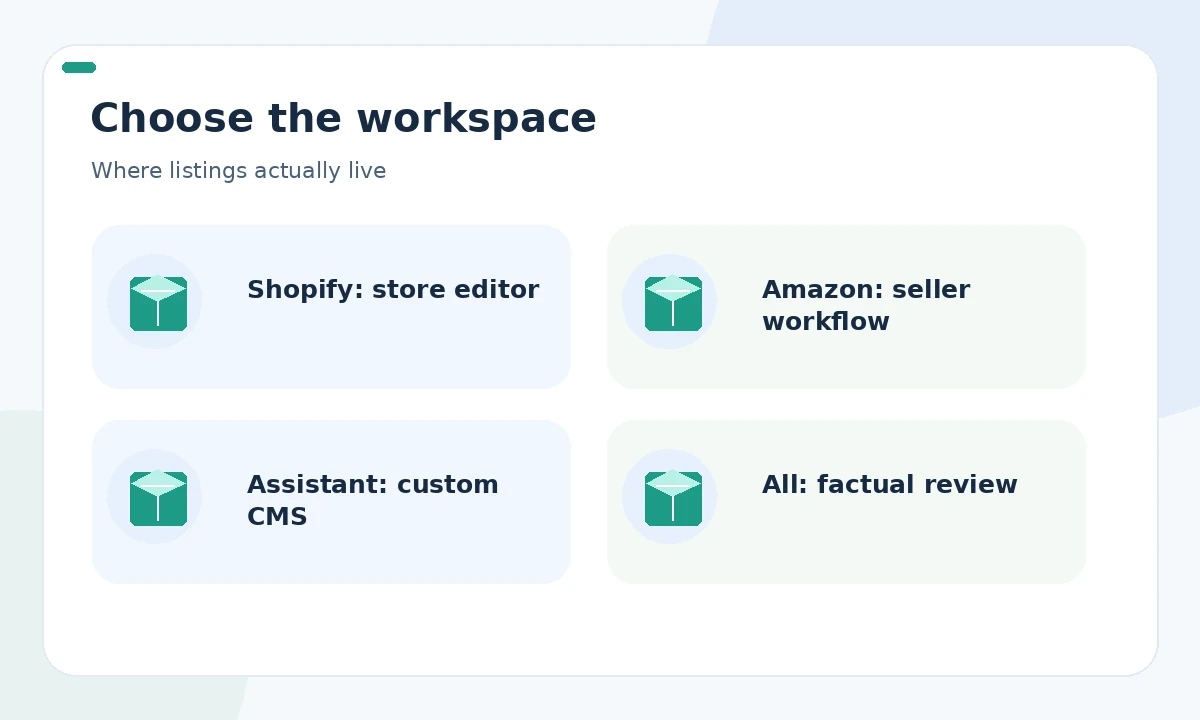
Amazon listing tools: marketplace-specific
Amazon’s seller information describes generative listing creation from short descriptions, images or product URLs and includes suggestions for titles, bullet points and descriptions. This can suit marketplace sellers who must fill standardized fields and review listing suggestions within their selling workflow. It should not be treated as permission to copy claims from competing listings.
A marketplace listing has distinct field rules and category constraints. Verify eligibility in your seller account, inspect prohibited-content rules and retain a draft diff before accepting changes. Product data that looks persuasive on a standalone store may be unsuitable for a marketplace bullet or title. Amazon’s feature descriptions do not establish that the tool writes perfect compliant copy for every category.
General assistants: flexible, but more supervision
ChatGPT, Claude or another general writing assistant can transform a supplied product fact sheet into several tones and formats. They are useful for businesses with custom content management systems or unusual product taxonomy. Their flexibility comes with extra work: exports, version control, exact variant matching and privacy settings remain the merchant’s responsibility.
For a fair comparison, provide the same verified SKU packet and ask each tool for a short description, a scannable detail list and a variant disclaimer. Score only observable criteria: factual preservation, editability, duplicate phrasing and consistency across channels. Do not declare a tool the best based on a single stylistic sample or a vendor conversion statistic.

Google Merchant Center needs structured accuracy
Google Merchant Center specifies distinct product title and description fields and emphasizes accurate product data. Its documentation also describes structured attributes for AI-generated titles and descriptions, where applicable. A pleasant paragraph in a store editor is not automatically a valid shopping feed; field limits, required identifiers and variant values still matter.
Create a channel map showing source field, storefront copy, marketplace field and shopping feed attribute. If a generated title misstates a color or model, fix the structured source before scaling generation. Avoid promotional slogans where a platform asks for product-only information. Confirm current requirements for the destination country and listing program rather than importing an old generic template.
A repeatable three-SKU buying test
Choose one simple item, one complex item with several variants and one item with sensitive or regulated claims. Supply the same facts to each candidate tool. Ask for draft copy, a list of fields it relied on and a visible list of information it could not verify. Have a product owner compare each sentence against the source record.
Judge the useful edit rate rather than total word count. Record unsupported claims, variant confusion, repetitive filler, time needed to correct the draft and ease of moving approved text into the store. A simple sheet with ‘pass’, ‘needs edit’ and ‘reject’ is more trustworthy than an invented numerical accuracy score. Use non-sensitive sample products if vendor data terms are unclear.

Publish through an approval and maintenance loop
Approve an item only after checking specifications, mobile readability, accessibility, related images and return-policy wording. Store the source version, generated version and approved final text. When a manufacturer changes material, bundle contents or certifications, trigger a new review rather than allowing outdated copy to remain because it once passed AI editing.
The value of a product description generator is repeatable catalog accuracy at a manageable cost, not a promise of instant ranking gains. Merchants can begin with store-native features, add a general assistant for edge cases and invest in specialist tooling only when the workflow demonstrably demands it. Keep the final human approval connected to the individual SKU.
How We Research
We compared the public primary documentation for Shopify Sidekick product descriptions, Amazon generative listings, and Google Merchant Center specification, reviewed on October 26, 2026. We mapped documented features and obligations to a specific user task, separated vendor descriptions from our editorial reasoning, and flagged areas that require account-level verification. We did not run paid campaigns, access merchant accounts, purchase subscriptions, or measure financial or ranking outcomes. Changes to platform interfaces, policies, access and plans should be checked before making an operational commitment.
Frequently Asked Questions
Yes. Shopify documents Sidekick-assisted product description drafting from merchant-supplied inputs; merchants must review and correct the result.
Amazon describes generative listing creation and suggestions, but eligibility, category requirements and approval steps must be checked in the seller workflow.
No. Search performance depends on many factors, and this comparison does not report a controlled test or any verified ranking lift.
Shared copy may be appropriate for common features, but distinguishing attributes such as size, color, materials and included items must stay accurate.
Use a few verified sample SKUs, mark any unsupported claims, inspect marketplace and feed requirements, and approve output item by item.