
AI writing for business is valuable when it reduces the friction of preparing a usable draft while preserving factual accountability. A proposal, customer note or operations update can sound professional and still be wrong about pricing, availability, policy or the recipient’s situation. The dependable workflow begins with evidence and an explicit purpose, then invites an AI assistant to improve presentation without inventing substance.
The method below covers day-to-day communications rather than enterprise vendor procurement or marketing campaign generation. Its concrete output is a one-page brief, a source-to-claim review and a final decision record that staff can reuse across approved writing tools. The examples are illustrative templates, not verified company communications.
Classify the message before opening an assistant
Identify the audience, distribution channel, consequence of an error and confidentiality level. A meeting recap sent to teammates may be lower risk than an account cancellation email or a contract proposal. Specify whether the document communicates a decision, requests an action, explains a process or summarizes evidence. One piece should have one primary job.
Use a simple routing rule: public material can follow normal editorial review; confidential internal context belongs only in an approved workspace; client-sensitive or legal text requires specialist review. Do not paste employee records or proprietary customer details into a tool simply because the draft feels urgent.
Create a one-page brief with the facts kept separate
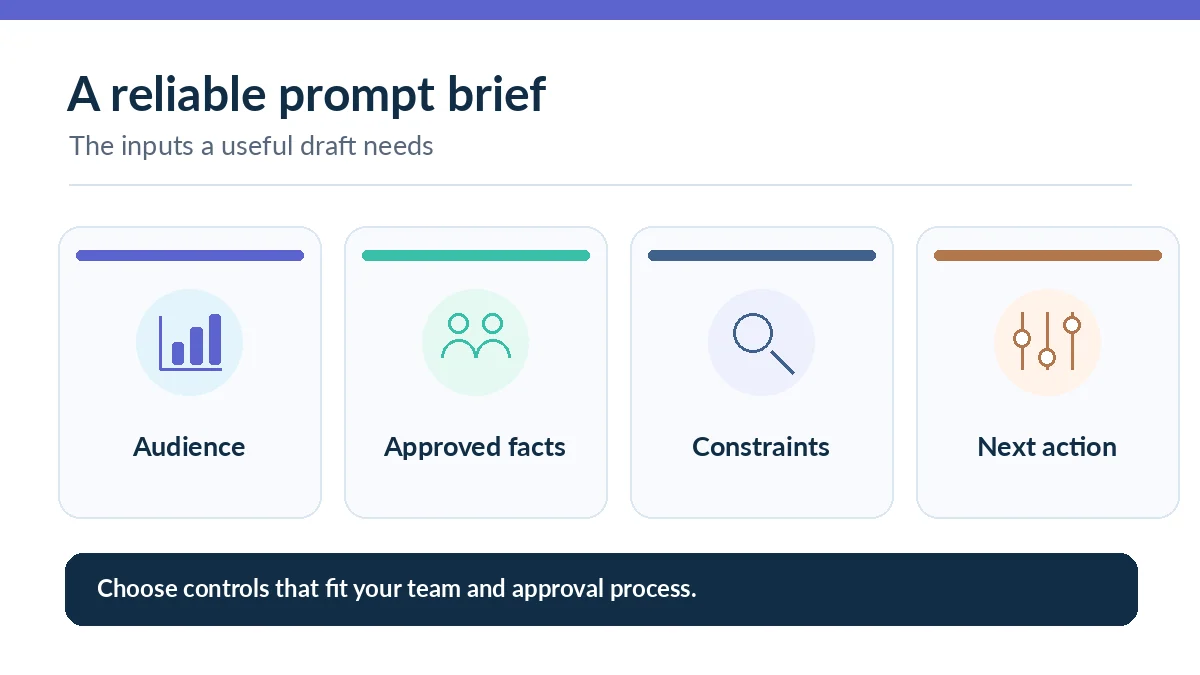
Write five fields: reader, desired action, approved facts, prohibited claims and review owner. For a scheduling update, the approved facts might include the confirmed time, meeting link and decision deadline. For a proposal, include the currently approved scope and state what has not yet been agreed. Keep unsupported suggestions out of the facts column.
Give each fact an origin, such as a dated product sheet, signed statement of work or approved policy URL. Labels like “latest plan” are not adequate for a time-sensitive quote. Date the brief and designate one owner who can correct it before writing starts.

Prompt for a constrained first draft
A useful prompt says: “Write a concise customer update for a busy operations manager. Use only the approved facts below, do not imply a contract has been signed, and mark any missing information as a question for the owner. Keep the tone direct and respectful.” Append the brief instead of asking the model to research unstated client circumstances.
Request a subject line or heading, one clear opening, a short body and an explicit next action. Where the tool exposes sources or file references, preserve them for checking; if it produces an unsupported date, quote or promise, remove it rather than letting polished language turn speculation into a commitment.
Review meaning before style and grammar
On the first pass, highlight every sentence containing an obligation, numeral, deadline, eligibility rule or external assertion. Compare each against the approved source. On the second pass, inspect whether the message answers the reader’s likely question and whether it leaves out a material condition. Only then adjust tone and grammar.
Use a visible diff when an assistant rewrites an approved paragraph. A well-meant shortening can delete a limitation or turn “may” into “will.” Make the reviewer explicitly approve changes that affect policy meaning; grammar improvements should not quietly modify commercial terms.
Adapt the same truth to different business formats
A customer email should state what changed, what it means for the recipient and the next step. An executive summary should begin with the decision required, followed by a small set of evidence-backed options. A proposal must distinguish confirmed deliverables from assumptions and dependencies. For a knowledge-base article, the sequence should mirror the customer’s actual task.
Do not indiscriminately repurpose one draft into every format. Context and implied promises change with distribution. A social post announcing a feature needs a different eligibility check from a customer email that promises the recipient access today.
Make approval and ownership visible
Use a minimal checklist: factual owner, tone reviewer, compliance reviewer when relevant, and publication approver. Record the version, decision date and location of supporting documents. When several people review, require one person to reconcile conflicting comments rather than letting multiple AI suggestions overwrite one another.
Treat approval as an outcome, not merely a completed AI task. The document should remain editable, and the company should be able to withdraw or correct it later. A permanent link to a source and a concise decision note matter more than recording every experimental prompt.

Use a measurable quality pilot with real tasks
Pick ten representative low-risk messages and run the same process both with and without AI assistance. Record time spent preparing a usable draft, accuracy corrections, reviewer effort and unresolved questions. Do not count a rapidly generated but rejected message as saved time. This is a suggested evaluation design, not a claim of measured productivity lift.
Track recurring defects separately, such as overly confident promises or unexplained jargon. Update the approved template only after the reviewers agree on the remedy. A writing workflow is successful when readers receive clearer accurate information with an accountable owner.
Know when not to automate the message
Pause automation for sensitive employee outcomes, novel legal interpretations, disputed account decisions and crisis communications. AI may help organize facts or offer a structural outline, but responsible staff should author and approve the substantive decision. Never ask a model to invent endorsements, case studies or evidence of customer consent.
For routine communications, give staff escalation language such as “I can confirm the approved next step, but the exception needs review.” A system that admits uncertainty and routes it correctly is usually more trustworthy than one that insists on finishing every draft by itself.
How We Research
We compared official OpenAI business governance guidance with Jasper IQ instructions for reusable company context. We used those sources to separate tool-supported context features from our suggested human approval method. The example prompts and worksheets are illustrative and were not tested against real customers or company documents.
Frequently Asked Questions
Only within an approved workflow with accurate customer data, policy checks and escalation controls. Start with draft-only use, especially where promises or account changes are involved.
Include the audience, one desired action, approved facts, tone rules, forbidden assumptions and review owner. Clearly flag missing information rather than letting the model fill it in.
Use only tools approved for the information category, with documented access, retention and third-party connector handling. Redaction can reduce exposure but is not a complete privacy policy.
Count reviewer corrections, rework and final usable output, not the moment the first draft appeared. Compare similar tasks under consistent conditions.
Follow organizational policies and applicable audience expectations. Disclosure does not replace fact checking, accountable authorship or legally required statements.