
Anyword can help a marketer draft alternatives, but a well-written ad is not the same thing as a verified claim or a successful campaign. The useful workflow starts with a disciplined brief and ends with actual campaign observation. The tool’s performance prediction is an input for choosing candidates, not the final verdict.
This 2026 guide focuses on writing one small, auditable set of campaign variants. It deliberately does not duplicate our Anyword review or pricing explainer. Instead, it supplies a reusable evidence sheet, a variation matrix and concrete approval gates for teams that must defend what their ads say.
Start with an evidence-bound campaign brief
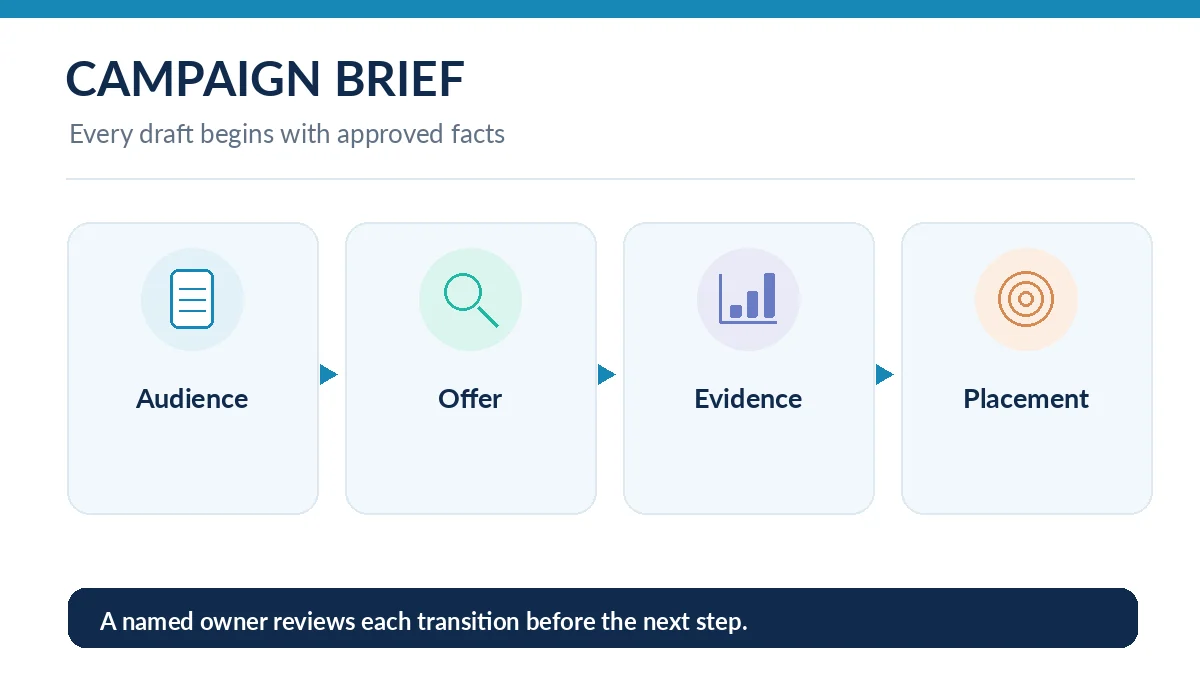
Write down the audience, offer, conversion action, placement, character constraints, compliance owner and publication date. Add a source column for every product claim: a published specification, approved offer page or verified customer policy. A headline saying “guaranteed results” cannot be justified by asking a language model to make it compelling.
For example, a small bookkeeping service might target owners scheduling a first consultation. Its approved facts could be service hours, geographic coverage and whether a free discovery call exists. Do not transform those into claims about tax savings or error reduction without documented evidence. Keep a separate “unknown” row so gaps are visible before copy is generated.
Generate purposeful variants, not random synonyms
Use the Data-Driven Editor to explore a limited set of substantially different angles: time saved in an ordinary workflow, relief from a specific nuisance, or clarity about next steps. Three angles with two headlines each are easier to compare than thirty near-identical rewrites. Preserve the same factual proposition across the variants to avoid making the comparison misleading.
Track each candidate with an ID in your own sheet, the original prompt, audience, landing page and supporting claim reference. Consider the sample headline “See Your Books in One Place” versus “Know What to Prepare Before Tax Season.” They target different anxieties; neither establishes a measurable benefit without further evidence.
Use prediction scores as screening, not proof
Anyword describes a predictive performance score in its editor. Treat this as a vendor-model estimate that may help rank candidates for review. The prediction is not an observed click-through rate, return on ad spend or conversion lift. It cannot reveal which offer, audience, placement and creative combination will actually win after an ad platform begins serving impressions.
Use a score to select a plausible short list only after rejecting unsupported claims. If the model prefers a dramatic sentence that subtly overpromises, choose the less sensational but demonstrably accurate alternative. Retain the predicted score with its date and settings so reviewers can reconstruct why the initial shortlist was selected.
Apply a four-part human review gate
Review truthfulness first: each factual clause should be traceable to approved evidence. Next check brand voice, including names and prohibited phrases. Third review destination consistency: a promise in an ad must be fulfilled by the landing page. Finally check placement requirements and accessibility, such as unambiguous calls to action and readable mobile copy.
An approval table should include “claim verified,” “landing page matches,” “legal review needed” and “approved by.” The owner is a real person, not an AI score. If the copy references an active discount, capture the expiration date and add a reminder to remove or revise the asset before the offer becomes inaccurate.

Launch a test with one controlled question
Choose one change to investigate, such as a problem-first angle versus an explanation-first angle. Keep the destination and offer consistent where feasible, then observe platform-reported outcomes over a useful sample. Audience targeting and delivery algorithms can still create confounding differences, so avoid calling a small early fluctuation proof of superiority.
Record spend, impressions, clicks, qualified outcomes and the period measured. Watch for low-volume campaigns: even an appealing percentage swing may represent only a handful of events. Do not claim a lift if the platform, attribution window or creative selection process makes the comparison unreliable.
Read results and update the source of truth
Compare the actual business outcome to the original objective. If a headline earns cheap clicks but attracts poor-fit prospects, it may be a weaker option than one with lower click volume and better-qualified enquiries. Attach the campaign result to the appropriate headline ID; never silently replace a scored draft with a revised final version.
Feed reliable observations into your next brief as examples, not as universal rules. An angle that worked in one industry, region or season may fail elsewhere. Anyword’s analytics and content-intelligence positioning is useful context, but integration availability and connected-data permissions must be verified for the account in use.

Build a repeatable one-page operating checklist
A simple sequence is: approved offer, verified claims, audience, three angles, draft variants, score screen, human approval, controlled launch, outcome log. Store each artifact in a shared campaign folder. This prevents a new editor from assuming the highest scored line is automatically compliant or that an old price can safely be reused.
Set a clear stop rule: no source for a factual claim means no publishing that claim. A creative review cannot repair nonexistent evidence. If approval is delayed, freeze the draft version and regenerate only after you know which underlying statement needs changing.
Choose when to skip the prediction step
You may not need predictive scoring for a one-off operational notice, a mandated legal disclosure or a tiny campaign with no realistic test volume. In those cases the central value is prompt consistency and the documented human check. Buying a higher plan solely for scoring would be difficult to justify without a reliable testing program.
The decision is functional, not ideological: use the prediction feature when you can connect it to a repeatable hypothesis and follow-up measurement. Otherwise, a basic writing assistant plus a careful claims checklist may be enough. The workflow remains valuable even when the software changes.
How We Research
We reviewed the official Anyword Data-Driven Editor description and Anyword product and Content Intelligence overview on October 26, 2026, and checked the US FTC advertising guidance for claim substantiation principles. This is a documented editorial workflow, not a first-hand Anyword account test or a measured campaign benchmark. Score behavior and access may vary by plan.
Frequently Asked Questions
No. A predicted score is a vendor estimate. Actual performance depends on campaign delivery, audience, offer, landing page and measured outcomes.
Start with a small number of meaningfully different angles, such as three angles and two headlines each; only expand if the first test answers a useful question.
No. Testimonials must represent genuine, authorized statements and meet the relevant disclosure and substantiation requirements.
No. Legal and factual approval is separate from model ranking. Reject unsupported or misleading claims even if the model scores them highly.
Keep the approved brief, evidence links, copy variants, prediction scores with dates, reviewer decisions and observed results for each test.