
A product launch can produce dozens of copy assets before anyone notices that their claims contradict one another. An AI copywriter may draft a landing page, launch email, sales enablement sheet and social posts in minutes, but it does not know which product benefits have been verified or which comparisons legal has approved. The highest-leverage workflow starts with evidence, not adjectives.
Below is a reusable process for a small marketing team. Its unique output is a claims ledger linked to each piece of launch copy. It is not a replacement for the earlier LabFin guides about a single product description or email sequence. No claim about faster production or better conversions is presented as a measured finding.
Collect product facts before writing the creative brief
Ask the product owner for a dated feature list, current availability, target users, supported integrations and known limitations. Keep a separate folder for screenshots, specification sheets and approved customer statements. Label planned features as planned, beta features as beta, and region-limited features by region. A launch page that turns “planned later” into “available now” creates an avoidable trust problem.
Write a concise source-of-truth sheet: product name, audience, offer, jobs-to-be-done, differentiators, exact proof and responsible reviewer. Record the version and date. If your team cannot explain the evidence behind a superlative such as “fastest,” remove it or request appropriate substantiation rather than asking AI to strengthen the wording.
Make a claims ledger with permitted phrasing
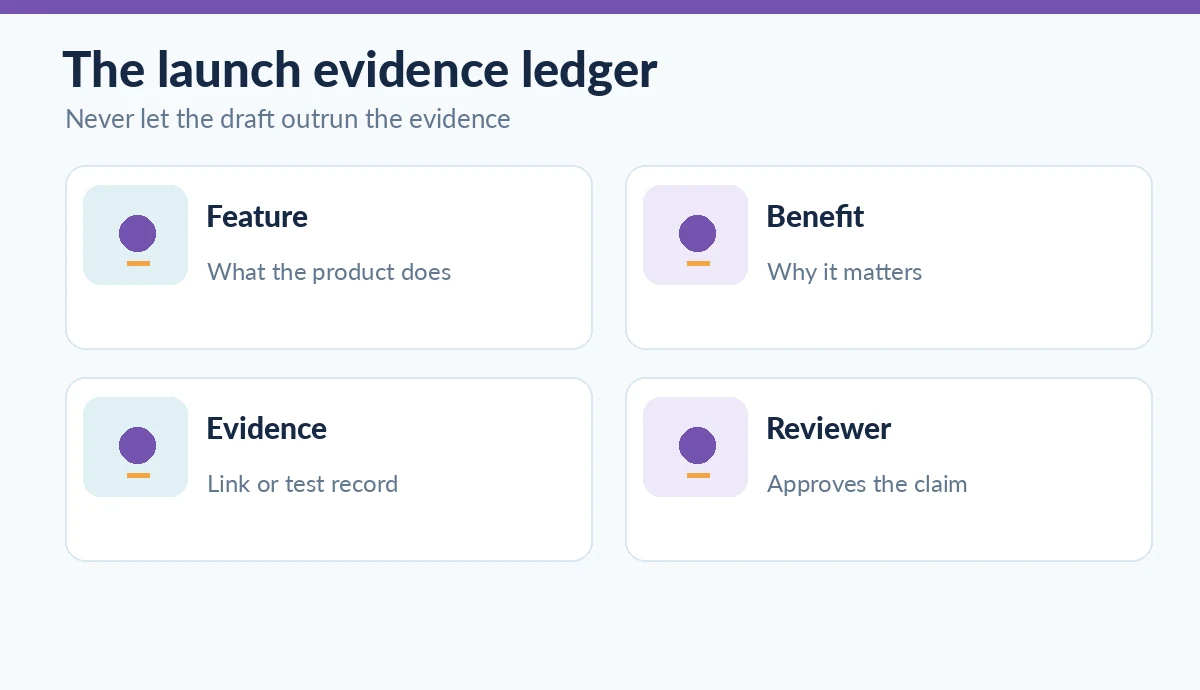
For every marketing statement, create four columns: claim, supporting evidence, permitted wording and approval status. Example: “Exports CSV files” can link to a verified feature page and might be approved. “Cuts reporting time in half” needs an appropriate study; it cannot be derived from an AI model’s enthusiasm. Mark unsupported statements “blocked” and keep them out of generation prompts.
The FTC’s guidance for US advertisers requires advertising representations to be truthful and appropriately substantiated. Exact legal obligations vary by industry and context, so specialized claims should go through qualified review. The ledger is an editorial control, not a substitute for legal advice; it simply prevents the writing process from treating an attractive benefit as a proven outcome.
Write one audience-specific copy brief
A brief should identify one buyer problem, the current workaround, the product’s verified mechanism, credible proof, likely objections and a meaningful next action. Add words to avoid, such as “guaranteed” and “effortless,” unless the business can defend them. If the feature is technical, explain the user outcome in plain language without hiding necessary limitations.
Use the same factual core when addressing two audience segments, but vary the framing. A team lead may care about review time while an analyst cares about traceability. Do not let the model invent two different product stories. Ask it to produce a list of claims used in each proposed asset so reviewers can compare the output to the source ledger.
Generate a small, reviewable launch set
Begin with one landing-page hero, one onboarding email, three short ad lines and an FAQ entry. Request two substantive message angles, not twenty near-identical synonyms. A useful prompt says: “Use only approved claims A, C and E. Draft for procurement managers. Mark every claim ID after the sentence. List unanswered product questions separately.” The IDs are for internal review, not for published imagery or customer-facing copy.
Prefer generating each asset from the same brief to editing a previous AI-generated asset into another format, because repeated rewrites can compound errors. Include necessary legal qualifiers near the claim they qualify. If a headline needs so many caveats that it becomes unreadable, revise the underlying promise rather than hiding qualifications in a footer.

Route claims through real reviewers
Product reviews capabilities, marketing reviews audience fit, legal or compliance reviews applicable risk, and the launch owner signs off on the final version. These may be the same person on a small team, but the questions remain distinct. Track the evidence URL and decision date with each approval. A chat transcript saying “approved” is not an organizational authorization.
If a reviewer changes a factual claim, propagate the change to every connected asset before publishing. Check localized versions separately because a feature or subscription might not exist in a market. Preserve earlier versions for an audit trail, and note who approved changes. The purpose of automation is to make this handoff visible instead of bypassing it.
Measure the campaign without inventing results
Choose metrics that match the channel: a landing-page conversion, email reply rate or qualified demo request. Define events before the campaign starts. When comparing variants, note traffic source, audience and dates, because seasonal changes and mismatched segments can overwhelm copy differences. An AI-suggested score cannot substitute for this measurement.
After the campaign, update the claims and objection sheet from verified customer feedback. Record surprising questions and exact product limitations that caused confusion. A useful postmortem specifies what people understood and what the team should rewrite next, rather than declaring the assistant’s copy inherently effective or ineffective.

Reuse the system for the next launch
Create a template bundle containing product sheet, claims ledger, audience brief, approved examples and channel checklist. General assistants can draft from the bundle. Jasper documents brand and product context; Copy.ai documents chained workflows. Which tool is appropriate depends on how much governance and cross-system reuse a team actually needs.
Recheck facts every time you reuse the template. Pricing, integrations and availability are particularly volatile. A safe launch process produces less unsupported copy, not necessarily more total text. The final publication gate remains a human decision with an evidence trail.
How We Research
We reviewed the FTC advertising-substantiation policy, Jasper’s product and brand context documentation and Copy.ai’s workflow description. We used these to design a conservative copy-control process. We did not run a real product launch, test conversions, validate legal compliance for a specific offer or claim that a particular vendor has approved our workflow.
Frequently Asked Questions
Not as a factual testimonial or substantiated claim. Use approved real evidence, clearly fictional illustrative examples where appropriate, and human review of the final copy.
The product owner checks feature accuracy; marketing checks communication; legal or compliance assesses applicable risk; and a designated publication owner signs off.
Keep a shared dated source sheet and claims ledger, then draft each asset from those approved inputs and review changes across every channel.
No. A score does not independently establish factual accuracy, compliance, user comprehension or real business outcomes.
Mark the superseded source, update affected claims, regenerate only necessary text and re-approve each impacted asset before it goes live.