
Anyword pricing mixes two very different ideas: generating marketing copy and measuring its potential performance with predictions and analytics. “Unlimited copy generation” on the pricing page does not mean unlimited performance predictions or connected campaign data. A team that ignores those limits may choose a seemingly affordable plan and run out of the feature it actually wanted.
This guide uses US public rates checked October 26, 2026, and separates billed-monthly prices, yearly equivalents, included seats and predictive-use allowances. Anyword’s scores are vendor estimates, not measured conversion rates or a promise that one headline will beat another in production.
Identify the two kinds of usage on the price page
Anyword Starter and Data-Driven provide a writing suite with templates, brand voice and generation features, plus allocations of performance predictions and data rows. The prediction allowance is a metered analysis feature. A user may continue creating words yet face a different limit when trying to score or compare many variations.
Therefore count your monthly campaign decisions, not only drafts. If an editor generates twenty headline candidates but needs comparative scores for each, prediction availability matters. If the job is a single landing page with a human review, a higher scoring allowance might not provide proportionate value. This is a purchasing framework, not a performance claim.
Compare Starter monthly and annual terms
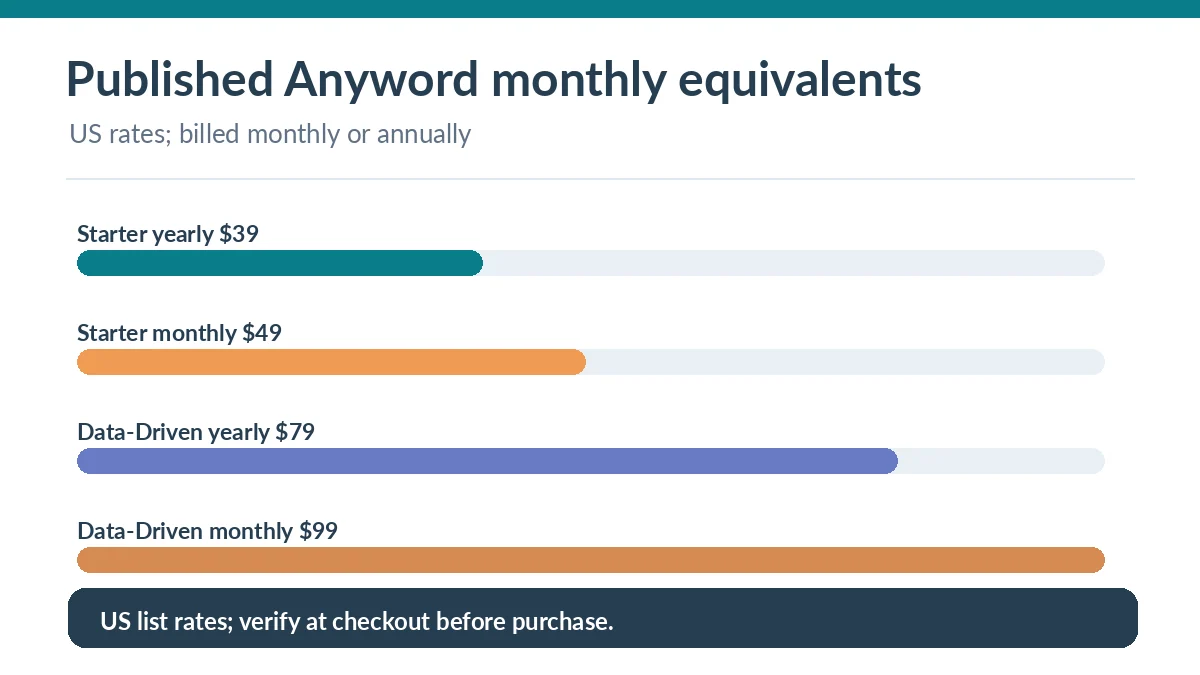
The official pricing page shows Starter at $49 per month on monthly billing or $39 per month billed yearly. The yearly equivalent implies $468 charged for twelve months before tax at the displayed rate; the month-to-month figure would total $588 if kept continuously for a year. Those are arithmetic comparisons of listed prices, not a quote for a specific buyer.
Starter includes one seat and one brand voice. The monthly view currently displays 50 performance predictions and 50 performance data rows; the annual view displays 100 predictions and 50 data rows. Because allowances differ by selected view, do not assume the billing toggle changes only price. Capture the feature table associated with the actual purchase.

Understand what Data-Driven buys a team
Data-Driven is listed at $99 a month on monthly billing or an effective $79 per month with yearly billing. At the listed yearly equivalent, twelve months total $948 before tax. The plan includes three seats and additional prediction capacity, with real-time predictions for manual edits described on the pricing page.
The monthly view currently indicates 100 performance predictions, while the annual view shows 175. Both shown views include 50 data rows. These differences are why feature selection should be checked in the chosen billing configuration, not summarized as a universal fixed monthly quota.
Budget seats and workspaces separately
Anyword’s plan comparison lists one Starter seat and three Data-Driven seats. It also lists optional extra Data-Driven seats at $59 per month or $49 per month on yearly billing, subject to plan terms and a maximum number of additional seats. A growing team should model active editors, approvers and users who only view finished content.
For example, a hypothetical five-editor team on Data-Driven needs to confirm whether two additional seats are purchasable and whether the quoted extras are required. At a $49 yearly-billing equivalent per extra seat, two extras imply $98 additional per month equivalent before taxes, but the actual annual charge must be confirmed by checkout. This is an explicit scenario, not a vendor-issued team quote.
Treat Business and Enterprise as negotiated products
The official public grid marks Business and Enterprise as custom-priced plans. Business includes broader data-connected performance analysis and significantly larger data-row allowances, with additional terms depending on the sales proposal. A universal monthly Business price should not be fabricated from a competitor comparison or an outdated screenshot.
When requesting a quote, specify channel connections, historical campaign volume, how many brands and workspaces are needed, permission controls, support expectations, usage overages and contract length. Ask the vendor to define “data row,” “prediction,” and permitted integrations in the written agreement before approving the purchase.
Know what a predictive score can and cannot do
Anyword describes a Predictive Performance Score designed to estimate copy performance potential from learned marketing patterns. That may help an editor choose which variants deserve a trial. It does not observe the actual purchases, audience mix, auction costs or tracking errors that will govern the outcome of your campaign.
Use scores as one hypothesis-generation input. Keep a record of the chosen variant, target audience, channel, spend, dates and observed conversions under your organization’s analytics practices. Do not state that a high vendor score guarantees a particular return. If you do not conduct controlled comparison, describe the result as observational rather than causally proven.
Use a prediction-budget worksheet before upgrading
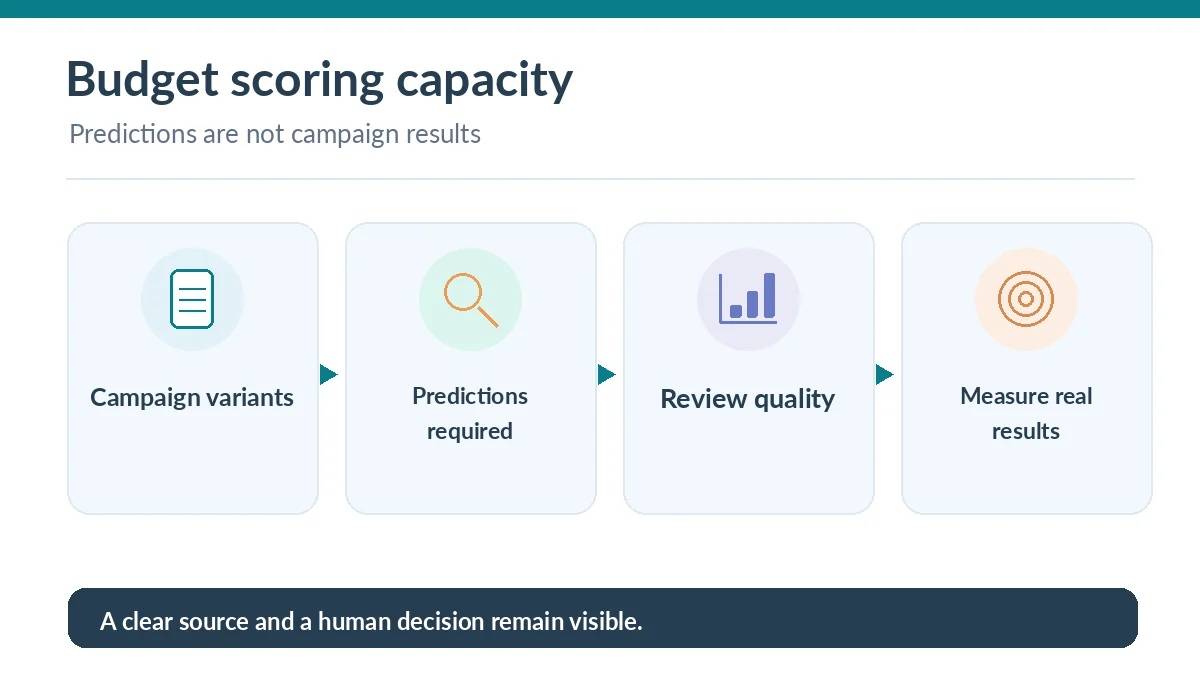
Define a campaign as an approval decision, then estimate candidate headlines or descriptions requiring scores per campaign. Multiply by campaigns per month to get an illustrative required prediction count. For example, six campaigns with twelve scored alternatives each would need 72 prediction uses if each score counts once; actual vendor metering may differ by feature.
Compare that need with the exact billing-toggle allowances and allow for revisions or rechecks. Team review time and source verification are additional costs. The right plan is the lowest tier supporting your real review process, not the tier promising the most generated words.
Choose the right plan without overclaiming ROI
Starter suits a single marketer who needs some scoring and one voice. Data-Driven becomes relevant when three editors need shared access, higher predicted-score allowances and collaboration. Business may make sense only when campaign data connections, custom analysis, security terms or larger volumes justify a negotiated contract.
Confirm the trial terms, taxes, selected billing cycle, number of seats and dashboard limits before payment. Anyword’s advertised performance advantages are vendor claims, not independent tests performed for this article. Maintain human approval of factual and regulated claims even if generated copy receives a favorable model score.
How We Research
We checked the official Anyword pricing and feature grid, the vendor’s Data-Driven Editor explanation and its Predictive Performance Score documentation on October 26, 2026. The plan toggle exposes differing prices and prediction allowances; this article records them separately. No campaign, scoring model, seat entitlement or conversion uplift was independently tested or guaranteed.
Frequently Asked Questions
No. The posted $39 monthly equivalent is shown with yearly billing, while the month-to-month Starter figure is $49 before tax.
No. The public plan grid lists separate prediction allowances even where generated words are described as unlimited.
No. The public plan includes three seats and describes additional seats with separate prices and terms.
Business is quote-based on the public pricing page. Request a written proposal covering seats, data rows, integrations and usage.
No. It is a vendor model estimate; actual conversions require properly observed campaign data and controls.