
Why global ordering can block an archive catalog
A museum catalog ingests condition reports, caption corrections, and publication decisions from several editors. The system must not publish the third update for one accession before its second update, but it does not need to wait for unrelated accession records. Amazon SQS FIFO queues support a MessageGroupId attribute that defines independent ordered streams. Giving every message the same group ID forces excessive serialization; assigning a group per actual accession workflow allows multiple consumers to progress separately. This article uses imaginary accession IDs and a conceptual queue, not a benchmark against a running AWS deployment. The purpose is to design safe update sequencing without claiming that the queue alone supplies database transactions, authorization, or exactly-once business outcomes.
Choose a MessageGroupId that matches the state boundary
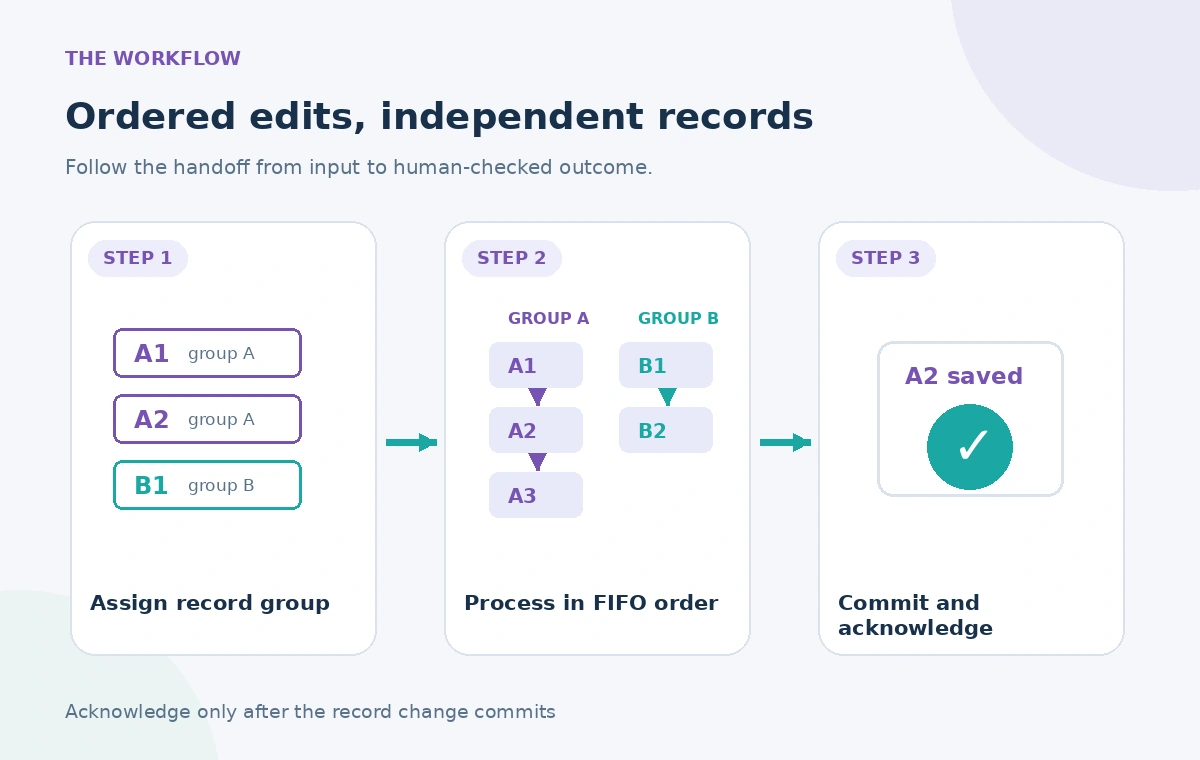
A practical message group key might be a stable accession identifier, normalized before publishing to the queue. Two edits to accession A should share its group even if they come from different user sessions or applications. Accession B should use a different group so a slow image review for A does not block B. Do not use a random new UUID for every event: that would destroy useful per-record ordering. Also avoid making the whole collection one group unless every edit truly must be serialized. Keep private visitor names and donor identifiers out of group IDs where possible; the ID can enter operational metrics and troubleshooting logs. Document how merges, splits, and renamed accessions map to a stable workflow key.
Understand FIFO ordering at receive time
Amazon documents that messages in a FIFO group are maintained in order and can be received together in a batch. A consumer receiving multiple messages from one group must still process them in the intended sequence before deleting them. SQS can return messages from other groups while the first group has in-flight messages. That interleaving enables parallel work, but different groups have no shared ordering guarantee. If an application truly needs a single globally ordered transaction, multiple groups do not meet that requirement. Design the consumer so state changes are tied to the current accession revision, not merely the time an individual worker happened to start running. A queue-level order is not a substitute for checking an upstream version constraint.
Connect visibility timeout to safe acknowledgement
When a worker receives a message, that message becomes invisible for a visibility period. Until its in-flight work is deleted or becomes visible again, subsequent messages in that group are restricted from moving forward. A worker should acknowledge a message only after the corresponding database change has committed successfully. If an editor’s photo task takes longer than the visibility timeout, redelivery can occur and the worker must handle the same event safely. Choose timeouts and extension behavior based on real job duration distributions, not invented speed figures. Logging should distinguish the initial attempt, retry, and committed state. Never delete a message merely because it was parsed; a parse success does not mean the catalog update persisted.
Compare one giant group with per-accession groups
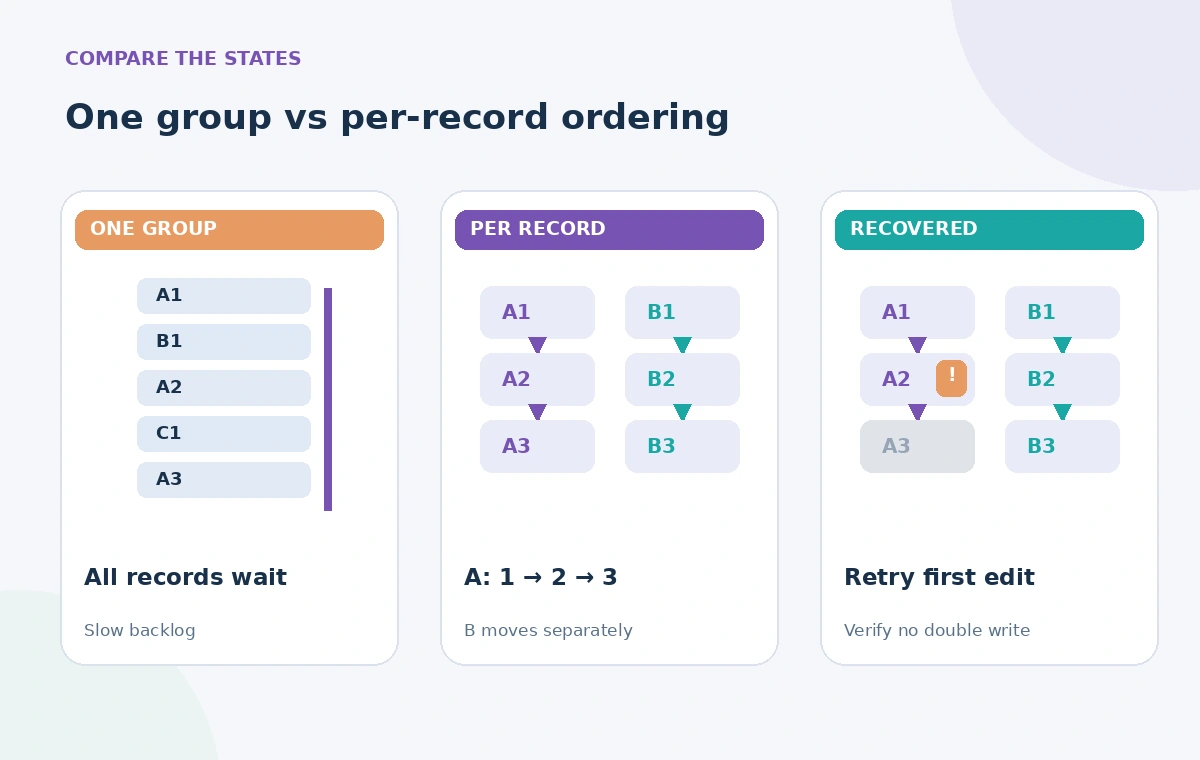
In a single-group diagram, accession A’s slow conservation review blocks all work behind it, including an unrelated accessions B and C. A per-accession diagram keeps A1, A2, and A3 in sequence while permitting B1 and C1 to be processed independently. A third diagram shows a failed A2 retry before A3 proceeds. Those are explanatory timelines, not recorded queue traces. Group design should follow the actual transactional boundary: if moving an object between collections updates two accessions together, a single group key may not be enough to guarantee cross-record consistency. In that case, use database transactions, a coordinated workflow, or another explicit consistency mechanism rather than claiming FIFO solves every multi-record operation.
Keep deduplication and idempotency separate from ordering
A FIFO queue also has message deduplication behavior, but deduplication IDs and message group IDs serve different purposes. Message groups decide ordered streams; deduplication IDs help suppress duplicate sends within the documented deduplication window. A business event may be retried or replayed outside that window, especially after worker failure or recovery. Make each catalog write idempotent with a durable event key, expected revision, or state-transition guard. That allows a repeated delivery to be recognized even when the queue legitimately sends it again. If downstream media generation or email alerts are triggered, they need their own idempotency boundary. Exactly one logical accession change is a property of the application and database design, not an automatic promise from queue ordering.
Design for poison messages and blocked groups
One malformed accession edit can hold up the rest of its group. Record the failing event ID, error class, retry count, and accession reference in a restricted operational log. Use a deliberate dead-letter and replay policy for messages that cannot be processed normally, while recognizing that moving a failed event out of the main flow can affect the intended sequence. Before releasing later edits, an operator may have to repair the malformed event or record an explicit skipped transition. Create a way to pause one accession workflow without stopping the entire catalog. A queue consumer should never silently drop a permissions failure and mark subsequent edits as approved. Preserve the reason a sequence was interrupted.
Test groups with small, fictional event sequences
Create an isolated test queue and emit A1, A2, B1, A3, and B2 using stable group IDs. Verify that each accession’s transitions remain ordered while separate groups can progress concurrently. Then force a failure on A2, allow a retry, and confirm that A3 does not silently leap over a missing prerequisite. Finally, deliver a duplicate A1 and confirm the catalog does not apply the same version change twice. Record the observed application behavior and API configuration rather than advertising a fabricated throughput improvement. Expand the tests to a batch that contains multiple messages from one group, since worker code may inadvertently parallelize an ordered batch in memory.
Ship with a group-key and recovery runbook
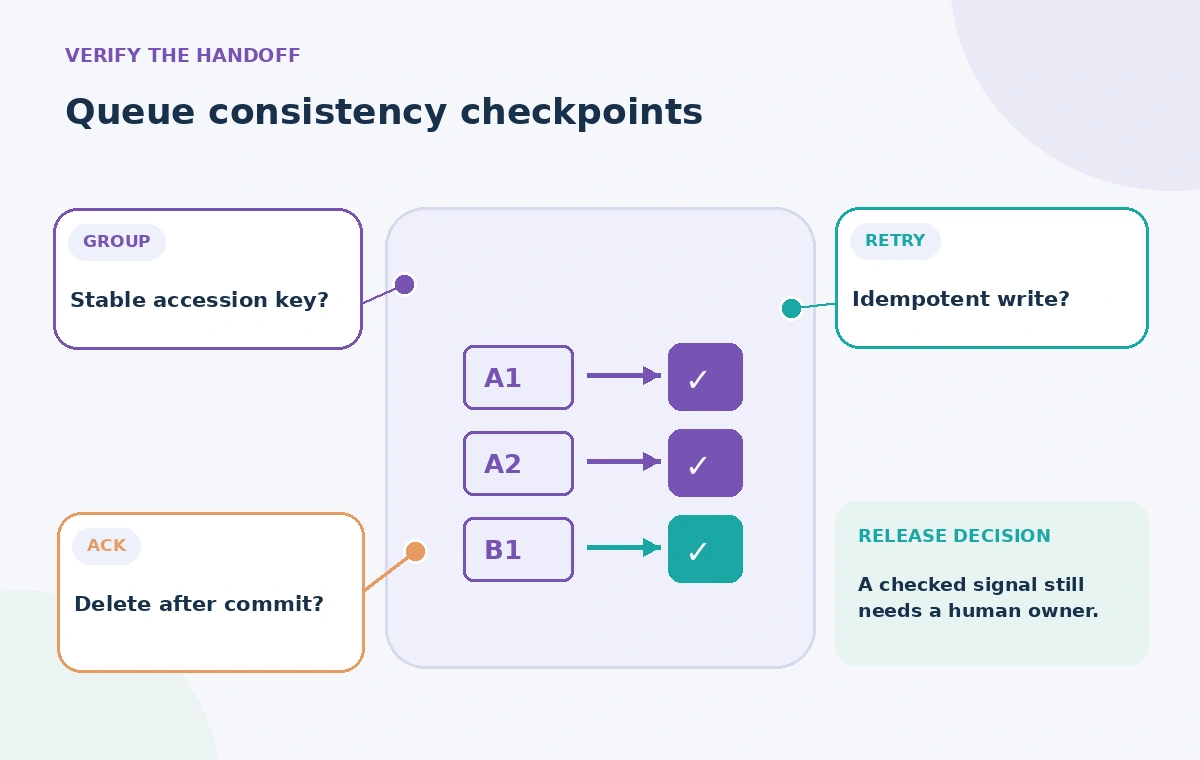
The release checklist should name the authoritative accession key, rules for generating MessageGroupId, deduplication strategy, consumer concurrency, timeout policy, idempotency ledger, and recovery owner. Include a clear manual path for a group stuck behind an invalid event and a way to audit which versions were actually committed. Keep the museum’s approval workflow separate from technical queue delivery: a successfully received caption change may still need editorial review before it becomes public. Review metrics by group backlog, not only the overall queue depth, because one long-running accession can be hidden in a healthy aggregate. Update the runbook whenever the catalog’s accession model changes.
How We Research
We reviewed current named primary documentation: Amazon SQS FIFO delivery logic, Using MessageGroupId in FIFO queues, Interleaving ordered message groups. The guide compares documented API controls with a hypothetical museum workflow; any record IDs, ranking diagrams, timelines or outcomes shown are illustrative. We did not access a customer account, perform a live service benchmark, submit a grant, apply an irreversible lock, process a real queue, or publish a site. Product capabilities and limits can change, so implementers should recheck official references and test in authorized nonproduction environments before a live deployment.
Frequently Asked Questions
Only if every message shares the same group. Different groups are individually ordered but can be processed in parallel.
Not when related messages must stay ordered. Reuse a stable group for the same accession or equivalent state boundary.
Yes. A batch may contain several ordered messages from one group; your consumer must still apply them sequentially.
No. Use durable idempotency checks and conditional database writes; FIFO grouping defines order, not end-to-end business exactly-once processing.
Visibility timeout can lead to redelivery. The consumer should check committed state, retry safely, and acknowledge only after the operation succeeds.