
Why a private intake answer needs a storage decision
A small museum might use an assistant to organize questions about tour access or lost property. Some requests contain phone numbers, descriptions of personal belongings or staff-only details. Before sending anything, decide whether keeping a retrievable API response is necessary. The OpenAI Responses API has a store setting; its default is true, and setting it to false disables storage of that response for later retrieval through the API. That is a specific application-state choice, not an all-purpose privacy switch. This article follows a hypothetical public-help-desk intake process, not a test against an account. The purpose is to distinguish where a record may exist, who can read it and which decisions require a human administrator.
Put store:false into the actual request
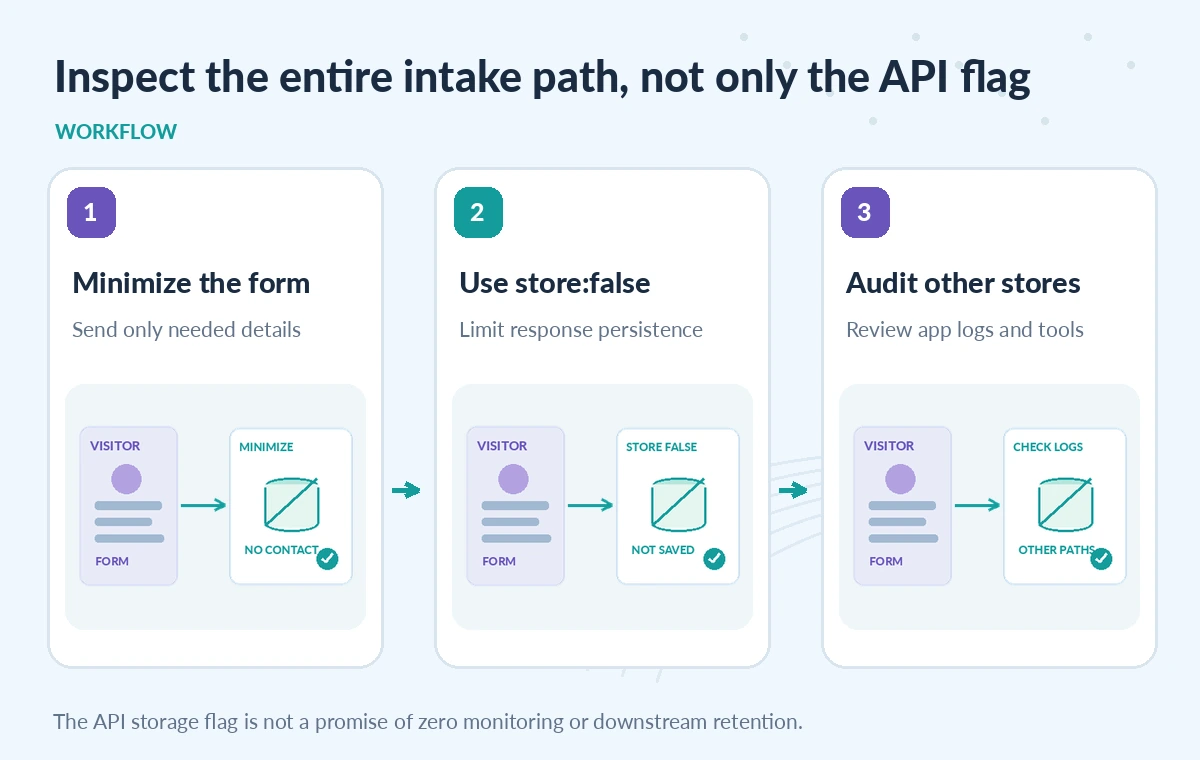
The application should explicitly send store:false for the response creation request rather than assuming an SDK default or relying on developer memory. Keep this setting in version-controlled code and regression tests, and log only an innocuous request reference or configuration version. Test against the official API definition whenever upgrading the SDK, because a future refactor might replace an explicit false value with an omitted property. A test fixture can contain synthetic visitor text; it should not contain a real phone number merely to demonstrate the flag. For an internal audit, review the serialized request options without copying sensitive prompt contents into a shared ticket. The intended behavior is reduced response-object persistence, not a guarantee that the model will never process personal data.
Understand the difference between application state and monitoring
OpenAI’s data-controls documentation separates training, abuse-monitoring logs and application-state retention. The Responses API normally stores response objects for at least thirty days when storage is enabled; the store:false choice changes the application-state behavior for that response. It does not independently erase content from security logs or change every retention exception. An organization’s approved Zero Data Retention setting is a separate contractual and technical control, and eligible endpoints can have additional restrictions. Do not label the entire deployment zero-retention solely because one parameter appears in a code review. Determine the organization’s approved controls, data categories and actual endpoints before making a public privacy statement. This distinction is critical when curators give patrons assurances in plain language.
Trace other places the same information can survive
The intake service might write the user’s message to an application database, debugging queue, analytics event or help-desk ticket before making an API call. A model can also invoke an external tool or send information to an MCP service governed by a different policy. Conversation objects, uploaded files, vector stores and background processing have retention rules that are not identical to an ordinary foreground response created with store:false. The documentation notes that conversations have their own persistence lifecycle. Therefore, map each storage destination as a separate box: source form, server logs, API response, optional retrieval stores and authorized human queue. Changing the API parameter does not automatically delete any of these other records.
Compare stored, stateless and misleading designs
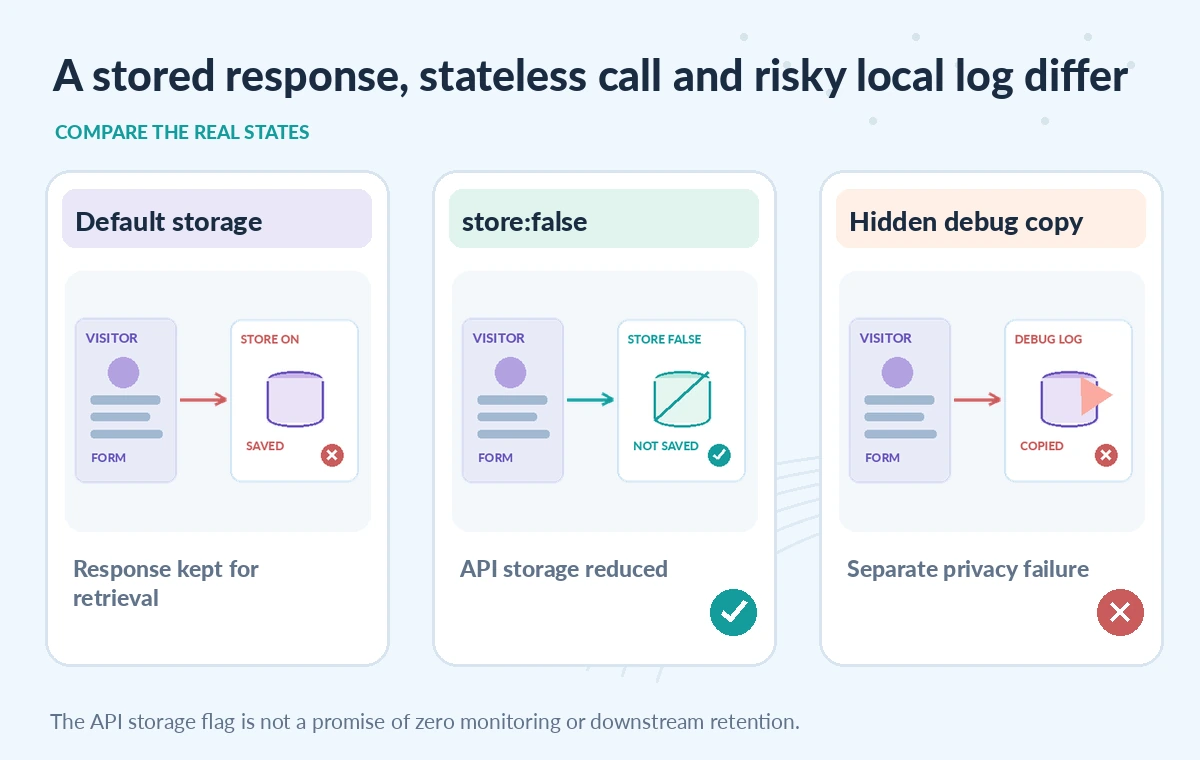
Picture three intake implementations. In the first, the application leaves store at its default and later retrieves the response object by identifier. In the second, the application explicitly sets store:false and handles the output in the active request, maintaining only a minimal approved case record in its own system. In the third, a developer uses store:false but stores the complete visitor conversation in a shared diagnostic log. Only the second is a meaningful reduction of response storage without adding an obvious new disclosure path. These are explanatory scenarios, not measured deletion tests. The comparison helps reviewers notice that one good parameter cannot compensate for collecting too much information in another system.
Handle retries and multi-turn requests deliberately
A stateless workflow needs a strategy for the next user message. Do not assume a previous response can always be retrieved or linked when the prior call used store:false. Pass a carefully minimized summary or selected user-approved context through your own controlled workflow if a follow-up is required. Keep immutable policy instructions fresh and review exceptions such as background-mode polling or explicitly persistent Conversations separately. For a one-question museum kiosk, starting from a clean request is often simpler than building a long conversation. An ordinary retry should also avoid generating duplicate staff tickets: attach an application-level idempotency reference, but never call it a privacy guarantee supplied by store:false.
Keep access, consent and staff review outside the model
Before any request reaches the API, strip unnecessary identifiers and classify which content may be transmitted. For example, an accessibility question usually needs a venue and date, not the patron’s full contact history. Provide a clear handoff if a visitor requests account deletion or shares a safeguarding concern; trained staff should handle those cases under established policy. If the assistant creates a suggested reply, require the desk operator to confirm facts such as opening times, appointment availability and emergency procedures. The model’s successful response is not an approval to disclose someone else’s information. Document the distinction between a generated text suggestion, the source of policy facts and an authorized human decision.
Audit the whole data flow with synthetic cases
A practical test matrix can use made-up inquiries representing public information, private contact details and a prohibited third-party record. Inspect request configurations, log payloads and fallback handling without depending on real patron data. Check that store:false appears at each response creation path, including error handling and worker retries. Confirm that no external tool is unexpectedly enabled and that debugging does not capture complete texts. Because the actual retention properties depend on organizational settings and endpoint use, do not claim a live deletion result without access to appropriate administrative evidence. Record only the test setup and confirmed observations, keeping unresolved conditions visible rather than treating absence of a retrievable result as proof of total erasure.

Write a privacy handoff people can actually follow
The release checklist should identify the exact endpoint, store configuration, other processing systems, responsible data owner and retention obligations. Show what is stored deliberately in the ticket queue and how authorized staff can correct or remove that local record. State the official documentation’s limits in any privacy notice, and seek legal review if regulated information is involved. This configuration can be a useful part of data minimization, but its success is judged against a complete retention inventory, access model and operational policy. The right outcome is a visitor service that gathers less unnecessary data while still preserving the evidence needed to resolve an inquiry appropriately.
How We Research
For this guide, we reviewed the official product documentation on November 8, 2026: OpenAI Responses Create API Reference, OpenAI Data Controls Guide, OpenAI Conversation State Guide. We checked the named setting or feature against its published behavior, mapped the documented constraints to the specific hypothetical scenario, and reviewed whether the topic duplicated titles in the supplied LabFin WordPress inventory or earlier LabFin draft article packages. No authenticated vendor service was run; we did not perform a benchmark, observe real customer data, verify third-party rights or claim operational outcomes. All illustrated records and comparisons are teaching examples. Confirm product documentation and security requirements again before implementing a workflow in a real organization.
Frequently Asked Questions
The Create API reference lists the store default as true; set false explicitly when response-object storage is not needed.
No. Zero Data Retention is a separate approved organization control; store:false is an application-state setting.
No. Logs and databases written by your own application are managed separately.
No. Conversation objects and their items have a different persistence lifecycle from an ordinary stored response.
Use synthetic inquiries, verify the transmitted store parameter, map all storage destinations and separately review authorized access.