
A late event can restore an old thumbnail
A museum uploads a corrected photograph to a known S3 object key, replacing a scan with an improved rights-safe crop. A downstream worker listens for S3 notifications and updates a public catalog thumbnail. If the first upload event arrives after the newer upload event, the worker could mistakenly publish metadata for the older image. Amazon documents S3 Event Notifications as at-least-once delivery, with no guarantee that event messages arrive in the original order. A consumer must therefore treat each notification as evidence of an object operation, not as an instruction to overwrite current catalog state without checking. The sequencer field supports ordering comparisons for events concerning the same object key.
Know exactly what the sequencer means
Amazon’s event message reference says object create and delete notifications include a sequencer represented as a hexadecimal string. For two notifications with the same object key, the greater sequencer value represents the later event. Compare different-length values by left-padding the shorter one with zeros before a lexicographic comparison, or use a correctly parsed hexadecimal comparison. Crucially, sequencers are not a global clock and must not be compared across different object keys. The event also provides bucket information, an encoded object key and often a versionId when bucket versioning is enabled. Preserve those identifiers for verification. Not every S3 notification type has a sequencer, so your handler needs a safe fallback policy.

Normalize the object key before deduplication
The S3 event structure documents URL-encoded object keys; for example, spaces may appear as plus signs. Decode keys consistently before matching catalog records, while preserving the raw value for troubleshooting. Use a stable comparison scope such as bucket plus decoded key, and protect the state store against two handlers racing on that same scope. If objects from separate buckets share a path, they still are separate streams. Do not infer identity from the image filename alone: a museum may reuse descriptive names across galleries. Where versionId is available, retain it and check that the intended version corresponds to the event being processed. A robust identity key prevents a correct sequencer comparison from being applied to the wrong photograph.
Store the highest accepted sequence atomically
Maintain a catalog-side record with bucket, key, most recently accepted sequencer, associated object version and editorial status. On each supported create or delete event, compare its sequence with the stored value in a conditional update. Only advance the record when the incoming sequence is strictly newer; otherwise acknowledge the stale or duplicate event without changing the display. Make that comparison and state transition atomic, since separate workers can race. The example is an architecture pattern, not a statement that S3 provides a turnkey catalog database. If the first event for a key arrives with no prior sequence, establish an initial record only after validating the object context and publication rights.
Show why arrival order is not edit order
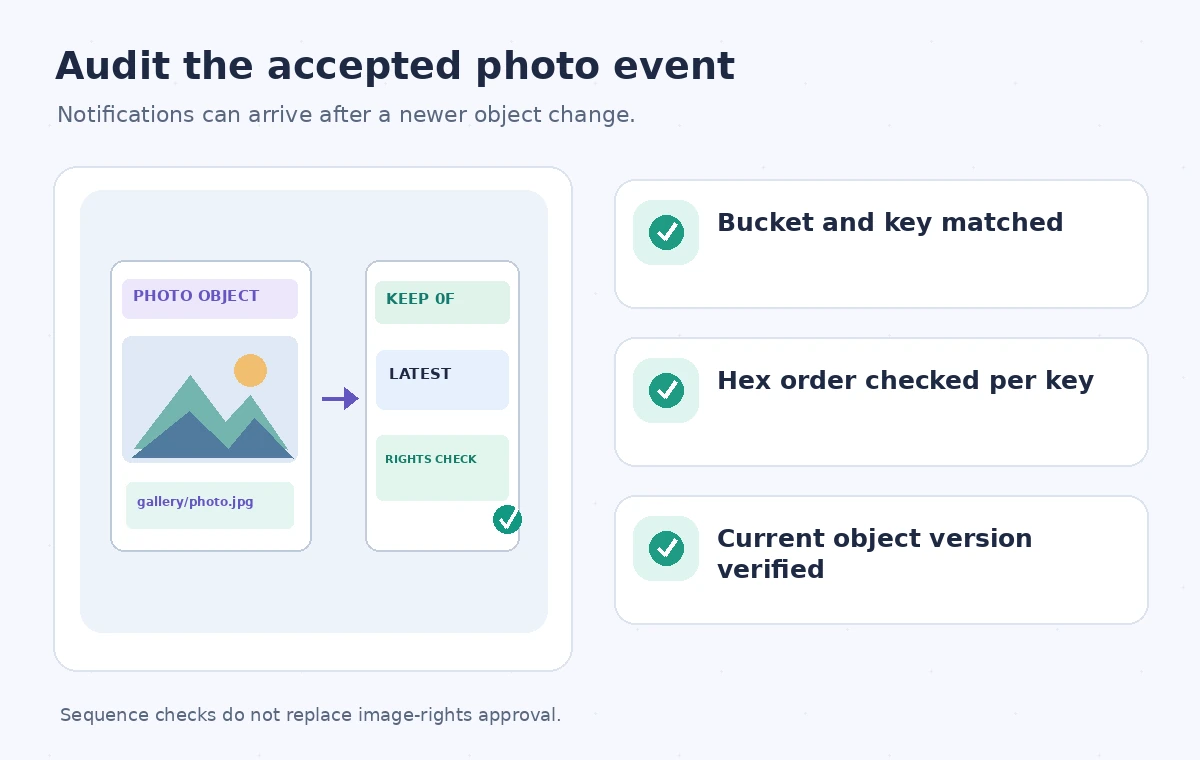
A clear comparison uses two illustrative events for the same key: an earlier update with hex sequence 0A and a later update with 0F. The queue may deliver 0F first and 0A afterward. The unsafe consumer accepts both in arrival order and replaces the newer catalog state with older metadata. The corrected consumer stores 0F and rejects the later-arriving 0A as stale. These values are purely instructional, not captured production telemetry. The accepted result should still be tied to the actual approved S3 object version and rights record. A higher sequence tells you which operation happened later, not whether its contents are fit for publication.

Treat duplicates as normal operational input
An S3 notification can be delivered more than once. Design the handler so two identical notifications do not trigger repeated thumbnails, multiple content-management drafts or duplicate staff emails. Store a deduplication key with the event type and relevant identity fields, and keep an operation ledger around side effects. Returning success to the delivery mechanism should mean the event was safely recorded or deliberately ignored, not necessarily that the image was put on a public page. If processing fails after changing a derived file but before committing the ledger, a retry must reconcile existing output rather than assume nothing happened. Maintain observability for skipped, duplicate, stale and unsupported events.
Do not use sequence order as a rights decision
The latest S3 object write may be an accidental replacement, a private original, or a photo awaiting curator review. After an event passes ordering checks, retrieve metadata and determine whether the object is the approved public rendition. Where versioning is enabled, reference the exact version rather than whatever the unversioned key returns later. Route deletion events through a separate policy so a deletion or delete marker cannot silently remove historical catalog evidence. Preserve the approved public image until a curator authorizes its successor. This editorial gate is separate from chronological order; a fast and correct event consumer can still publish the wrong file if rights controls are absent.
Recover from missing and unsupported notifications
Event ordering logic cannot replace periodic reconciliation. The service may be paused, destinations may be misconfigured, or an event type may lack the field required by your ordering algorithm. Build a scheduled inventory comparison between source objects and the catalog’s accepted versions. Flag keys whose storage state and catalog record disagree; inspect them manually or through an approved repair process. Amazon documents multiple notification destinations, including SNS, SQS, Lambda and EventBridge, with configuration details that can affect delivery design. Avoid a notification loop if a processing function writes new objects back under the same triggering prefix. Use separate prefixes or a distinct output bucket when appropriate.
Release with a sequence and provenance audit
Before a new photograph appears publicly, the catalog record should expose which bucket, key, version, sequence and approval decision produced the displayed rendition. Test out-of-order delivery using synthetic create and delete messages for one key, then repeat with two different keys to confirm no cross-key comparison occurs. Verify the URL decoding logic with spaces and non-ASCII filenames. A passing automated ordering check means the sequence state is consistent, not that the photo belongs on the public site. Keep curator sign-off and an independent record of image rights. When an exception arises, operators should be able to reconstruct why an event was accepted, ignored or held for review.
How We Research
For this guide we consulted the official documentation: Amazon S3 event message structure; Amazon S3 Event Notifications; Event types and duplicate delivery. We compared named fields, supported behaviors and stated limitations, then developed an instructional museum scenario with explicit failure states. We did not run a live vendor API benchmark, inspect a production museum system, or measure vendor performance. The workflow and illustrations are proposed review steps; verify API-version support and your organization’s current policy before applying them.
Frequently Asked Questions
No. Amazon documents at-least-once delivery, so consumers must handle duplicates.
No. The sequencing rule only applies to events involving the same object key.
Left-pad the shorter value with zeros before lexicographic comparison, or safely parse both as hexadecimal numbers.
No. The documented ordering field is associated with object create and delete events; handle other types explicitly.
No. Publication still requires a source-version and rights review outside event-ordering logic.