
A volunteer coordinator uses an AI-assisted inbox to sort messages about a community event. One person reports that the accessible entrance was locked and includes a personal phone number. The coordinator needs the complaint, but a public-facing summary must not expose the phone number. Amazon Bedrock Guardrails provides configurable filters for sensitive information and other risks. The challenge is to protect the person without filtering away their legitimate concern.
This article describes an illustrative workflow rather than a live AWS deployment or a measured protection rate. The diagrams use invented names and messages. The intended outcome is a defensible separation between private information, actionable feedback, automated moderation decisions, and staff review.
Define the allowed purpose before configuring filters
Write a short intake policy: accept service feedback, requests for accessibility assistance, and volunteer scheduling questions. Never auto-close a complaint, promise a remedy, or publish identifying details. Decide which staff role receives urgent concerns and which data may be used in an anonymized operations report. The model should classify a message for routing, not make final operational decisions.
Keep full contact details only where staff have a legitimate need and appropriate access. For example, the private case-management system may retain a callback number under its retention policy, while an analytics summary should show a generic contact placeholder. Privacy is not achieved by making a message disappear; a report about an inaccessible door must remain visible to the person who can fix it.
Choose the guardrail policies that match the risk

AWS documents several guardrail capabilities, including content filters, denied topics, word filters, sensitive information filters, and contextual grounding checks. They solve different problems. A sensitive information filter can mask or block recognized private data; a denied topic is not a reliable way to match an individual telephone number. Select controls according to the kind of exposure rather than applying an aggressive general block to every difficult message.
For this scenario, prioritize sensitive-information handling and test how an input message and the generated response are each evaluated. Keep any blocked-message text respectful and useful. If a person complains about the venue’s accessibility, the assistant should not interpret criticism itself as harmful content and remove the report from the staff queue.
Decide where masking belongs in the data flow
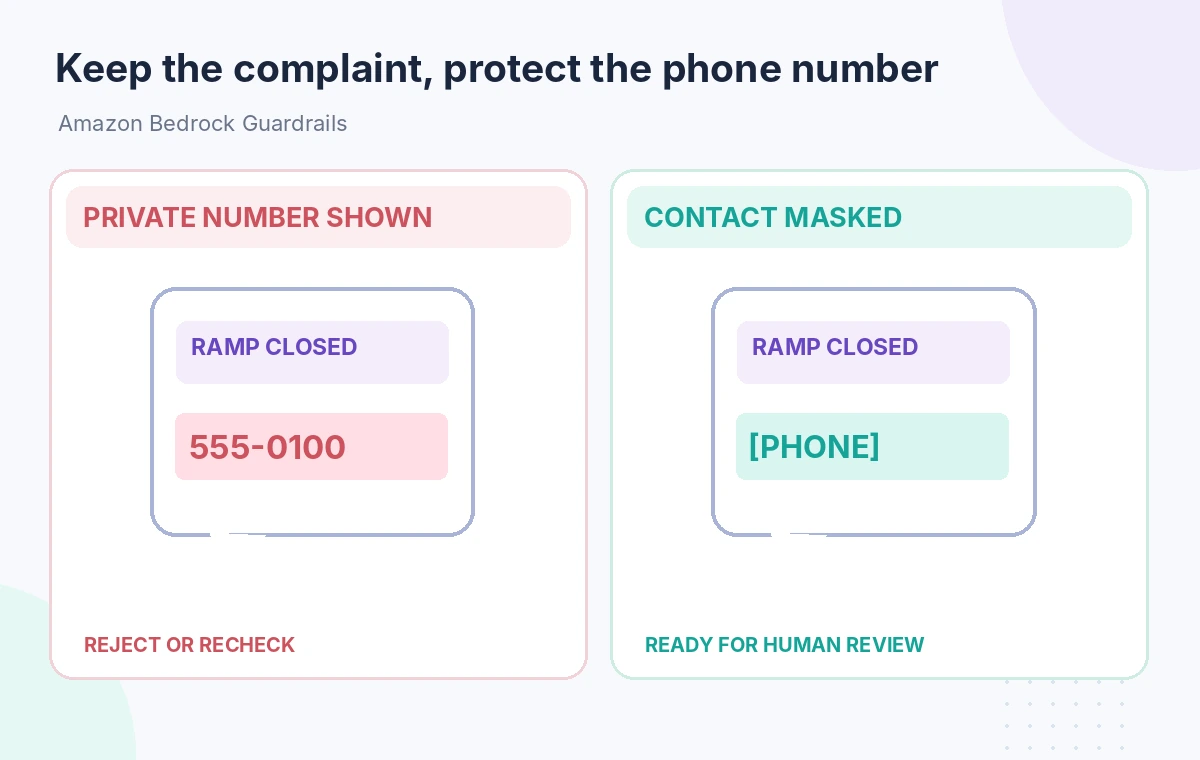
AWS describes block and mask actions for supported PII patterns. In a masked interaction, a detected phone number or email address can be replaced with a type marker. This is different from deleting the entire complaint. The public summary might say, “Visitor reports locked east entrance; callback detail removed,” preserving the operational information without the identifier.
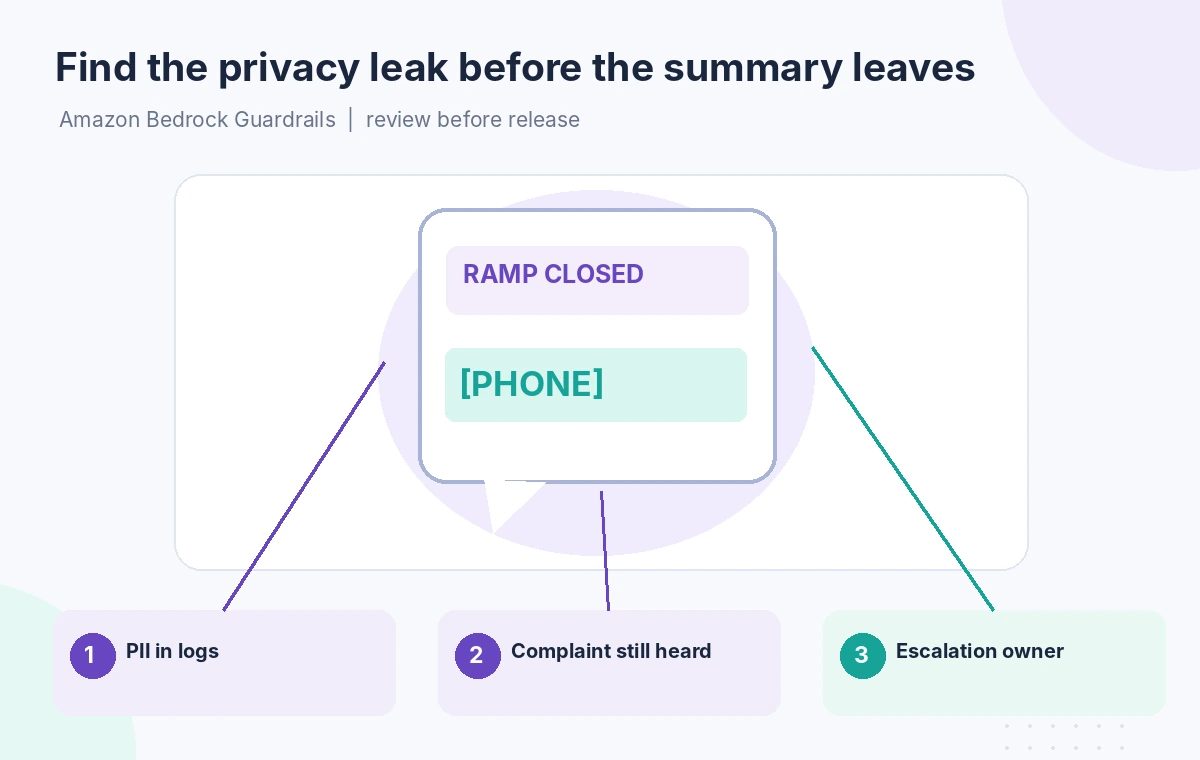
The precise path matters. AWS explains that PII masking concerns content sent to a model and content returned from it, not every other storage location. In particular, invocation logs may retain original inputs, and some diagnostic traces can expose matched values. Review your logging configuration and access controls before calling the workflow private by default.
Test legitimate complaints and false positives
Build a set of fictional test messages. Include a clear phone number, an unusual identifier, a message without contact information, and a complaint that contains strong but nonabusive criticism. For each, define the expected output and staff destination. A system that blocks all negative feedback would fail the real objective, even if it appears to have an impressive filtering rate.
The comparison illustration contrasts an unsafe summary that prints a callback number with a better version that masks the identifier yet retains “east ramp inaccessible.” Neither example claims to reflect actual Bedrock model output. Detection is probabilistic and context-dependent, so testers must review misses and overblocking rather than assuming the filter catches every format.
Keep log retention and traces within policy
Sensitive information can appear in several places: the original intake inbox, model inputs, invocation logs, application traces, ticket attachments, and downstream exports. Document who can read each. AWS explicitly cautions that masking may not remove the original input from CloudWatch or S3 invocation logs and that some trace fields contain original matches. Data protection in those systems requires separate configuration.
Create sanitized sample logs for testing, then review a production logging plan with the organization’s privacy owner. A claim such as “all PII is removed everywhere” would be unsupported. Restrict logs, define retention, and avoid storing full messages for debugging when identifiers and status codes would suffice.
Separate blocked content from action tracking
If a message is blocked, it may still require a private escalation route. For example, a health-related disclosure from a volunteer should not be put into a broad project summary, but it may need a trusted staff member to respond under the organization’s policy. Avoid designing moderation as a single irreversible delete action.
Create distinct states such as received, privacy-filtered, needs staff review, and resolved by staff. The model can suggest a routing label, but the responsible coordinator decides when an accessibility issue is actually addressed. Do not infer completion from the absence of further emails or from a neutral-sounding rewritten summary.
Evaluate policy updates over time
AWS notes that underlying guardrail models may be updated and recommends continued evaluation. Maintain a small regression set of approved fictional examples and review them when you change configuration, supported region, tier, or application prompts. A new filter setting that helps one category can accidentally change behavior on another; keep the previous configuration version available for comparison.
Do not publish an invented accuracy percentage or describe this article’s examples as measured tests. Record actual false negatives, false positives and escalation failures only after running your own controlled evaluation under the relevant permissions. Operational review matters as much as model behavior, because a perfectly masked complaint is useless if it goes to the wrong staff queue.
Release summaries only after a human check
Before a public operations report leaves the system, a reviewer verifies that identifiers are absent, complaint substance is accurate, and no statement implies a repair has already happened. The private case remains available to authorized people for follow-up. Give staff a simple path to mark a summarization error and request a correction.
The goal is not maximum blocking. A reliable guardrail workflow lets an organization hear real problems without broadcasting people’s private details. Configure the right filters, protect logs, test context-dependent mistakes, and reserve final case handling for accountable staff.
How We Research
For this November 2026 editorial review, we read the named official materials: AWS: Amazon Bedrock Guardrails overview, AWS: Sensitive information filters, AWS: How guardrails work. We compared the documented user actions, feature restrictions, supported source types, and security or data limitations against the illustrative scenario. We did not access a live account, run a controlled experiment, measure vendor accuracy, inspect real contracts, or verify fictional artwork as a product screenshot. Interface labels, eligibility, availability, and pricing may change; revisit the cited documentation and get the appropriate local authorization before deployment.
Frequently Asked Questions
AWS documents sensitive information filters that can block or mask supported PII types. Detection is context-dependent and should be evaluated with your examples.
No. AWS notes that invocation logs may contain unmodified input even when masking is applied in the model path; protect logs separately.
Not simply because they are critical. A valid complaint must reach authorized staff while private details are handled according to policy.
No. AWS distinguishes contextual topics from word or sensitive information filters. Choose the control matching the risk.
Not necessarily. AWS updates underlying safeguards, so repeat regression tests when policies, prompts, tiers or models change.